

By Our Chief Sports Correspondent in Toronto
IT WAS a night where Father Time was left gasping for breath, the video referees needed a cold shower, and a modern World Cup epic was written in pure, unadulterated drama. In a stadium shaking with the deafening roar of Toronto, Cristiano Ronaldo’s golden farewell tour survived by the absolute skin of its teeth.
Thanks to a 94th-minute bullet header from substitute hero Gonçalo Ramos and a mind-boggling intervention from VAR in the 113th minute of play, Portugal marched into the Round of 16 after an absolute blockbuster that ended 2-1 in their favor.
For Croatia, it was a tragedy of Shakespearean proportions. This was the final bow for Luka Modrić, their legendary 40-year-old midfield maestro.
He departed the global stage not with a standing ovation, but amid a furious cascade of plastic bottles thrown by distraught Croatian fans who couldn’t believe their eyes.
The match had emotional undertones from the very first whistle, marking exactly one year since the tragic passing of Portuguese winger Diogo Jota. On the pitch, Roberto Martínez’s side started like an express train.
The electrifying Rafael Leão was a constant, terrifying menace down the left flank. Within just four minutes, Leão sliced through the checkerboard defense, cutting the ball back for Bruno Fernandes, whose initial stinging effort was saved by Dominik Livaković before Josip Šutalo threw his body in front of the rebound. Pedro Neto was equally destructive on the opposite wing, whipping a devastating cross that just managed to elude the leaping, gravity-defying hair of Ronaldo.
Yet, for all Portugal’s early pressure, Croatia held firm and began to methodically choke the life out of the game. Modrić, ever the orchestral conductor, started pulling the strings. It was a tactical chess match that exploded into life after the interval.
In the 53rd minute, the underdogs bit hard. Nikola Vlašić and Josip Stanišić linked up beautifully on the right wing. Stanišić’s deflected cross found the veteran Ivan Perišić at the far post, who smashed a ruthless volley directly between the legs of Diogo Costa to give Croatia a shock lead.
Suddenly, Portuguese panic set in. Croatia thought they had doubled their lead moments later when Igor Matanović slid in to convert another Vlašić cross, but the assistant referee’s flag saved Martinez’s men.
That stroke of luck finally woke the Iberian giants. Leão rattled the crossbar with a ferocious drive, and Ronaldo had a gorgeous dinked finish ruled out for the tightest of offsides.
But you cannot keep the scriptwriter of modern football down for long. In the 68th minute, Vlašić foolishly dragged down Renato Veiga from a corner.

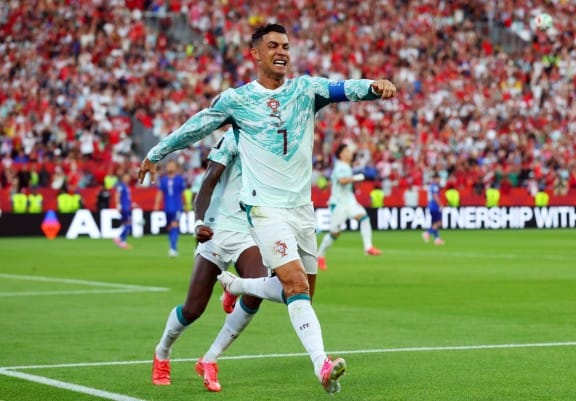
Premier League VAR official Jarred Gillett intervened, referee Espen Eskaas pointed to the spot, and up stepped the 41-year-old icon. Ronaldo coolly dispatched the penalty, recording his first-ever goal in a World Cup knockout match and making him the oldest knockout goalscorer in history.
With ten minutes left and needing fresh legs, Martínez made a high-stakes managerial gamble, substituting Ronaldo for Gonçalo Ramos. It was a masterstroke.
In the fourth minute of stoppage time, Leão delivered yet another tantalizing, looping cross. Ramos anticipated it perfectly, rising highest above the exhausted Croatian center-backs to power a bullet downward header past Livaković, sending the Portuguese bench into total delirium.
Yet, the true madness was still to come. Deep into the 113th minute of extended regulation time, Croatia threw everything forward. A desperate “Hail Mary” ball fell to Mario Pašalić, who squared it for Manchester City’s Joško Gvardiol to tap home.
The Croatian fans celebrated wildly, believing they had forced extra time. But as the stadium held its breath, VAR uncovered a microscopic touch from Matanović earlier in the buildup, rendering Pašalić offside.
The goal was chalked off, the final whistle blew, and Portugal escaped to face Spain in Dallas.
The final statistics told the story of an evenly contested battlefield. Portugal edged the total shots with fifteen attempts compared to Croatia’s twelve.
The European giants were far more accurate, hitting seven shots on target, whereas Croatia tested Diogo Costa five times. Possession was fiercely fought, with Portugal retaining fifty-four percent of the ball, leaving Croatia with forty-six percent.
In terms of disciplinary action, it was a gritty affair; Portugal picked up a single yellow card through Rúben Dias in the first half, while Croatia accumulated two bookings, with Modrić seeing yellow in the fifty-ninth minute and goalscorer Perišić cautioned deep into stoppage time.
Ultimately, the only statistic that mattered was the 2-1 scoreline, keeping Ronaldo’s ultimate dream alive while bringing down the curtain on the immortal Luka Modrić.
