

By Foreign Desk I July 24, 2026
SEATTLE — A commercial floatplane carrying 10 passengers and a pilot made an emergency landing in the marine waters of the northern San Juan Islands on Thursday evening before bursting into flames, local authorities said. Miraculously, all 11 people aboard survived the impact and subsequent fire.
The aircraft, a single-engine de Havilland DHC-3 Otter operated by Seattle-based Kenmore Air, went down at approximately 5:15 p.m. in Shallow Bay, just off the shores of Sucia Island, an uninhabited state park roughly 80 miles north of Seattle near the Canadian border.
According to flight manifests and airline officials, the turboprop seaplane had departed Lake Union in downtown Seattle at 4:30 p.m. and was scheduled to land at Roche Harbor on San Juan Island.
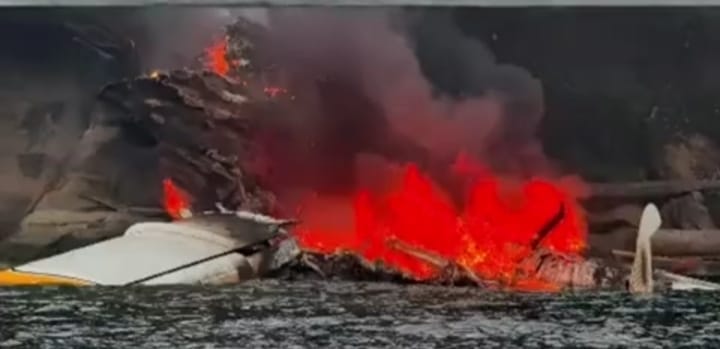
Eyewitnesses on nearby recreational boats described seeing the aircraft touch down forcefully on the water before smoke and flames began engulfing the fuselage.
Photos and video footage posted to social media showed thick black smoke billowing from the orange wreckage as it sat partially submerged in the bay.
Emergency response teams, including the United States Coast Guard, the San Juan County Sheriff’s Office, Orcas Island Fire and Rescue, and Washington State Parks rangers, rushed to the scene. Good Samaritans aboard nearby civilian vessels also moved in immediately to pull survivors from the water.
“We are grateful that everyone aboard has been accounted for, and our immediate focus is ensuring our passengers and pilot receive the care and support they need,” David Gudgel, chief executive officer of Kenmore Air, said in a statement released late Thursday night. “We extend our sincere thanks to the United States Coast Guard, local emergency responders, and everyone assisting in the response.”
While all passengers and crew survived the initial impact and fire, several sustained significant injuries.

Four individuals were reported to have serious injuries, according to emergency dispatch records. The San Juan County Sheriff’s Office confirmed that at least one victim was in critical condition, suffering from severe head trauma, lacerations, and bone fractures.
First responders staged emergency medical operations at Brandt’s Landing Marina on nearby Orcas Island. Medical helicopter services operated by Airlift Northwest transported two patients to PeaceHealth St. Joseph Medical Center in Bellingham, while two others were treated locally on Orcas Island before further evaluation.
Federal officials from the National Transportation Safety Board (NTSB) and the Federal Aviation Administration (FAA) arrived early Friday morning to secure the wreckage and begin a formal investigation into what caused the forced landing and subsequent fire.
Seaplanes are an indispensable pillar of transportation infrastructure in western Washington, serving as vital transit links across the Puget Sound, the Strait of Juan de Fuca, and the San Juan archipelago. Because many remote islands lack full-length runways for conventional commercial airliners or are accessible only via lengthy ferry rides, floatplanes provide time-sensitive commuter, mail, and medical services.
Founded in 1946, Kenmore Air is widely recognized as the largest seaplane airline in the United States. Operating a fleet of de Havilland Beavers and Otters along with conventional wheeled aircraft, the regional carrier transports more than 90,000 passengers annually across scheduled, charter, and scenic routes. Its iconic yellow-and-blue aircraft operating out of Lake Union are a staple of Seattle’s maritime and aviation landscape.
Thursday’s incident highlights the unique operational conditions of Pacific Northwest island flying. Shallow Bay on Sucia Island is surrounded by rocky shorelines and shallow, cold marine waters that present significant landing challenges during emergencies.
The forced landing off Sucia Island comes as aviation safety authorities continue to monitor commuter and air taxi operators throughout the region. In September 2022, a tragic crash involving a floatplane off Whidbey Island in Mutiny Bay resulted in 10 fatalities, sparking renewed federal debates regarding mechanical inspections, floatplane safety modifications, and pilot training standards for single-engine aircraft operating over water.
Investigators from the NTSB noted that preliminary work on the Sucia Island crash will focus on flight control mechanics, engine performance data, environmental conditions, and fuel system integrity to determine whether mechanical malfunction or environmental factors contributed to the emergency landing.
Federal authorities expect to release a preliminary report within 30 days, while a full investigation detailing the probable cause could take up to a year.
