

Byline: Sports Desk
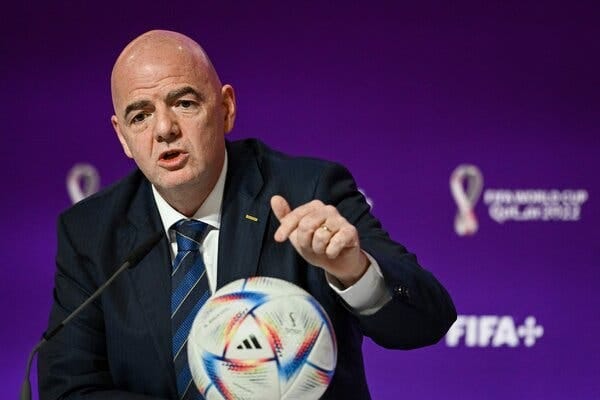
MADRID — Fresh off the conclusion of the most expansive World Cup in soccer history, the longstanding ideological war between European club football and the sport’s global governing body erupted into open hostility on Tuesday, as La Liga President Javier Tebas called for FIFA President Gianni Infantino to step down immediately.
In a blistering interview published by the Italian daily La Gazzetta dello Sport, Mr. Tebas accused Mr. Infantino of systematically harming domestic leagues and overriding regulatory integrity to serve corporate and political interests.
“In my opinion, yes, I think his time is up,” Mr. Tebas said. “They are destroying the football industry, which generates tens of thousands of jobs, for an event that lasts 40 days and involves a minority of players. Not everything can revolve around the World Cup.”
Mr. Tebas’s explosive remarks came just days after Spain defeated Argentina 1–0 in the World Cup final in East Rutherford, N.J., bringing a close to the first 48-team edition of the tournament hosted across the United States, Mexico, and Canada. While FIFA celebrated record-breaking broadcast revenue and attendance, Mr. Tebas pointed to what he characterized as a series of alarming procedural compromises and blatant commercial overreach that unfolded throughout the monthlong event.
Chief among his grievances was FIFA’s extraordinary disciplinary handling of United States striker Folarin Balogun. After receiving a red card in the group stage, Mr. Balogun’s mandatory one-match suspension was postponed following direct intervention by U.S. President Donald Trump prior to the Americans’ Round of 16 knockout match against Belgium.
“The suspension of the American player’s ban is an extremely serious matter,” Mr. Tebas said. “They were lucky that Belgium eliminated the U.S., because otherwise a case could have arisen that might have cost Infantino his job. Since Belgium won, they managed to bury the matter. But these things are just the tip of the iceberg.”
Mr. Tebas also taking aim at mid-match operational decisions during the tournament, accusing FIFA of altering the fundamental laws of the game to accommodate commercial sponsors. He cited the decision to expand halftime during Sunday’s final to 27 minutes—nearly double the traditional 15-minute break—to accommodate an American-style entertainment show, as well as mandatory hydration breaks ordered inside modern, climate-controlled dome stadiums in Atlanta, Dallas, and Los Angeles.
“If they need a 27-minute break, they take it,” Mr. Tebas remarked. “The hydration breaks were a gimmick—a break for commercials. In stadiums in Dallas, Los Angeles, or Atlanta, there was air-conditioning; I actually had to wear a jacket in the stands. It was done solely for commercial interests without consulting the rest of football.”

The pushback against Mr. Infantino is not isolated to Spain. Former FIFA President Sepp Blatter also weighed in on Tuesday, endorsing calls for leadership change and urging national associations and players to “reclaim football and bring it back to its roots.”
The fundamental dispute lies in the calendar. As FIFA pushes forward with an expanded 32-team Club World Cup and considers a proposal from South American confederation CONMEBOL to further expand the men’s World Cup to 64 teams by 2030, domestic leagues argue that player fatigue has reached critical levels and local competitions are being financially squeezed out.
Despite the rising outcry, Mr. Tebas acknowledged that ousting Mr. Infantino remains a formidable challenge. FIFA’s electoral structure grants equal voting weight to all 211 member nations, meaning small federations reliant on FIFA development funds hold immense collective power. Mr. Infantino announced in April his intention to run for a fourth term during the FIFA Congress in Morocco in March 2027, where he is currently expected to stand unopposed.
“He shouldn’t stay, but the current state of affairs means he won’t leave,” Mr. Tebas admitted. “There is no opposition candidate because no one wants to run just to lose. It is a system that is flawed from the ground up.”
The rift between Europe’s elite domestic leagues and FIFA has escalated into an institutional war over the future calendar, commercial revenue, and governance of global soccer. For years, La Liga President Javier Tebas has served as one of world football’s most vocal critics of FIFA’s centralized expansionism, repeatedly taking legal and public action against the sport’s governing body.
The friction reached a flashpoint following the expanded 48-team 2026 FIFA World Cup in North America. Tensions intensified over:
Tournament Over-Expansion: With CONMEBOL proposing a further expansion to 64 teams for the 2030 World Cup, league leaders warn that adding international fixtures dilutes domestic broadcasting value, compresses local schedules, and risks severe player burnout.
Disciplinary Integrity: FIFA faced intense scrutiny during the 2026 World Cup when U.S. forward Folarin Balogun received a red card, only for his mandatory suspension to be temporarily set aside after political intervention from U.S. President Donald Trump before the U.S. played Belgium in the Round of 16.
