

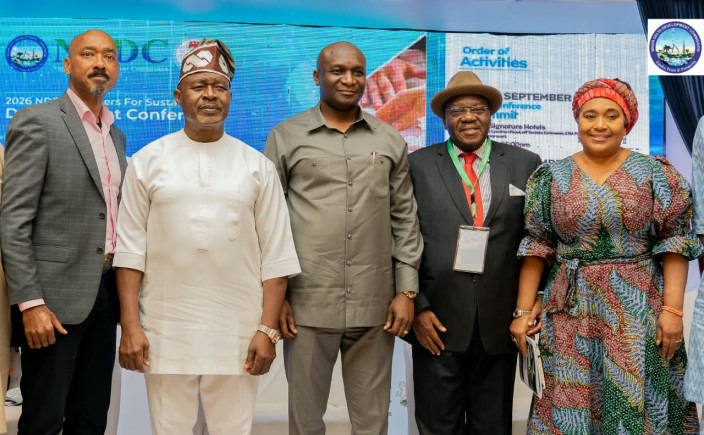
- R-L:Resource Person, Hilda Dokubo; the National Chairman, PANDEF’S, Amb. GOdknowns Igali; the NDDC Managing Director, Dr Samuel Ogbuku; the NDDC Executive Director Corporate Services, Hon. Ifedayo Abegunde and Resource Person, Mr inko Tariah
By Emmanuel Thomas l Wednesday, Sept 23, 2026
PORT HARCOURT — The Niger Delta Development Commission (NDDC) has reaffirmed its commitment to regional progress, emphasizing the urgent need for robust, sustainable partnerships and inter-agency collaboration to accelerate human capital and infrastructural development across the oil-rich Niger Delta.
Speaking during a pre-conference press briefing ahead of the anticipated 2026 Partnership for Sustainable Development (PSD) Conference in Port Harcourt, Rivers State, the Managing Director and Chief Executive Officer of the NDDC, Dr. Samuel Ogbuku, declared that the upcoming summit will serve as a vital platform for the Commission to render a full account of its stewardship to the people of the region.
Addressing journalists, stakeholders, and community leaders, Dr. Ogbuku stressed that the 2026 PSD Conference is anchored on the core principles of transparency, probity, and open governance.
He urged host communities, youth leaders, traditional institutions, and development partners to actively engage in the deliberations, offer constructive feedback, and critically evaluate the Commission’s ongoing interventions.
Reflecting on the operational history of the interventionist agency, Ogbuku revealed that the historical absence of a comprehensive governance framework was a primary catalyst for past structural failures.
To permanently correct these deficiencies, the current management has designed an institutional governance framework aimed at safeguarding the Commission’s core mandate.
”The new governance framework is designed to serve as an institutional safeguard for the Commission, protecting its development mandate from practices that could undermine the interests of the Niger Delta,” Ogbuku stated.
He noted that once fully adopted, the document will bind future management teams, the Governing Board, and external actors to strict standards of accountability, effectively regulating stakeholder demands and operational conduct.

Highlighting internal reforms, Dr. Ogbuku disclosed that the NDDC is aggressively pursuing full automation of its operations. As part of this digital transformation strategy, directors and senior management personnel are undergoing specialized training to transition the agency toward an enterprise-wide digital workflow.
According to the Managing Director, full digitization will eliminate bureaucratic bottlenecks, reduce human interference, drastically minimize corruption risks, and streamline the tracking and retrieval of official files.
Expressing gratitude to President Bola Ahmed Tinubu for his sustained backing of the Commission’s reform agenda, Ogbuku noted that the agency’s recent achievements were made possible through presidential support and active public engagement.
”With your support, the NDDC is respected today. Where we make mistakes, call us; we shall listen to you. That is why we are here today—to submit ourselves to you and hear from you,” he added.
In his opening remarks, the NDDC Director of Community and Rural Development, Engr. Theophilus Alagoa, explained that the upcoming conference aims to establish a unified policy framework.
This framework will align all regional actors toward a single, cohesive master plan for the Niger Delta, transitioning the agency from merely being “determined to make a difference” to tangibly “making a difference.”
Concurring with the Commission’s vision, the Chairman of the Pan Niger Delta Forum (PANDEF), Ambassador Godknows Igali, called on all key groups—including civil society organizations, youth bodies, and sister agencies such as the South-South Development Commission and the Niger Delta Basin Development Authority—to unite behind the NDDC.
Igali emphasized that sustainable development in the Niger Delta can only be realized through strategic alignments and a shared vision for long-term regional stability.
