

By SCM Correspondent
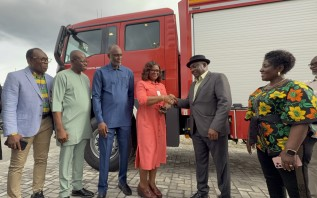
PORT HARCOURT, NIGERIA – In a move to bolster safety infrastructure in one of Africa’s most critical economic hubs, the Niger Delta Development Commission (NDDC) has officially unveiled a state-of-the-art firefighting fleet designed to protect both its headquarters and the surrounding Port Harcourt community.
The handover of the first high-capacity fire truck to the Commission’s Department of Health, Safety and Environment (HSE) marks a significant shift in the agency’s approach to corporate social responsibility and disaster preparedness.
A Shield for the Neighbourhood
Speaking at a ceremony held at the NDDC’s towering headquarters, Managing Director Dr. Samuel Ogbuku made it clear that the Commission is no longer content with just internal safety. Represented by the Director of Administration and Human Resources, Sir Kelechi Nwelue, Ogbuku drew parallels between the NDDC and global industrial giants.
”This fire truck was bought to ensure the safety of the Commission and its environs, to help to fight fire in the case of any outbreak in and within the neighbourhood,” Ogbuku stated. “We will assist in fighting fire as much as possible, just like Shell and Julius Berger.”
The comparison to multinational oil firms and construction conglomerates signals a new era for the NDDC—one where it operates as a frontline first responder in a region where fire outbreaks, often linked to industrial activity or infrastructure challenges, can be devastating.
The initiative isn’t stopping at the Port Harcourt gates. In a bold commitment to regional security, Dr. Ogbuku announced that the programme would be rolled out across the entire Niger Delta. Fire trucks are slated to be deployed to all NDDC state offices, creating a synchronized emergency response network across several Nigerian states.
This expansion is seen as a vital move to mitigate hazards in high-risk zones and strengthen the overall capacity of the region to handle environmental and domestic emergencies.
Mrs. Chinyere Umeh, Director of the HSE Department, hailed the intervention as a “timely milestone.” For years, safety departments in regional agencies have often struggled with a lack of heavy-duty equipment.

”The equipment and fire truck will greatly enhance the department’s capacity to respond promptly to emergencies, promote effective safety practices, and improve environmental protection measures within the Commission,” Umeh said. She reaffirmed her department’s commitment to ensuring that safety awareness isn’t just a policy on paper, but a lived reality for the thousands of staff and visitors who pass through the NDDC’s doors daily.
The Niger Delta Development Commission was established in 2000 with a clear mandate: to facilitate the rapid, even, and sustainable development of the Niger Delta into a region that is economically prosperous, socially stable, ecologically regenerative, and politically peaceful.
Historically, the NDDC has focused on massive infrastructure projects like roads, bridges, and electrification. However, under the current leadership of Dr. Samuel Ogbuku, there has been a noticeable pivot toward “soft infrastructure”—human capital, health, safety, and environmental protection.
Key Statistics of the Niger Delta Region:
Population: Over 30 million people.
Economic Impact: Accounts for the bulk of Nigeria’s oil and gas revenue.
Environmental Risk: High due to industrial density and urban congestion.
By equipping its offices with firefighting capabilities, the NDDC is addressing a critical gap in municipal services. In many parts of the region, public fire services are often overstretched.
The intervention by a federal agency like the NDDC provides a necessary safety valve for the local population, ensuring that a small spark doesn’t turn into a regional catastrophe.
