

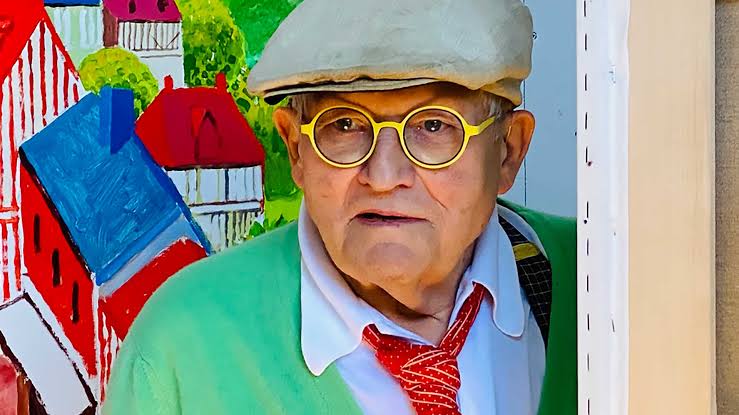
BY SCM Art & Showbiz Desk
BRITAIN’S most-loved art rebel David Hockney has died at the age of 88. The legendary Bradford-born painter—famous for his bleach-blonde hair, thick-rimmed glasses, and sun-drenched pictures of California swimming pools—passed away peacefully at his home yesterday, just weeks before his 89th birthday.
His long-time publicist, Erica Bolton, confirmed the heartbreaking news, paying tribute to “one of the most important figures in contemporary art of both the 20th and 21st centuries.”
Tributes have poured in from around the globe for the working-class Yorkshire lad who conquered the global art world while refusing to play by the rules.
Known for his incredible lust for life, Hockney was as famous for his stubborn streak as his brushwork. A defiant lifelong chain-smoker, his team revealed he happily puffed away right up until the very end, once famously raging at authorities for banning a poster of him holding a cigarette.
In his later years, despite suffering a minor stroke in 2012 and battling severe deafness, Hockney refused to stop working. He famously claimed losing his hearing only made his eyes sharper, saying: “I feel I could see space clearer.”
He is survived by his long-term partner, Jean-Pierre Gonçalves de Lima, and a large, loving extended family.
David Hockney wasn’t just an artist; he was a cultural powerhouse who helped define the “Swinging Sixties.”
Born to a strict Methodist mother and an accounting clerk father in industrial Bradford in 1937, he grew up dreaming of escaping the gloomy, rain-streaked north of England.
As a boy, he watched Laurel and Hardy films in the cinema and became obsessed with the heavy shadows on screen—realizing that strong shadows meant somewhere out there, the sun was shining brightly.

He moved to London in 1959 to study at the Royal College of Art, where he immediately proved to be a rebel. He famously refused to write the mandatory final essay to graduate, arguing he should be judged solely on his art. The college relented and changed their rules to give him his diploma.
While abstract, moody art was all the rage, Hockney boldly chose to paint real life, bright colors, and people. He became a central figure of British Pop Art, rubbing shoulders with the likes of Mick Jagger and Andy Warhol.
He was also incredibly brave. At a time when homosexuality was illegal in Britain, Hockney openly explored gay themes and relationships in his work, risking imprisonment to stay true to himself.
In 1964, he finally chased the light across the Atlantic to Los Angeles. It was love at first sight. Armed with bright new acrylic paints, he began documenting the luxurious, liberated Californian lifestyle. His masterpiece, Portrait of an Artist (Pool with Two Figures), broke world records in 2018 when it sold at auction in New York for a jaw-dropping $90 million (£70m)—making it the most expensive painting by a living artist at the time.
Hockney never got stuck in the past. Over seven decades, he mastered everything from oil painting and photography to set designs for the world’s grandest operas. When smartphones and iPads came along, the octogenarian artist didn’t shy away; he embraced them, creating stunning digital drawings of the British and French countrysides.
During the dark days of the 2020 pandemic lockdown, he beamed joyous iPad drawings of spring flowers to his friends with the defiant message: “Do remember they can’t cancel the spring.”
Britain has lost its colorful champion, but the world he painted stays forever bright.
