

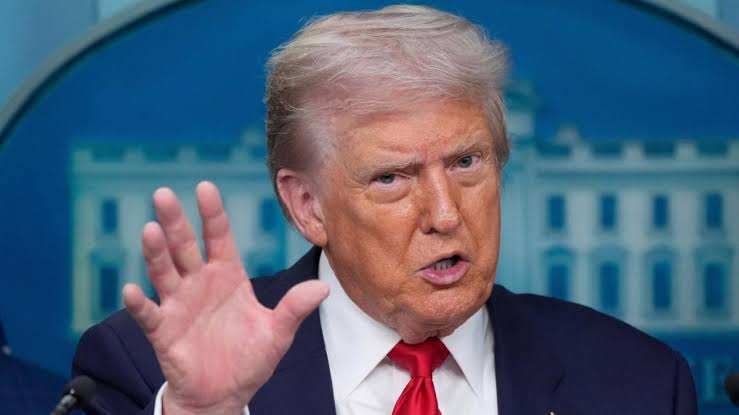
By SCM Foreign Desk
WASHINGTON — President Donald J. Trump declared on Thursday that the international body established to oversee the future of the Gaza Strip has reached a “historic agreement” for the complete disarmament of Hamas and all other armed factions in the enclave, framing the deal as a landmark breakthrough in ending the conflict.
In a statement published on his Truth Social platform, President Trump said the agreement negotiated by the “Board of Peace”—an international oversight body authorized under United Nations Security Council Resolution 2803—marks a decisive step toward establishing long-term security for Israel and creating a new governance structure for the Palestinian territory.
“Today, the Board of Peace reached a HISTORIC agreement for the COMPLETE DISARMAMENT of Hamas and all other armed groups in Gaza,” Mr. Trump wrote. “This is a monumental step toward lasting PEACE and SECURITY.”
According to the president, the agreement will be executed in “carefully structured phases.” Under the outlined roadmap, as the decommissioning of heavy weapons and demilitarization proceed, Israeli Defense Forces will step back, transferring ground security responsibilities to an International Stabilization Force operating alongside a newly trained Palestinian police force.
The announcement represents the second phase of the administration’s broader 20-Point Gaza Peace Plan, introduced to halt more than two years of devastating warfare, secure the return of Israeli hostages, and map out a post-war order without Hamas control.
“Under this agreement, Gaza will finally be in the hands of a new Palestinian government that serves its PEOPLE,” Mr. Trump added, offering thanks to key regional mediators Egypt, Qatar, and Türkiye. He insisted that “the threat that emerged from Gaza on October 7 will NOT be allowed to rebuild!”
The roots of Thursday’s announcement stem from the October 7, 2023, attacks led by Hamas, in which militants crossed from Gaza into southern Israel, killing approximately 1,200 people and abducting more than 240 hostages. Israel responded with a sustained, large-scale military offensive that reshaped the geopolitics of the Middle East.
Over the course of two years, much of the Gaza Strip was reduced to rubble, triggering a global humanitarian response and creating massive geopolitical pressures across the region.
Diplomatic efforts to secure a permanent resolution repeatedly faltered until the Trump administration introduced its 20-point framework.
The initiative sought to pair immediate humanitarian goals—such as the release of remaining captives and the flow of aid—with long-term structural changes to Gaza’s security and administration.
Central to that strategy was the creation of the Board of Peace, an international body chaired by Mr. Trump and endorsed by the UN Security Council.

The board was tasked with coordinating international pledges for Gaza’s multi-billion-dollar reconstruction, facilitating the deployment of non-aligned peacekeepers, and supervising a non-political, technocratic Palestinian committee to run daily civil affairs.
While the initial phase of the peace plan brought about a cessation of major combat operations and the return of surviving hostages, progress had slowed significantly over the logistics of Phase Two: the demilitarization of militant cadres and the precise schedule of Israel’s military drawdowns.
Implementation and Diplomatic Challenges
While President Trump heralded the disarmament deal as an “amazing development that everybody said could never be achieved,” significant operational hurdles remain ahead.
Military analysts and Middle East experts note that disarming an embedded guerrilla organization like Hamas presents formidable technical and verification challenges.
It remains unclear how international monitors will verify the destruction or surrender of underground tunnel networks, hidden weapons caches, and small-arms stockpiles scattered throughout densely populated urban areas.
Furthermore, the precise composition and mandate of the International Stabilization Force remain subject to ongoing negotiations. Several nations, including regional partners in North Africa and Central Asia, have pledged personnel to the force, while Egypt and Jordan have committed to training the domestic Palestinian police force.
However, deployed forces will require clear rules of engagement should rogue elements or splinter groups attempt to disrupt the disarmament process.
On the diplomatic front, the role of the new Palestinian administrative body will be crucial. For the arrangement to maintain domestic credibility, the technocratic government must demonstrate visible progress in civil service delivery, infrastructure restoration, and economic relief while working alongside international stakeholders.
Despite the challenges ahead, officials in Washington and regional capitals expressed cautious optimism that a structured, internationally backed framework for disarmament offers the most viable path away from perpetual conflict.
“One year ago there was a violent raging war, humanitarian crisis and hostages kept in brutal captivity,” Mr. Trump noted in his statement. “We have made historic progress and there is still much work to do.”
