

By SCM Correspondent I July 20, 2026
TEHRAN — Iran’s Foreign Ministry announced on Sunday that the Islamic Republic remains open to diplomatic negotiations with the United States, provided its national interests are guaranteed, even as direct military engagements between the two nations intensify across West Asia.
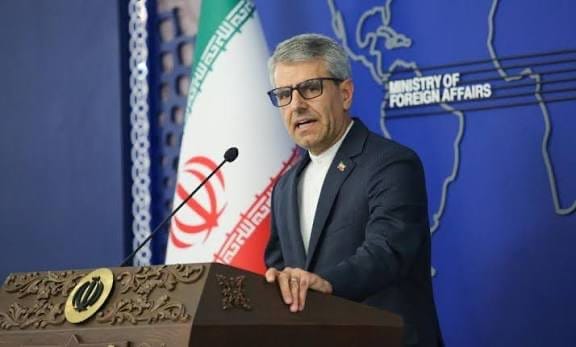
Speaking at a press conference in Tehran, Iranian Foreign Ministry spokesman Esmail Baghaei confirmed that third-party mediators have recently presented new proposals aimed at curbing the escalating regional crisis.
While Baghaei acknowledged that “proposals conveyed through mediators have been communicated to us,” he declined to elaborate on the specific details or the identities of the nations facilitating the backchannel.
”The principle of the matter is clear: mediators are working and trying to prevent tension from escalating,” Baghaei told reporters. However, the spokesman struck a highly cautious tone, accusing Washington of routinely violating previous diplomatic commitments. While emphasizing Tehran’s willingness to engage, Baghaei warned that any future dialogue must be substantive, stating firmly that talks “should not be to deceive.”
The diplomatic overture comes at a highly volatile moment. Following a brief period of hope in June when a 14-point tentative memorandum of understanding (MoU) was brokered in Switzerland, relations quickly fell apart.
Tehran officially walked away from its commitments under the MoU last week, citing widespread U.S. airstrikes on maritime and military infrastructure in southern Iran. Washington, conversely, maintains that its military actions are defensive operations intended to secure international commercial shipping lanes through the critical Strait of Hormuz.
The potential pivot back to backchannel diplomacy occurs against a backdrop of deep domestic and international skepticism. Over the past several months, indirect talks hosted in neutral venues like Muscat, Oman, have yielded little permanent relief.
Negotiators have consistently stumbled over the sequencing of sanctions relief, the scope of Iran’s nuclear program, and regional proxy networks.

The U.S. position remains similarly conditional. Responding to the latest diplomatic signals, U.S. Secretary of State Marco Rubio reiterated that Washington is not fundamentally closed to a diplomatic resolution but noted that any engagement “has to be real.”
Rubio added that the U.S. would continue to respond militarily to provocations unless a verifiable shift in Iranian policy occurs.
For Iran, the dual strategy of military readiness and diplomatic flexibility appears designed to manage domestic economic pressures while keeping a communication channel open to avoid full-scale war. Baghaei pushed back against critics who suggest diplomacy signals weakness, stating, “To imagine that diplomacy is the negation of defense, or that defense is incompatible [with diplomacy], is a flawed understanding.”
Whether the new proposals offered by international mediators will be enough to bridge the widening trust gap—and halt active hostilities—remains highly uncertain.
In mid-June 2026, the US and Iran were on the precipice of signing a landmark 14-point memorandum of understanding in Switzerland to normalize maritime traffic in the Strait of Hormuz and outline a 60-day roadmap for broader peace.
The collapse of this agreement serves as the direct reason for Iran’s current accusation of “broken commitments.”
The Mediation Framework: Historically, Oman, Qatar, Turkey, and Switzerland have served as the core intermediary network for US-Iran relations. Mentioning these specific actors helps contextualize who the unnamed “mediators” likely are.
The Military Reality vs. Diplomatic Posturing: Over the last few days, U.S. forces have struck suspected underground missile bases and coastal radar networks near Tabriz and Bushehr.
Concurrently, Iran has targeted shipping and regional infrastructure. The stark contrast between active fighting and “openness to talks” is a crucial element of the story.
