

By SCM International Desk I Friday, Sept 25, 2026
BENI, Democratic Republic of Congo — The death of a respected local physician from Ebola has sent shockwaves through eastern Democratic Republic of Congo, highlighting a dangerous new phase in an outbreak that public health officials warn is expanding beyond its original epicenter.
Outside the clinic where the doctor treated some of the outbreak’s earliest patients, the sound of weeping and wailing filled the air as colleagues, family members, and local residents gathered to mourn. The physician, whose name is being withheld pending full family notifications, died late Tuesday evening after contracting the hemorrhagic fever while providing care on the front lines.
The death marks a grim turning point for regional containment efforts.
Epidemiologists report that confirmed and suspected Ebola cases have surged into neighboring health zones, breaching the initial geographic perimeter set up by the Ministry of Health and international response teams.
For weeks, the deceased doctor had operated at the heart of the triage effort, working long shifts in overcrowded facilities to isolate suspected cases and administer supportive care. Colleagues described him as a dedicated clinician who routinely risked his safety to serve a community suffering under the combined weight of infectious disease and persistent regional violence.
”He was our shield,” said Justin Kasereka, a community leader standing outside the regional health facility where crowds gathered. “When others fled or hesitated, he stepped forward. To lose a doctor in a region that already has so few means losing hundreds of lives in the long run.”
The mourning ritual reflected both deep personal sorrow and mounting collective fear. In Congolese cultural traditions, mourning often involves close physical gathering and shared grief, practices that health officials are now desperately trying to modify to prevent further transmission of the highly contagious virus.
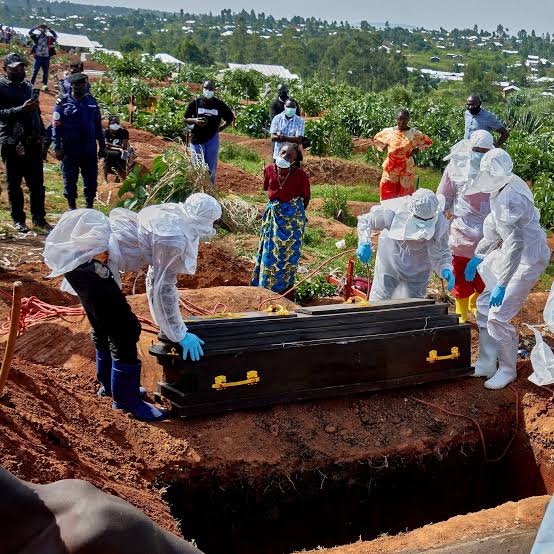
Emergency response crews in protective gear were deployed to manage the burial under strict biosecurity protocols, a process that frequently sparks tension between grieving families and medical teams.
The Democratic Republic of Congo has battled multiple Ebola outbreaks since the virus was first identified near the Ebola River in 1976.
The disease, caused by an orthoebolavirus, is transmitted to humans through contact with infected wildlife—primarily fruit bats or primates—and subsequently spreads via direct contact with the blood, bodily fluids, or organs of infected individuals.

The current resurgence comes against a backdrop of complex humanitarian challenges in the eastern provinces. Decades of conflict involving armed militias have severely disrupted public infrastructure, displaced millions of civilians, and left health facilities chronically under-resourced.
While modern medical interventions—including the Ervebo vaccine and monoclonal antibody treatments like Ebanga and REGN-EB3—have vastly improved survival rates compared to earlier epidemics, deploying these tools effectively requires stable logistics, robust contact tracing, and high levels of community trust.
Epidemiological teams face three primary obstacles in the current flare-up:
Geographic Mobility: Population movement driven by conflict and commerce has carried exposed contacts into urban transit hubs, complicating efforts to monitor potential transmission chains.
Community Resistance: Misinformation and mistrust of official interventions continue to cause delays in patient reporting, allowing the virus to spread undetected within households.
Resource Deficits: Regional clinics lack adequate supplies of personal protective equipment (PPE), clean running water, and isolation beds, increasing the vulnerability of healthcare workers.
With cases now confirmed outside the primary containment zone, the World Health Organization (WHO) and regional public health authorities are scaling up surveillance at border crossings and major transport routes.
Surrounding health districts have been placed on high alert, with emergency vaccine stockpiles being mobilized for ring-vaccination strategies targeting healthcare providers and close contacts of confirmed cases.
International health agencies emphasize that protecting medical staff remains the top priority to prevent a total collapse of local healthcare services. Every health worker lost not only reduces medical capacity but also fuels public anxiety, making containment significantly harder to achieve.
As night fell over the district, grief gave way to anxious anticipation. Local authorities urged residents to report symptoms immediately—including high fever, severe headache, muscle pain, and unexplained bleeding—while health workers redoubled efforts to trace everyone who came into contact with the late physician during his final days.
