

By SCM News Desk I Tuesday, October 06, 2026
NAIROBI, Kenya — Health authorities in Kenya confirmed the nation’s first case of Ebola on Tuesday, announcing that a citizen returning from the Democratic Republic of Congo had died in Nairobi shortly after arriving in the country.
The announcement marks an alarming expansion of a severe Ebola epidemic that has ravaged eastern Congo and threatened regional health security across East Africa.
Kenya’s Cabinet Secretary for Health, Aden Duale, stated during a press conference in Nairobi that public health officials have identified 28 close contacts of the deceased, including family members and healthcare workers who were in direct contact with the patient. Quarantine and contact-tracing procedures are underway to contain potential transmission within the capital.
”I wish to reassure the public not to panic, as all systems are in place to mitigate the spread of the disease,” Mr. Duale said, adding that health authorities had screened more than 650,000 travelers entering the country prior to this first confirmed positive case.
According to health officials, the individual arrived in Nairobi on Saturday. Upon arrival at the port health screening desk, the traveler exhibited classic signs of Viral Hemorrhagic Fever, including high fever, severe fatigue, sore throat, and bleeding at injection sites.

The patient was immediately isolated at Nairobi Hospital. Subsequent testing by the National Virology Reference Laboratory and the Kenya Medical Research Institute (KEMRI) confirmed infection with the Bundibugyo strain of the virus.
The cross-border case underscores the difficulty of containing the current epidemic, which originated earlier this year in the eastern provinces of the Democratic Republic of Congo.
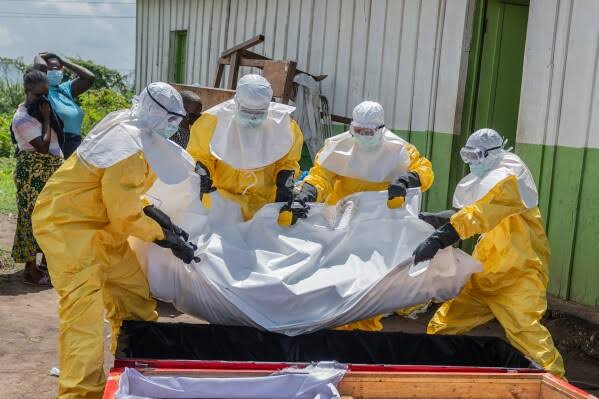
Driven by the Bundibugyo Ebola virus—a rarer and historically less common strain than the Zaire virus—the outbreak has caused more than 8,000 cases and over 4,000 deaths in Congo, making it one of the largest recorded in history.
The virus spreads through direct contact with body fluids of infected individuals or contaminated surfaces. While medical advances have produced effective vaccines and monoclonal antibody treatments for the Zaire Ebola strain, medical tools specifically targeted against the Bundibugyo species remain more limited, leaving public health systems dependent on rapid quarantine, contact tracing, and strict infection control.
Uganda had previously registered 20 cases and two deaths tied to the Congo outbreak before being declared free of active transmission by the World Health Organization in August. Kenya’s confirmation brings fresh urgency to border surveillance across East African transport corridors connecting Nairobi to central Africa.
Health officials urged citizens to maintain rigorous hand hygiene and immediately seek medical evaluation if experiencing symptoms after travel to active outbreak regions.
