

By SCM Writer
PARIS — The United Nations Educational, Scientific and Cultural Organization (UNESCO) has expressed profound concern over the rapidly deteriorating medical condition of imprisoned Iranian journalist and human rights activist Narges Mohammadi.
In an official statement, the UN body urged Iranian authorities to grant immediate, specialized medical attention to the jailed activist, emphasizing that her safety and fundamental rights must be upheld.
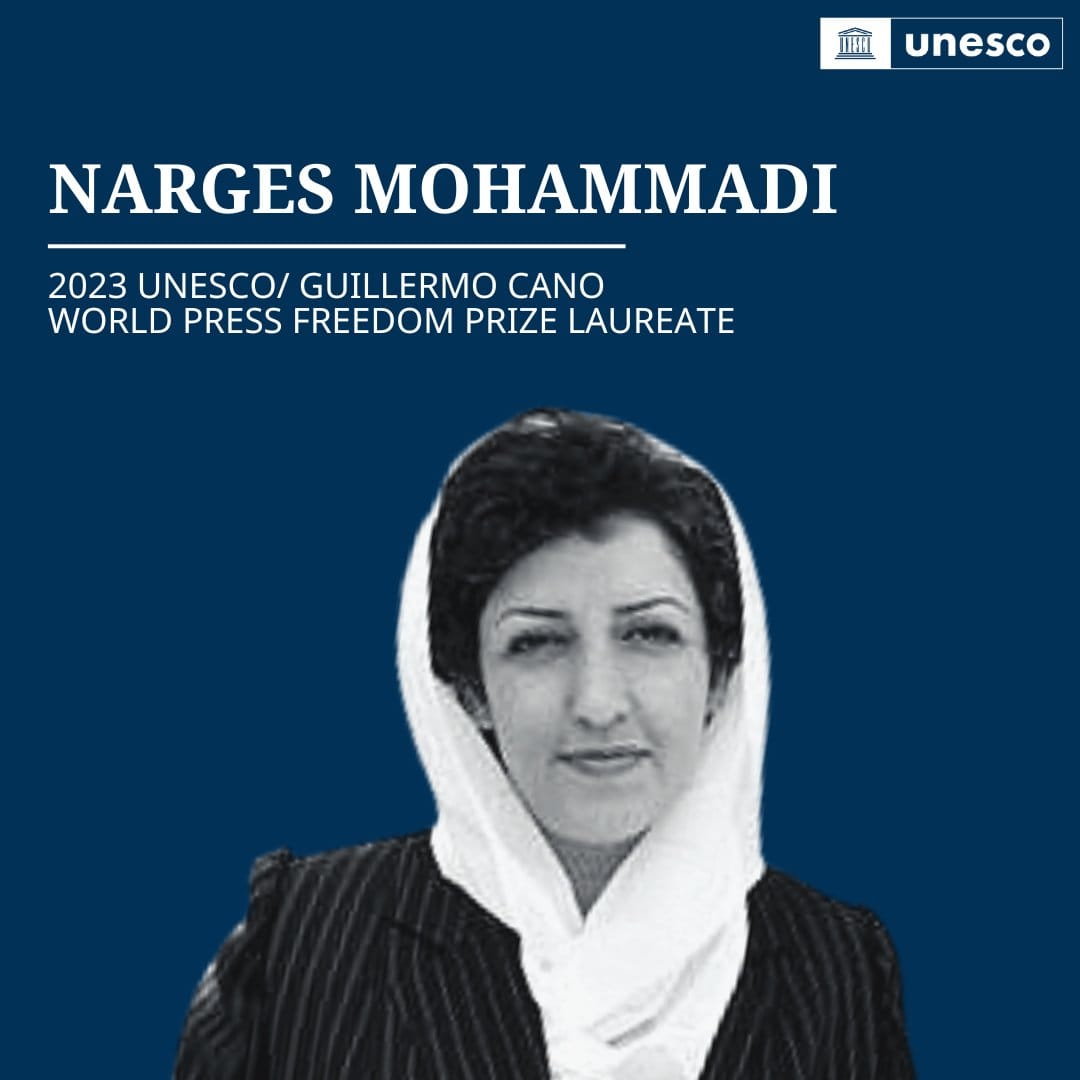
”UNESCO expresses deep concern over the medical condition of imprisoned Iranian journalist Narges Mohammadi, UNESCO/Guillermo Cano laureate and Nobel Peace Prize laureate, and urges authorities to ensure she receives urgent medical care,” the organization stated. “We call for full respect of her rights, her safety and wellbeing.”
The international appeal comes at a perilous moment for the 54-year-old activist.
According to her family and legal team, Mohammadi is currently fighting for her life in a coronary care unit in Zanjan province, following a series of severe cardiac events.
Her supporters have described her current state as an “unprecedented degradation” of health, revealing that she has lost approximately 20 kilograms (44 pounds), suffers from extreme blood pressure fluctuations, and is experiencing recurring, acute chest pains.
The crisis escalated dramatically when Mohammadi was found unconscious in her cell, having suffered a suspected heart attack.
While Iranian authorities authorized a “last-minute” transfer to a local hospital under heavy guard, her family, medical experts, and international observers argue that the local facilities are entirely inadequate. Independent cardiologists have stated that due to her complex medical history—which includes a previous heart surgery and the placement of a cardiac stent—she requires immediate relocation to a specialized facility in Tehran to be treated by her personal medical team.
However, requests for a medical furlough or transfer continue to face severe bureaucratic resistance from Iran’s Ministry of Intelligence.
Narges Mohammadi’s current imprisonment is part of a decades-long pattern of judicial harassment by the Iranian government, aimed at silencing her prominent voice.
A physicist by training and a journalist by profession, Mohammadi has spent the better part of the last twenty years moving in and out of Iranian prisons due to her relentless campaigning against the death penalty, solitary confinement, and the systemic oppression of women.

In May 2023, Mohammadi was awarded the prestigious UNESCO/Guillermo Cano World Press Freedom Prize for her unyielding commitment to truth and justice. Later that same year, she was named the recipient of the 2023 Nobel Peace Prize.
Because she was barred from leaving Evin Prison, her twin children, Kiana and Ali Rahmani, accepted the Nobel prize on her behalf in Oslo, reading a speech she had smuggled out of her cell.
Mohammadi had been temporarily released on a medical furlough in late 2024 due to her ongoing cardiovascular illness. However, her freedom was short-lived. In December 2025, she was re-arrested while attending a memorial service for a fellow human rights activist.
Following her arrest, during which her family alleges she was severely beaten by security forces, she was handed an additional seven-and-a-half-year prison sentence. In total, she faces up to 18 more years behind bars and 154 lashes.
Mohammadi was a vocal supporter of the “Woman, Life, Freedom” movement, which erupted across Iran following the 2022 death of Mahsa Amini in the custody of the morality police.
Even from within prison walls, Mohammadi frequently managed to release statements condemning state-sanctioned violence and executions, establishing herself as what her family calls “the voice of the voiceless.”
UNESCO’s urgent intervention aligns with a chorus of alarms raised by other global entities. The World Medical Association (WMA) also issued a stern rebuke to Tehran, reminding the Iranian government of its obligations under international human rights treaties, such as the International Covenant on Economic, Social and Cultural Rights.
WMA President Dr. Jacqueline Kitulu emphasized that denying essential medical care to a detainee is a direct violation of the right to health and places a patient’s life at immediate, artificial risk.
As Mohammadi remains hospitalized under armed guard, human rights organizations and press freedom groups worldwide are increasing pressure on Iran.
Supporters warn that keeping the Nobel laureate in these brutal, high-stress conditions amounts to a slow death sentence, turning her detention from a matter of political imprisonment into an immediate struggle for survival.
