

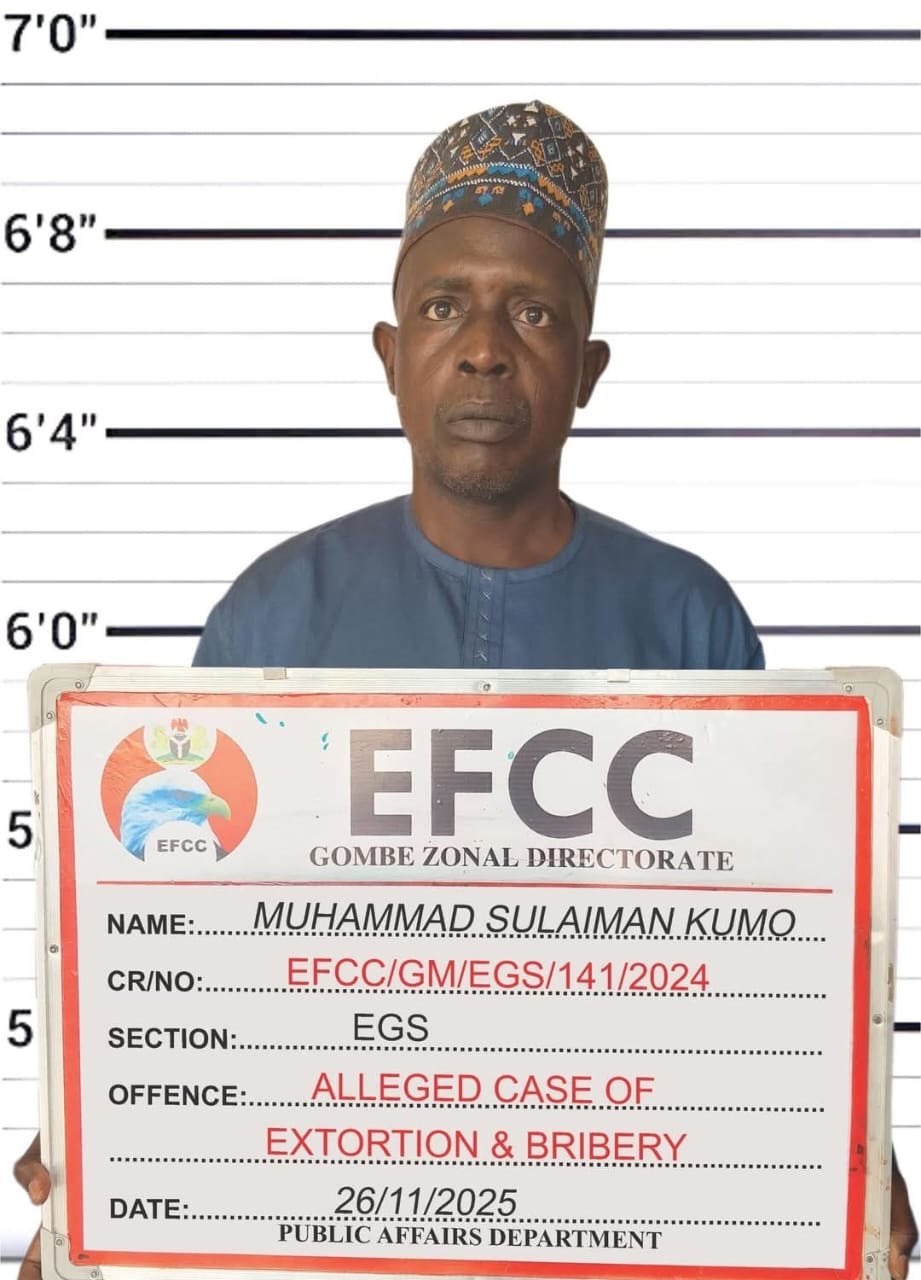
By Emmanuel Thomas, Staff Reporter
In the quiet, dusty corridors of the Chief Magistrate Court in Pantami, Gombe State, Mohammad Suleiman Kumo’s word was once absolute law. Draped in his judicial robes, he was the man entrusted with weighing the scales of justice, determining the fates of everyday citizens who looked up to him for fairness and integrity.
Today, those very scales have crashed down upon him.
In a dramatic legal showdown that has gripped the West African nation, Kumo has swapped his comfortable magistrate’s bench for the grim reality of a prison cell. Justice H.H. Kereng of the Gombe High Court has sentenced the high-ranking judicial official to two years and six months in prison. His crime?
Turning the sacred halls of justice into a marketplace where verdicts could be bought, sold, and traded for cash.
The shocking fall from grace began with two ordinary citizens, Abubakar Isa Jauro Kuna and Suleiman Haruna. Believing they were trapped in a rigged system, they refused to stay silent. They took a massive risk, stepping forward to report the magistrate to the Ministry of Justice.
Their bravery triggered an investigation by Nigeria’s fearsome anti-graft agency, the Economic and Financial Crimes Commission (EFCC), exposing a web of corruption right at the heart of the courtroom.
The prosecution’s case laid bare a cynical operation. On November 6, 2024, Kumo didn’t just break the law; he used his own staff to do it. The court heard how the magistrate corruptly received a hefty bribe of One Million Naira (N1,000,000).
To cover his tracks, the money wasn’t handed over in a dark alley or a brown paper bag. Instead, it was funneled directly into a Zenith Bank account belonging to Adamu Ahmed—who just happened to be the registrar working right alongside Kumo in his own court.
When the EFCC finally moved in and arraigned him in December 2025, Kumo did what many powerful men do when cornered: he looked for a loophole.
In a bid to escape the slammer, Kumo’s defence team filed a cheeky legal objection, claiming the court had absolutely no right to try him. His lawyer argued that because Kumo was a “judicial officer,” any wrongdoing should be handled quietly by the Judicial Service Commission (JSC) rather than a criminal court. It was a blatant attempt to hide behind his title.
But the EFCC’s legal team wasn’t having it. Quoting Section 318(1) of the Nigerian Constitution, they pointed out a harsh truth: as a magistrate, Kumo was a public servant, not an untouchable deity above the law. Justice Kereng agreed, ruthlessly crushing the defence’s objection and clearing the way for Kumo to face the music.

Seeing that his legal shields had completely disintegrated, Kumo’s arrogance collapsed. At his latest court appearance on May 5, 2026, his lawyer made a stunning announcement. The ex-magistrate wanted to change his plea.
When the charges were read out to him one last time, the man who used to demand answers from the dock could only look down and utter a single word: “Guilty.”
The prosecution made sure Kumo didn’t get off lightly, arguing that his desperate attempts to dodge the system had wasted immense public time and taxpayers’ money.
Delivering his final hammer blow of a judgment, Justice Kereng did not hold back on the severity of the betrayal:
”I hereby convict you for the offence of corruption under Section 10 (a)(i)(ii) of the Corrupt Practices and Other Related Offences Act 2000… N500,000 is not excessive as compensation for investigation and prosecution.”
Alongside his two-and-a-half-year prison sentence, Kumo was slapped with an order to pay N500,000 in compensation to the anti-graft commission, with an alternative option to pay a N250,000 fine to avoid part of his jail time.
For the people of Gombe, the verdict is a bittersweet victory. While it proves that no one is above the law, it serves as a chilling reminder of how easily the system can be corrupted from within.
Mohammad Suleiman Kumo walked into court expecting to rule over others; he walked out as a convicted felon, proving that when the law finally catches up, even the judge must face the sentence.
