

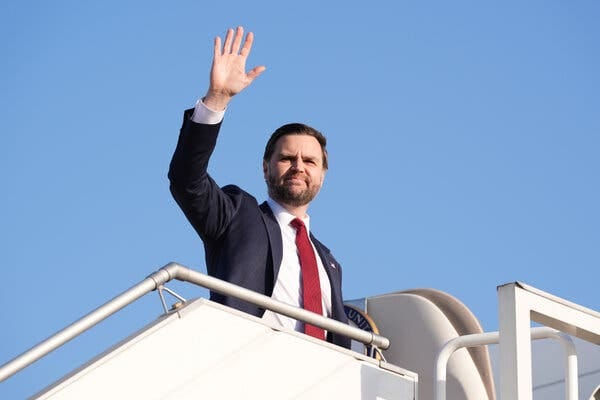
By SCM Foreign Correspondent
WASHINGTON — The Trump administration is doubling down on a landmark $300 billion reconstruction and investment package for Iran, as Vice President JD Vance and President Trump move to frame the massive financial incentive as a “tough-minded” business tool rather than a diplomatic handout.
The disclosure, which has set Washington political circles ablaze, comes just days before the formal signing of a peace agreement in Geneva, Switzerland, intended to permanently end months of devastating conflict.
The war, which saw U.S. military strikes on Iranian nuclear infrastructure and a total blockade of the Strait of Hormuz, left global energy markets in chaos and inflation soaring.
In a series of media appearances on Monday, Vice President Vance clarified the mechanics of the proposed $300 billion capital pool. Addressing domestic anxieties about the scale of the relief, Vance was unequivocal: “The agreement says they are not getting a single dime of American money.”
Administration officials are positioning the fund as a “performance-based” incentive. According to the plan, the money would not come from U.S. coffers but would be structured through private companies and regional energy partnerships.
The primary backers are expected to be wealthy Gulf Arab states, which have a vested interest in stabilizing global energy markets and reintegrating Iran into the regional economy.
”That is the sort of thing they could have access to, funded by the Gulf Coast Coalition, so long as they honor their end of the obligation,” Vance told CBS News.
The scope of the package has drawn immediate fire from critics, many of whom have drawn parallels to the 2015 JCPOA—a deal that became a focal point of Republican opposition for unfreezing Iranian assets.
President Trump, acutely aware of the optics, took to social media to aggressively distance his strategy from past accords. “Iran has agreed to never have a Nuclear Weapon! Also, the story that the U.S. is paying Iran… is Fake News,” the President wrote, emphasizing that the capital is private and regional.
The administration’s defense centers on the concept of “active distrust” diplomacy. Rather than simple asset relief, Vance described the deal as a pragmatic economic pivot: “We’re willing to talk about unfreezing assets… but a much bigger deal is unsanctioning their economy so long as they make the long-term commitments on the nuclear program.”

The stakes for the agreement remain incredibly high. The implementation timeline is contingent on a 60-day ceasefire extension and the full, unhindered reopening of the Strait of Hormuz.
A senior official confirmed that the technical benchmarks for the fund are rigid. Washington plans to collaborate with international atomic watchdogs to verify the destruction of Iran’s enriched uranium stockpile. “What we’re going to do is destroy the highly enriched material, the nuclear dust, and we’re gonna do it with the Iranians,” Vance said.
While the MOU has been electronically initialed by President Trump, Vice President Vance, and Iranian Parliamentary Speaker Mohammad Bagher Ghalibaf, the true test begins this week.
Diplomats from the U.S., Iran, and Pakistan are currently converging on Geneva. Should the regime in Tehran fail to honor its non-proliferation commitments, the administration has signaled that the financial incentives—and the diplomatic bridge they represent—will be immediately withdrawn.
For now, the world watches as the “active distrust” experiment moves from the battlefield to the negotiating table.
This diplomatic breakthrough follows an extraordinarily volatile period in Middle Eastern history:
February 2026: U.S. and Israeli forces launch a massive air campaign, striking Iran’s three primary nuclear sites following a kinetic regional conflict.
The Blockade: In retaliation, Iran imposes a total blockade on the Strait of Hormuz, choking off nearly a fifth of the world’s oil supply.
The Attrition: The conflict expanded into a brutal multi-month war, featuring direct missile exchanges across Jordan, Lebanon, and the Persian Gulf.
The Pivot: Faced with total economic collapse and the threat of regime change, Tehran engaged in mediation led by Pakistan, culminating in the current peace process and the move toward the Geneva accord.
