

By SCM Business Correspondent
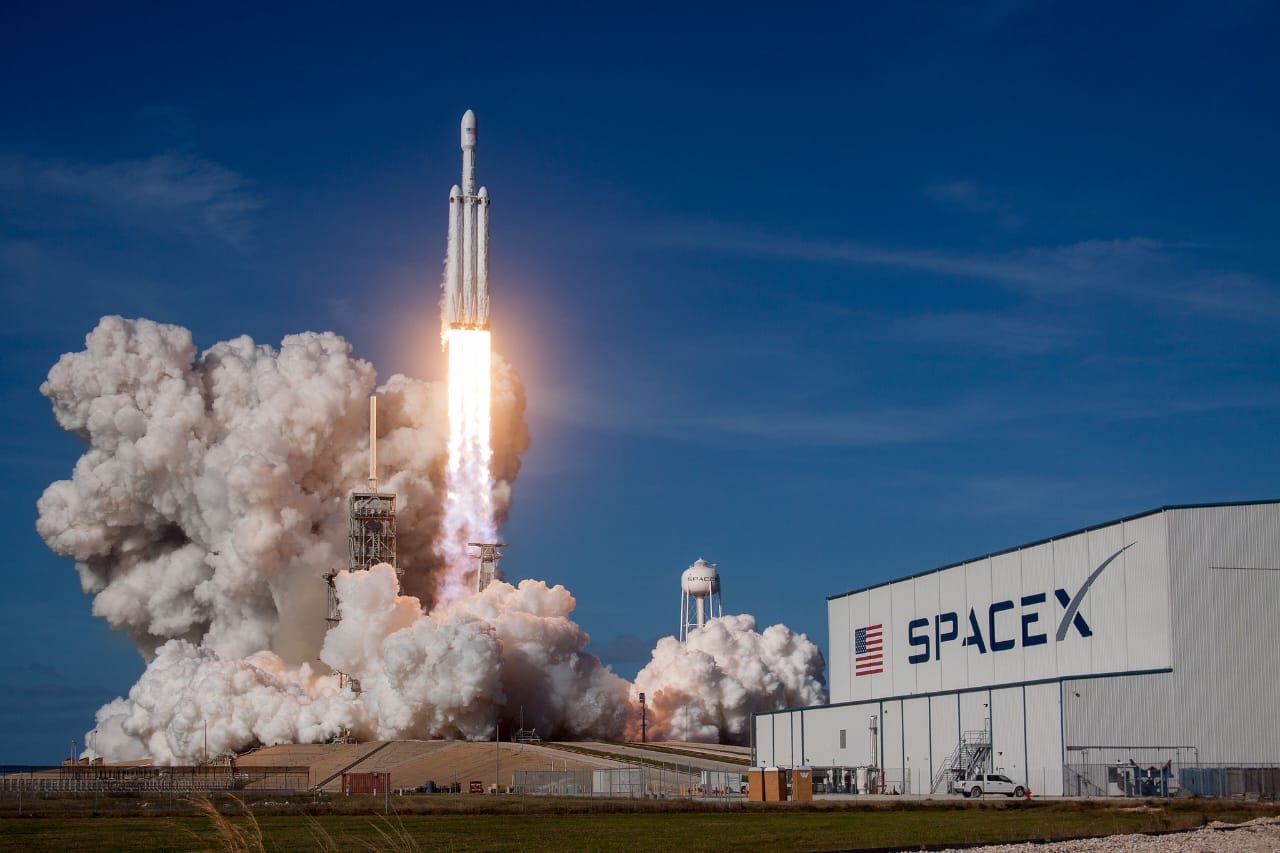
NEW YORK / LONDON — Elon Musk’s SpaceX has officially crossed the final frontier of corporate finance, launching onto the public markets in a record-shattering initial public offering that fundamentally alters the landscape of global equity indices.
The aerospace and satellite giant finalized its pricing late Thursday at $135 per share, raising a staggering $75 billion by selling 555.6 million shares. The debut, under the Nasdaq ticker SPCX, mints SpaceX with an initial market valuation of $1.77 trillion.
This safely eclipses Saudi Aramco’s historic $29.4 billion listing in 2019 to become the largest IPO in global history, positioning the company as the eighth-largest publicly traded corporate entity on Earth from day one.
Demand for the offering was described by institutional underwriters as “unprecedented and borderline frantic.” The bookbuilding process drew over $250 billion in orders—nearly four times oversubscribed—with institutional heavyweight BlackRock single-handedly anchoring the bid with a $5 billion order.
Early indications of interest on Friday morning suggested the stock could open as high as $175, a 30% first-day premium driven by a retail investor book that cleared $100 billion.
While the headline numbers are stratospheric, the underlying financials revealed in SpaceX’s S-1 prospectus show a company balancing structural dominance with capital-intensive ambitions.
The core commercial launch engine is undeniably robust; SpaceX controls roughly 90% of the commercial launch market and more than 80% of all US rocket launches. In 2025, overall corporate revenue climbed 33% to $18.7 billion.
This growth was anchored heavily by its Starlink satellite internet constellation, which brought in $11.4 billion—accounting for 61% of total top-line revenue—and now boasts over 12 million subscribers across 160 countries.
However, public investors are stepping into a company facing steep, ongoing structural costs.
SpaceX posted a net loss of $4.94 billion for 2025, reversing a slim $791 million profit from 2024. The cash burn has continued into early 2026, with a reported net loss of $4.28 billion in the first quarter alone.

Much of this deficit stems from heavy vertical integration, including massive capital expenditure into autonomous systems and AI infrastructure. This includes the build-out of the 300-megawatt “Colossus 1” data center housing 220,000 Nvidia GPUs, which recently secured a lucrative $1.25 billion-per-month infrastructure contract with AI startup Anthropic through 2029.
The pure scale of the $1.77 trillion listing has triggered a frantic scramble among passive index providers, exposing fractures in how Wall Street benchmarks handle incoming mega-cap companies.
Historically, rigid “seasoning” rules forced newly listed companies to wait months or years before benchmark inclusion. Facing the reality of a multi-trillion-dollar entity floating outside its borders, Nasdaq swiftly modified its rules, effective May 2026.
The exchange will allow top-40 ranked companies by market capitalization to bypass traditional waiting periods and enter the Nasdaq-100 index in just 15 trading days. Conversely, the S&P Dow Jones Indices concluded a late-May consultation by refusing to adjust its criteria, meaning the S&P 500 will retain its standard seasoning and financial viability screens.
The divergence creates an acute tracking dilemma for passive fund managers who must navigate mismatched exposures across competing indices.
”The SpaceX listing breaks the traditional machinery of index tracking,” noted one senior equity strategist. “Passive investors in certain large-cap funds will automatically absorb exposure to an incredibly complex, high-risk aerospace firm within weeks, while others will have zero exposure.”
Furthermore, governance advocates are waving yellow flags over the listing’s extreme corporate structure. Following a 5-for-1 stock split in May 2026 and a structural merger with xAI earlier in the year, Elon Musk retains an ironclad grip on the company.
Despite owning roughly 42% of the equity, Musk holds 85% of the total voting control. The arrangement shields management from activist shareholder interventions, ensuring that capital allocation will remain fixed on long-term interplanetary exploration over near-term quarterly margins.
As trading begins, the market’s response to SPCX will serve as a definitive litmus test for whether public investors have the stomach for Musk’s high-stakes, multi-planetary timeline, or if the sheer gravity of a $1.77 trillion valuation proves too heavy to sustain.
