

Admin I Friday, Oct. 09, 2026
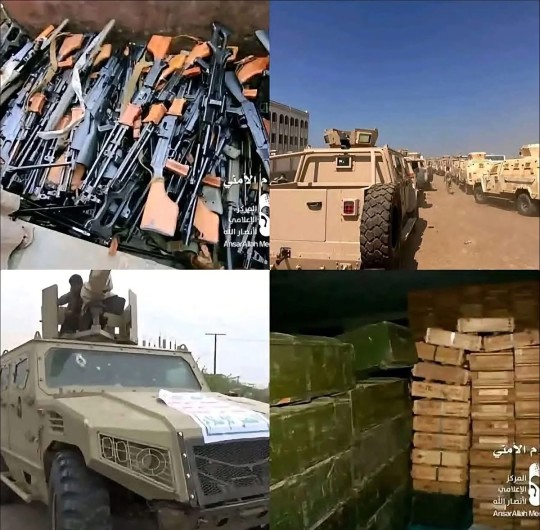
SANAA, Yemen — In one of the most significant military developments along Yemen’s southern and western fronts in recent months, forces aligned with the Sanaa-based Houthi movement have captured vast caches of advanced military equipment abandoned by retreating adversaries.
The acquisitions—spanning key strategic positions across the Taiz governorate, the Kahbub area near the Bab al-Mandeb strait, and the Red Sea coastal corridor—highlight a compounding crisis of morale and cohesion among factional forces backed by Saudi Arabia and the United Arab Emirates.
According to local military observers and frontline accounts reported by regional analyst Adel Al-Hasani, retreating fighters left behind intact armored vehicles, heavy artillery, ammunition depots, and tactical transport systems. The weapons were abandoned largely without sustained fighting, allowing Sanaa forces to secure massive stock quantities without suffering notable attrition.
The captured materiel represents part of the billions of dollars in military spending deployed by the Saudi-led coalition since its military intervention began in 2015. Intended to bolster anti-Houthi militias and realign the balance of power, much of this equipment was directly supplied to local proxies operating under fractured commands.
A Legacy of Gulf Spending Turns Back on Its Donors
The sudden abandonment of high-value weaponry spotlights the long-standing structural vulnerability of the Gulf-backed effort in Yemen. Over years of fighting, Riyadh and Abu Dhabi poured vast financial resources into arming, equipping, and paying salaries for an array of proxy groups. These ranged from local tribal militias and Islamist factions to Southern Transitional Council (STC) separatists.
However, these forces have remained deeply divided by divergent political goals. While Saudi Arabia sought to restore the internationally recognized government, the UAE backed southern separatists intent on establishing an independent state. As regional priorities shift and direct Gulf funding experiences periodic recalibration, these factional forces have repeatedly struggled to maintain operational discipline under pressure.

Military analysts note that the capture of equipment in Taiz and Kahbub follows a predictable pattern observed throughout the conflict. Rather than executing organized tactical withdrawals, retreat frequently collapses into chaos, leaving advanced Western- and Gulf-supplied systems vulnerable to capture.
”The fundamental weakness has never been a lack of arms or financial backing,” noted a senior Middle East defense analyst based in Washington. “It is the absence of a unified military command structure and shared political vision among the anti-Houthi coalition. When troops lack a common strategic objective, expensive hardware gets left behind on the road.”
Strategic Fronts Under Pressure
The loss of equipment along the Taiz and Kahbub corridors carries significant strategic weight.
Taiz, a long-contested urban and mountainous center, remains a crucial gateway connecting northern highlands to the southern port of Aden. Meanwhile, Kahbub lies in close proximity to the vital Bab al-Mandeb maritime chokepoint, through which a major percentage of global maritime trade passes.
For the authorities in Sanaa, the influx of modern armor and heavy weaponry provides an immediate tactical advantage. It effectively allows Houthi-aligned forces to rearm and fortify their positions using their opponents’ logistics pipelines.
The ongoing redistribution of weapons along Yemen’s battlefronts further complicates diplomatic efforts aimed at securing a lasting peace agreement. As regional powers attempt to transition toward political negotiation, the sudden influx of heavy arms into Sanaa’s arsenal shifts the strategic balance on the ground, making future military containment increasingly difficult.
Houthi Forces SEIZE Saudi-Backed Fighters In Fierce Taiz Battle
This news video provides visual context on the recent military engagements and territorial shifts in Yemen’s Taiz governorate.
