

By Our Religion Correspondent
JERUSALEM — The Organization of Islamic Cooperation (OIC), representing 57 Muslim-majority nations, has issued a scathing condemnation of the Israeli parliament after it advanced a highly controversial piece of legislation aimed at sharply restricting the traditional Muslim call to prayer over mosque loudspeakers.
In a forceful statement issued from its General Secretariat in Jeddah, Saudi Arabia, the OIC labeled the draft legislation—widely known as the “Muezzin Law”—a “legislative crime of a discriminatory and racist nature.”
The pan-Islamic body declared the measure null and void, asserting that it constitutes “a flagrant violation of freedom of religion and worship,” as well as a direct assault on the cultural and religious rights guaranteed to Palestinians under international law.
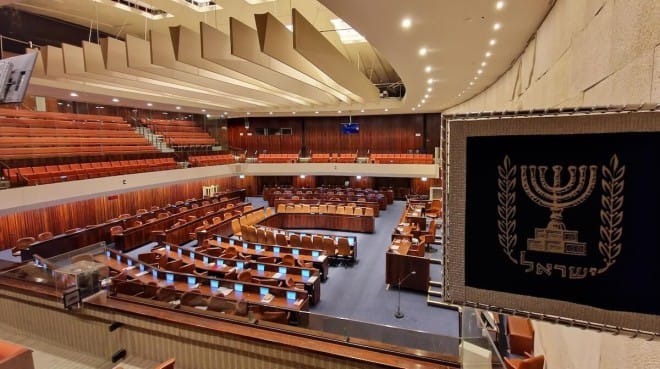
The diplomatic backlash follows a turbulent session in the Israeli Knesset, where lawmakers voted 50 to 36 in a preliminary reading to advance the bill. Sponsored by Zvika Fogel, a member of the far-right Otzma Yehudit (Jewish Power) party, the proposed law would require mosques to obtain formal municipal permits to operate loudspeaker systems.
Crucially, it would grant Israeli police unprecedented authority to enter religious premises to silence broadcasts deemed “unreasonable noise” and slap violators with heavy administrative fines ranging from 10,000 to 50,000 shekels ($2,700 to $13,500).
The adhan, or Muslim call to prayer, is broadcast from minarets five times a day, beginning at dawn. For centuries, it has been a defining acoustic fabric of life across Jerusalem and the wider region.
Supporters of the bill have long maintained that the legislation is a public health measure rather than a religious one. “This is not a political issue,” Mr. Fogel argued before the plenum, contending that the volume of mosque loudspeakers impairs the quality of life for neighboring residents. National Security Minister Itamar Ben-Gvir, the leader of Otzma Yehudit who has pushed for strict crackdowns on Arab communities, enthusiastically welcomed the preliminary victory, proclaiming that “governance begins with noise.”
However, Arab and opposition lawmakers in Israel, along with international observers, see a vastly different motivation. They argue that existing noise pollution regulations are already sufficient to handle local grievances and that the new bill is explicitly designed to target Israel’s Muslim minority, who make up roughly 20 percent of the population.
Critics noted with alarm that the bill’s explanatory notes specifically claimed mosque volumes had been intentionally turned up after the October 7, 2023, attacks to show solidarity with Hamas—an allegation Arab leaders dismissed as an Islamophobic dog whistle meant to justify the erasure of their heritage.
”The muezzin does not disturb their ears; it disturbs their racism,” countered Ofer Cassif, an opposition lawmaker from the left-wing Hadash-Ta’al faction, who accused the far-right coalition of trying to “silence” the country’s Muslim community.

The OIC’s intervention elevates a domestic municipal dispute into a volatile geopolitical issue. By framing the bill as part of a “dangerous escalation within the context of a series of racist Israeli decisions,” the organization connected the loudspeaker restrictions to broader grievances regarding Israeli control over Islamic holy sites, particularly the Al-Aqsa Mosque compound in Jerusalem.
In its appeal, the OIC called upon the United Nations and the wider international community to take “urgent action” to halt the legislation before it passes the three subsequent readings required to become law. They urged global bodies to hold Israel accountable for “ongoing violations of international law” and to protect the sanctity of religious rites without discrimination.
Legal experts warn that if the bill successfully navigates the committee phase and passes into law, it will likely face immediate, fierce challenges in Israel’s High Court of Justice on the grounds of religious discrimination and infringement on freedom of worship.
1. A Decade of “Muezzin Bill” Battles
Efforts by right-wing Israeli politicians to muffle mosque loudspeakers are not new; they have been introduced in various iterations for over a decade. A prominent version surfaced in 2016 and 2017 under Prime Minister Benjamin Netanyahu’s previous coalitions.
At the time, the bill faced unexpected resistance not just from Arab lawmakers, but also from ultra-Orthodox Jewish parties. Ultra-Orthodox politicians feared that a generic “noise prevention” law targeting houses of worship might inadvertently ban the traditional sirens (shabbat sirens) blasted in Jewish neighborhoods on Friday afternoons to mark the beginning of the Sabbath.
2. Shifting Coalitions and the Role of Shas
The geopolitical and domestic political alignment in Israel has shifted decisively rightward. The preliminary passage of this latest version was made possible because the ultra-Orthodox Shas party chose to vote in favor of it, breaking a fragile, implicit understanding with Arab factions.
In previous legislative battles, Arab and ultra-Orthodox parties occasionally coordinated to protect their respective religious autonomies from secular or nationalist state overreach. The willingness of ultra-Orthodox parties to align with Ben-Gvir’s hardline anti-Arab agenda underscores the current dominance of nationalist-religious factions within the ruling coalition.
3. Escalating Tensions Over Symbols of Identity
The battle over the adhan is inseparable from the broader, ongoing conflict over space, sovereignty, and identity in Israel and the occupied West Bank. For Palestinians, the call to prayer is an irreplaceable symbol of continuous geographic and historical presence.
For the Israeli far-right, silencing or regulating the volume of the call is framed as an assertion of Jewish sovereignty, particularly in mixed cities and East Jerusalem.
This legislative push comes amidst a landscape of heightened regional sensitivities following years of intense military conflict, expanding West Bank settlements, and bitter disputes over access to holy sites.
