

By Emmanuel Thomas l Thursday, August 27, 2026
JAPPA, EFFURUN – Democracy is sustained not merely by the physical act of casting a ballot, but by public trust in the institutions tasked with safeguarding the vote.
When the institution mandated to act as an impartial referee repeatedly displays technical opacity, administrative clumsiness, and institutional evasiveness, it ceases to be a guarantor of democratic expression and becomes its greatest threat.
As Nigeria prepares for the 2027 general elections, the Independent National Electoral Commission (INEC) finds itself locked in a crisis of credibility that threatens the survival of the country’s constitutional order.
The latest manifest of this systemic rot was laid bare following the August 15, 2026, Osun State governorship election. Prominent economist, civic leader, and founder of the Anap Foundation, Atedo Peterside, issued a scathing critique targeting the integrity of INEC’s electronic infrastructure.
Peterside raised three fundamental, data-backed questions regarding the operation of the INEC Result Viewing (IReV) portal on election night:
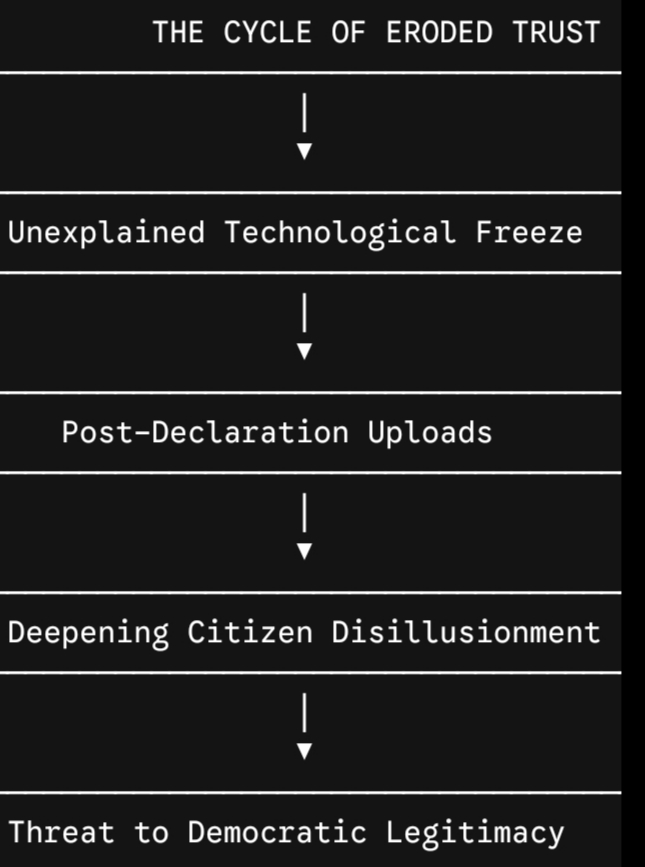
Why did result transmission freeze completely for nearly three hours (between 20:48 hrs and 23:42 hrs), only for an unprecedented dump of 236 polling unit results to hit the server in less than 60 seconds immediately afterward?
Why were 51 polling unit results uploaded only after a winner had already been declared by the returning officer?
Why did 11 polling unit results remain entirely unaccounted for on the IReV portal days after the exercise concluded?
These queries are not mere technical nitpicking; they strike at the heart of the “triangle of compromise” currently eroding Nigerian statehood. Peterside’s observations prove that despite legislative overhauls, billions of naira in budgetary allocations, and repeated institutional promises,
INEC’s technological infrastructure remains vulnerable to unexplained outages that consistently coincide with critical moments of collation.
A Pattern of Institutional Evasion
The technical glitches highlighted in the Osun gubernatorial contest are part of a broader, systemic failure. Rather than operating as an independent body dedicated to transparency, INEC has established a pattern where digital platforms—introduced specifically to eliminate manual rigging—are compromised at crucial junctures.
Electoral integrity is predicated on predictability. When the digital transmission pipeline freezes without explanation, public suspicion fills the void. A sudden dump of 236 results in under a minute following a three-hour blackout suggests manual batching or administrative intervention rather than automated real-time transmission.

Furthermore, declaring an election winner while scores of polling unit results remain offline—or uploading them post-declaration—renders the IReV portal a retrospective archive rather than a real-time verification tool.
This behavior directly fuels voter cynicism. As former INEC officials, civil society organizations, and international observers have repeatedly noted, when citizens believe the referee is compromised, the incentive to participate vanishes.
Elections are reduced to performative rituals where outcomes are perceived to be manufactured in administrative corridors rather than determined at polling stations.
Replicating the Mistakes of the Past
The dangerous trajectory toward 2027 mirrors the institutional failures that damaged public faith during the 2023 general elections.
The non-transmission of presidential election results in real time on the IReV portal shattered public trust and cast a shadow over the judicial petitions that followed. Rather than treating that failure as an emergency requiring radical reform, INEC’s conduct in subsequent off-cycle elections indicates an entrenchment of bad practice.
Civic leaders across the political spectrum have sounded the alarm. The recurring narrative of “technical hitches”—conveniently occurring during the collation of high-stakes results—has transformed INEC from an agent of democratic consolidation into a vector of political instability.
When citizens lose faith in the ballot box, the alternative is often street protests, political apathy, or a slide toward total lawlessness.
The Implication for 2027
Nigeria cannot afford an electoral umpire whose operations invite perpetual litigation and civil unrest.
A general election involves the simultaneous processing of tens of thousands of polling units across 36 states and the Federal Capital Territory. If INEC cannot manage real-time result transmission and full transparency in a single-state off-cycle election like Osun, its capacity to conduct a credible, peaceful, and transparent nationwide election in 2027 is doubtful.
The commission’s persistent refusal to offer transparent forensic logs, clear operational explanations, or account for missing polling unit data reinforces the perception that it operates above public accountability. In a democracy, institutional silence in the face of mathematical and operational anomalies is an admission of failure.
If Nigeria’s democratic experiment is to survive past 2027, INEC must be subjected to immediate, independent technical audits and structural reform.
The electoral body must understand that its primary duty is not to declare winners, but to protect the integrity of the process.
Until INEC provides clear answers to the questions raised by Atedo Peterside and addresses its systemic technological flaws, it remains the single greatest institutional threat to Nigeria’s democracy.
