

By Our Staff Writer
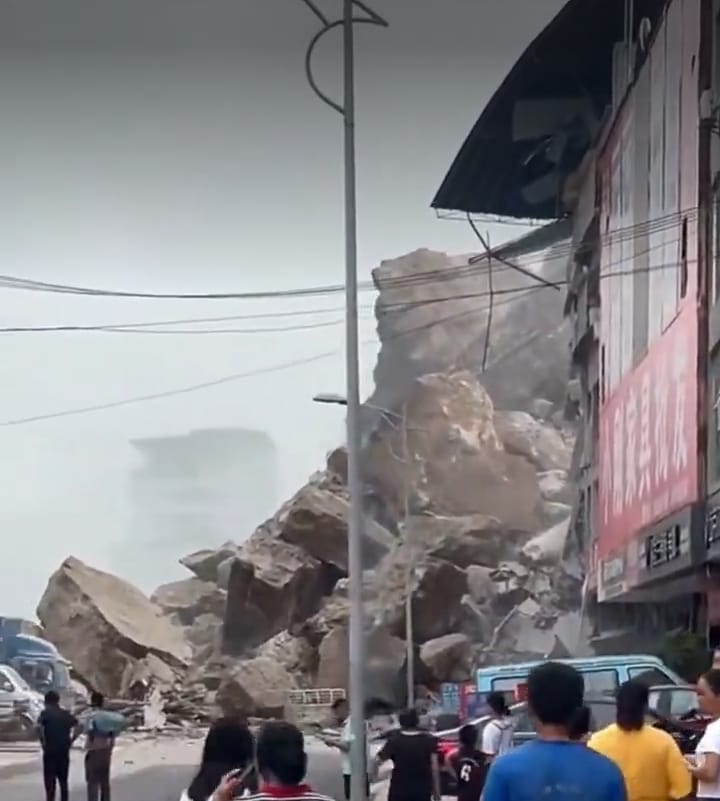
BEIJING — A massive, rain-triggered landslide tore down a mountainside in the southwestern Chinese municipality of Chongqing on Friday morning, burying a cluster of residential buildings, trapping an unknown number of people, and forcing more than 1,100 residents to flee into temporary shelters.
The disaster occurred at approximately 9:08 a.m. local time in the Hanjia sub-district of Pengshui Miao and Tujia Autonomous County, a mountainous region sitting along the banks of the Wujiang River. According to state broadcaster CCTV, a catastrophic volume of rock and mud broke loose from a nearby hillside, obliterating more than 10 multi-story residential homes down slope and sending a towering plume of dust into the air.
Disaster was averted for many because of a quick-thinking community worker who noticed falling debris around 8:00 a.m. and raised an emergency warning.
While local authorities swiftly managed to evacuate more than 60 residents in the immediate vicinity, the mountain gave way before wider structural clearings could be finalized, catching some individuals inside their homes.
As of Friday afternoon, emergency crews using heavy excavators and advanced detection equipment had successfully pulled 10 survivors from the rubble. Local officials reported that none of those rescued sustained life-threatening injuries.
However, the exact number of people still missing remains dangerously fluid as emergency personnel work through shifting debris.
The Chinese Ministry of Natural Resources rapidly upgraded its geological disaster response to Level II—the second-highest tier in the country’s emergency management system—signaling severe risk to life and property. A specialized force of over 800 rescue personnel, including 110 expert engineering and geological specialists from the state-owned China Anneng Construction Group, has converged on Pengshui County.
They face an uphill battle. The terrain remains highly unstable, and rescue crews must navigate the constant threat of secondary landslides.

To minimize the risk of secondary explosions or fires, utility companies cut off all water, electricity, and gas supplies within a one-kilometer radius of the impact zone. Several snapped power poles have plunged surrounding villages into darkness, compounding the logistical hurdles.
In response to the displacement of over 1,100 residents, the Ministry of Emergency Management has dispatched more than 8,000 relief items to Chongqing, including emergency family kits, folding beds, and tents.
Pengshui County lies tucked within the scenic but fragile karst geography of southeastern Chongqing, bordering the provinces of Guizhou and Hubei. Karst landscapes, characterized by porous limestone mountains, sharp cliffs, and steep slopes, are inherently vulnerable to shifting when heavily saturated with water.
The region has been battered by a heavy, compounding summer monsoon season. Meteorological agencies warned that the intense weather system is far from over: a municipal Level IV emergency response for flooding has been issued across 25 districts in Chongqing.
Forecasters expect an additional 60 to 90 millimeters of rain to fall within short intervals, alongside level 8 to 10 thunderstorm gales, threatening to further undermine the rain-soaked mountainsides.
In recent years, China has experienced an uptick in devastating, localized geological disasters fueled by erratic weather pattern changes.
Torrential rains during the summer months have routinely pushed river levels past historical thresholds, making densely populated mountainous enclaves like Chongqing primary focal points for disaster preparedness and infrastructure reinforcement.
