

Emmanuel Thomas I Friday, July 17, 2026
CALABAR – In a decisive move to drive financial independence, food security, and inclusive growth, the Niger Delta Development Commission (NDDC) has announced a major expansion of its women and girl-child empowerment initiatives across the region.
The Commission revealed plans to scale up sustainable livelihood, agricultural, and entrepreneurship schemes designed to transition women from local subsistence traders into global exporters.
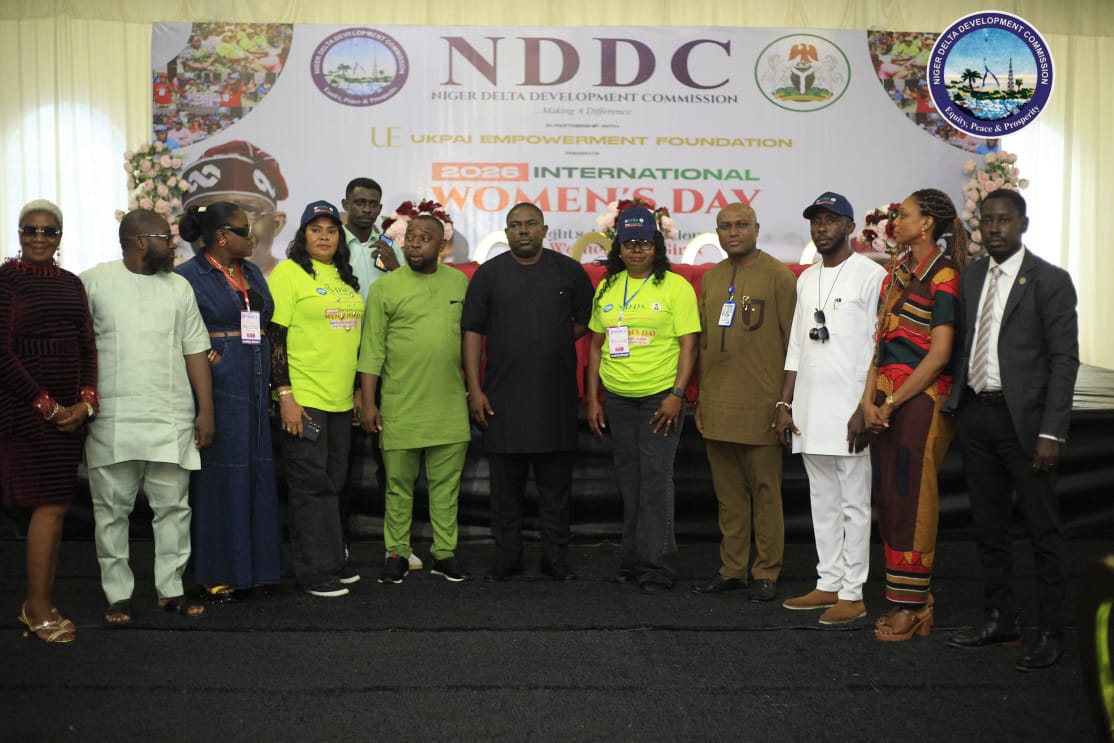
Speaking at the 2026 International Women’s Day (IWD) celebration held in Calabar, the Cross River State capital, the Managing Director and Chief Executive Officer of the NDDC, Dr. Samuel Ogbuku, reaffirmed that the holistic empowerment of women remains an institutional priority.
Dr. Ogbuku, who was represented at the event by the NDDC Assistant Director of Youths, Sports, Culture, and Women Affairs, Dr. Esther Philip, emphasized that investing in women yields a multiplier effect on the socio-economic fabric of Nigeria.
“Empowering women translates directly into empowering the nation. The NDDC has consistently designed and implemented impactful interventions that enable our women to build sustainable livelihoods. We are committing to sustaining these specialized development programmes to foster wealth creation, self-reliance, and community development across the nine Niger Delta states,” Ogbuku stated.
Alignment with President Tinubu’s Renewed Hope Agenda
The NDDC boss further noted that the Commission’s renewed vigor toward gender mainstreaming and economic inclusivity is a direct reflection of its statutory mandate and aligns seamlessly with the Renewed Hope Agenda of President Bola Ahmed Tinubu.
He expressed optimism that the 2026 IWD capacity-building sessions would leave a legacy of financial emancipation for the participants, urging them to utilize the acquired practical skills to scale their enterprises and secure their financial future.
Echoing this sentiment, the Cross River State Representative on the NDDC Board, Mr. Orok Duke, celebrated the untapped potentials of the girl-child in the region. Represented by his Special Assistant on Administration, Mr. Bassey-Ita Duke, the board member remarked that women have broken barriers to excel in previously male-dominated professional sectors.
“Women are the foundational pillars of resilience and development in the Niger Delta. To demonstrate our commitment to gender equality, the NDDC has consciously positioned accomplished women in management and strategic decision-making roles within the Commission,” Duke said.
Beyond corporate representation, Mr. Orok Duke highlighted the NDDC’s aggressive interventions in the agricultural sector as a tool for women’s liberation. Under the current leadership of the Governing Board Chairman, Mr. Chiedu Ebie, and the Managing Director, Dr. Samuel Ogbuku, the Commission has repositioned agriculture as the primary alternative to oil dependency.
The NDDC’s agro-empowerment models span across:
Animal Husbandry: Providing livestock and technical veterinary support.
Fisheries: Establishing aquaculture hubs managed by women cooperatives.
Crop Production: Supplying high-yield seedlings, processing equipment, and accessible micro-credit.
According to Duke, these initiatives are specifically targeted at enhancing food security, mitigating rural poverty, and providing predictable, long-term streams of income for rural women.
Breaking into International Markets: The NEPC Partnership
A major highlight of the 2026 celebration was a specialized technical masterclass aimed at moving Niger Delta women into the global trade ecosystem.

Delivering a lecture titled “Best Practices for Packaging Certified Products for Export,” Mrs. Christiana Ekeng, a regulatory expert from the Nigerian Export Promotion Council (NEPC), provided actionable insights into international trade compliance.
Mrs. Ekeng explained that the global market holds immense wealth for Nigerian women, but strict adherence to international standards is non-negotiable.
She clarified that all non-oil products intended for export must undergo rigorous verification and certification by the NEPC before exiting Nigerian borders.
“Obtaining the required certification is not just a regulatory hurdle; it enhances your product’s credibility, builds trust with international buyers, and unlocks premium pricing in global supermarkets,” Ekeng advised.
The NEPC resource person also broke down the structural science of product presentation, categorizing packaging into three vital stages:
Primary Packaging: The immediate container that protects the product from contamination or damage.
Secondary Packaging: The branding and consumer-facing wrapping.
Tertiary Packaging: Bulk transit boxes and cartons necessary for safe freighting.
She warned that poor packaging could ruin high-quality agricultural yield, urging entrepreneurs to invest heavily in presentation and compliance.
In her remarks, the Consultant for the Ukpai Empowerment Foundation, Dr. Boma Nathan, lauded the NDDC leadership for moving away from periodic cash handouts toward structured, knowledge-driven empowerment models.
“True empowerment is not about giving temporary stipends. It is about helping women discover their purpose, pursue their economic passions, and attain their full potential.
The NDDC’s strategic approach ensures that these women will not just survive, but become employers of labor,” Dr. Nathan stated.
The event concluded with a strong call to action from the NDDC Corporate Affairs Directorate, signed by Director Seledi Thompson-Wakama, urging regional stakeholders to continue collaborating with the Commission to build a prosperous, equitable, and self-sufficient Niger Delta.
