

BY OUR SPORTS DESK
NEW YORK – The long journey across three nations has officially reached its ultimate destination. After thirty-seven days of high-intensity drama and one hundred and three matches played across the United States, Mexico, and Canada, the 2026 FIFA World Cup final has arrived.
On Sunday, July 19, the New York New Jersey Stadium in East Rutherford will play host to a dream encounter that pits the reigning European champions, Spain, against the defending world and South American champions, Argentina.
The massive, eighty-two thousand five hundred capacity stadium—customarily home to the New York Giants and New York Jets—is set to provide a fittingly theatrical backdrop for a fixture overflowing with tactical intrigue, heavy historical weight, and a poetic narrative script that feels almost too perfect to be true.
Beyond the glittering trophy itself, the winning squad will make history by receiving the first-ever custom-made FIFA World Cup Championship Rings, a new tradition modeled after American sports culture. For the fans inside the arena and the billions watching around the globe, the match is defined by a generational passing of the torch.
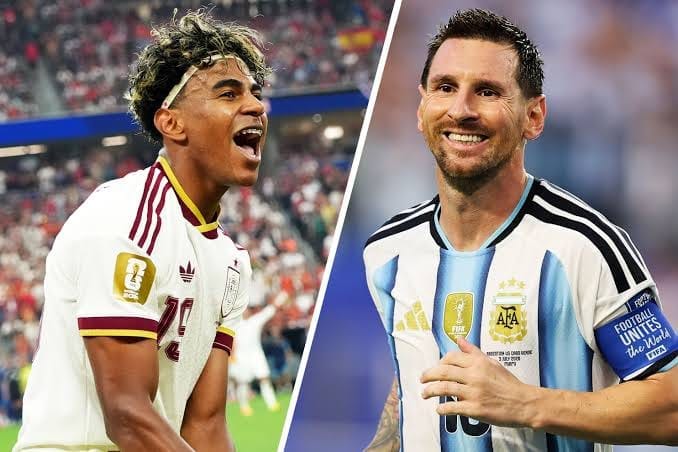
Lionel Messi, at thirty-nine years old and playing in what is widely expected to be his international swansong, will square off against Spain’s nineteen-year-old sensation Lamine Yamal.
Adding to the magic, the global audience has been captivated by the resurgence of a famous 2007 charity photoshoot where a young Messi washed a baby Yamal in a bathtub at Camp Nou—a long-lost image that now frames the most anticipated player-versus-player matchup of the decade.
Analyzing the Winning Chances
When looking at the probabilities calculated by the data experts at Opta, Spain enters the grand finale as the statistical favorite. The supercomputer assesses a forty-five point one percent probability that Spain will secure the victory within the regulation ninety minutes.
Argentina has been given a twenty-nine point four percent chance of winning in normal time, while the likelihood of the game stretching into the drama of extra time or a penalty shootout sits at twenty-five point four percent.
Spain’s high percentage of success is heavily grounded in their absolute, unwavering consistency throughout the tournament. Following an opening-day scoreless stalemate against Cape Verde, the European giants have put together a blistering run of six consecutive victories.
They brushed aside Saudi Arabia, Uruguay, Austria, Portugal, and Belgium, before completely neutralizing France with a commanding two-to-zero victory in the semifinals. Under manager Luis de la Fuente, Spain has transformed into a relentless possession machine, averaging an unmatched sixty-three point eighty-six percent of the ball across the tournament.
Their tactical identity centers on suffocating their opponents; they boast the highest success rate for direct ball recoveries at over sixty-eight percent, and they have won more balls back in the attacking third than any other squad.
Most impressively, Spain arrives at the final having conceded just a single solitary goal in seven matches, establishing a defensive record for a World Cup finalist.

If Spain can seize control of the midfield tempo early on and choke out Argentina’s supply lines, their impenetrable defensive block makes them incredibly difficult to break down.
Argentina, on the other hand, might not have the same pristine statistical profile in this specific tournament, but they possess a psychological edge that numbers cannot easily quantify.
The South American champions are riding an incredible, long-term fourteen-match winning streak dating back to late 2025. However, their journey through this tournament has been a wild, chaotic tightrope walk defined by a refusal to give up.
They needed an own goal in extra time to get past Cape Verde, survived a missed Lionel Messi penalty to stage a three-to-two comeback against Egypt, outlasted Switzerland in extra time, and engineered a late, magical turnaround against England in the semifinals. Trailing the English side until the eighty-fifth minute, two flashes of genius from Messi setup goals for Enzo Fernández and Lautaro Martínez to rescue the holders.
While Argentina’s pressing success rate of fifty-six point seventy-four percent is lower than Spain’s, they are much more aggressive, making more total ball recovery attempts than anyone else. If Argentina can disrupt Spain’s passing rhythm in the middle of the pitch and use their signature grit to turn the game into a chaotic, physical brawl, they possess the ultimate weapon in Messi to punish any rare Spanish mistake.
World Cup History and Records
The historical pedigree backing both of these soccer superpowers represents the absolute pinnacle of international sport. Argentina enters the match chasing their fourth star, looking to solidify a dynasty by becoming the first nation to successfully retain the World Cup trophy since the legendary Brazil side accomplished the feat back in 1962.
The South Americans have a deeply storied, emotional relationship with the World Cup final, having reached this ultimate stage on six prior occasions.
They suffered heartbreaking defeats in 1930, 1990, and 2014, but reached soccer immortality with historic triumphs in 1978 on home soil, in 1986 under the magical guidance of Diego Maradona, and most recently in 2022 during that unforgettable, cinematic night in Qatar.
Spain’s historical footprint in the final is vastly different but equally imposing in its efficiency. Sunday marks only the second time in history that the European nation has ever reached a World Cup final.
Their only previous appearance came sixteen years ago at the 2010 tournament in South Africa. On that occasion, their golden generation defeated the Netherlands one-to-zero in extra time thanks to an iconic Andres Iniesta strike, giving Spain a flawless one-hundred percent success rate when playing in the final match.
Remarkably, despite the giant reputations of both countries, history shows that Spain and Argentina have rarely crossed paths when the stakes are at their highest. This final marks the first time in sixty years that these two nations will square off in a competitive, senior international tournament.
The last time they met in a non-friendly environment was during the group stages of the 1966 World Cup, a match that ended in a two-to-one victory for the Argentines. While they have played thirteen friendly matches over the decades—with Spain winning six, Argentina winning five, and two ending in draws—all previous data points will be rendered completely irrelevant when the whistle blows in New Jersey.
Spain is aiming to match Italy’s legendary European unbeaten record of thirty-seven games, while Argentina is looking to cement Lionel Messi’s status as the undisputed greatest of all time. With history hanging in the balance, Sunday’s final promises an unforgettable clash of titans.
