

By SCM Foreign Desk
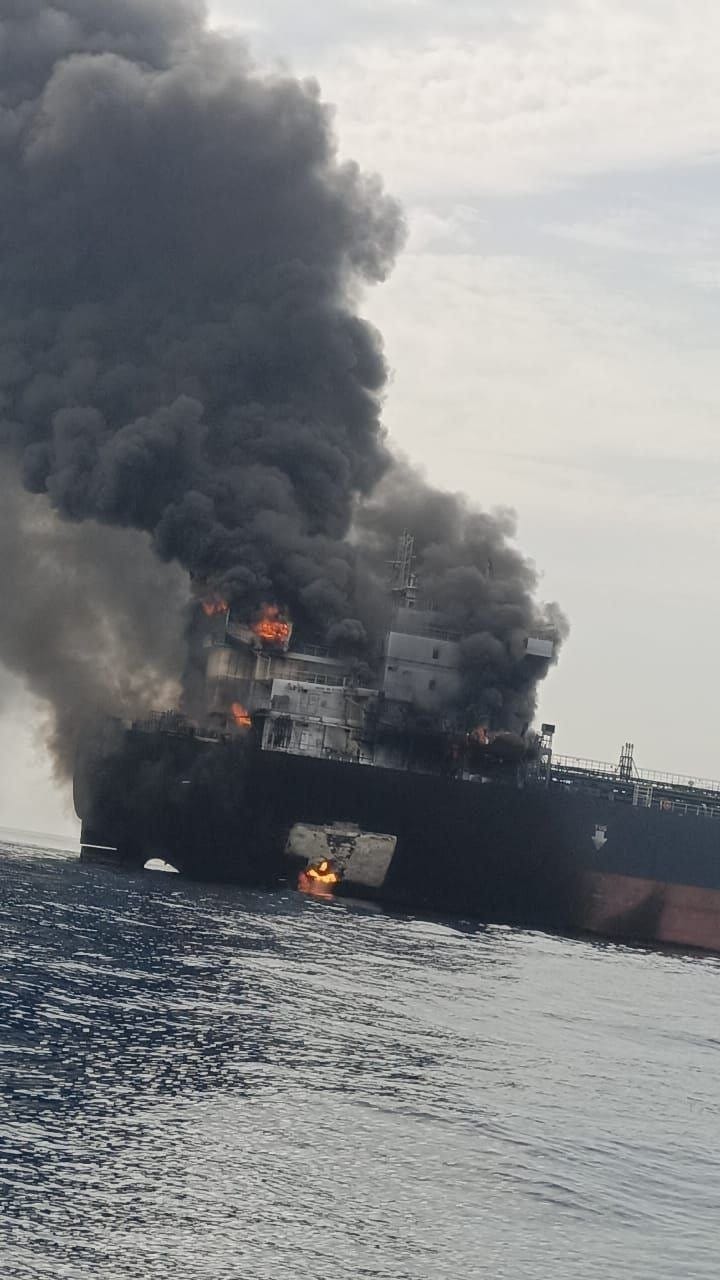
WASHINGTON — A commercial crude oil tanker was struck by projectiles and caught fire near the treacherous mouth of the Bab el-Mandeb Strait, maritime authorities said, shortly after Yemen’s Iran-backed Houthi militia claimed to have targeted two ships carrying Saudi oil through the Red Sea.
The United Kingdom Maritime Trade Operations (UKMTO), an arm of Britain’s Royal Navy that tracks commercial shipping in the region, issued an emergency alert confirming that a vessel had sustained explosive damage and that crew members were attempting to extinguish an onboard blaze.
The attack represents a sharp escalation in maritime violence along one of the world’s most critical commercial energy corridors, raising fresh alarms across global commodity markets and naval defense commands.
UKMTO Advisory: Commercial vessels operating in the southern Red Sea and Gulf of Aden are advised to exercise extreme caution and transmit minimal tracking data following reported projectile strikes near the Bab el-Mandeb Strait.
A Direct Threat to Saudi Energy Exports
A spokesperson for the Houthi military command announced that the group had executed targeted strikes against two tankers transporting Saudi crude. The militia framed the action as part of a newly declared “maritime embargo” against Saudi Arabia, citing long-standing regional grievances.
For years, Saudi Arabia has relied on its cross-country Petroline pipeline to route crude oil from its eastern fields to the Red Sea port of Yanbu. This overland connection allowed the kingdom to bypass vulnerable Persian Gulf shipping channels like the Strait of Hormuz. However, by expanding targeted strikes into the southern mouth of the Red Sea, Houthi forces are actively squeezing Saudi Arabia’s primary alternative export corridor.
Maritime tracking intelligence showed several laden crude tankers executing abrupt U-turns in the Red Sea and Arabian Sea, choosing to anchor or divert toward the Suez Canal rather than risk passing the Yemeni coast.
Strategic Importance of the Bab el-Mandeb
The Bab el-Mandeb—Arabic for “Gate of Tears”—is a narrow neck of water separating Yemen on the Arabian Peninsula from Djibouti and Eritrea in the Horn of Africa. It serves as the indispensable southern gateway to the Suez Canal.

When the strait is compromised, container ships and supertankers traveling between Asia, Europe, and North America face two difficult choices:
Brave the Target Zone: Transit the narrow passage under threat of antiship ballistic missiles, explosive drone boats, and armed fast-craft attacks.
Take the Long Way Around: Divert around the southern tip of Africa via the Cape of Good Hope, a detour that consumes millions in extra fuel, ties up international shipping capacity, and delays supply chains by up to two weeks.
The Houthis, an Iran-aligned Zaydi Shia movement that took control of Yemen’s capital, Sanaa, in 2014, have repeatedly used their geographic position overlooking the Red Sea as leverage in broader Middle Eastern conflicts.
Between late 2023 and mid-2025, Houthi forces launched over a hundred drone and missile attacks on commercial shipping in response to the war in Gaza, forcing Western nations to launch multinational naval escorts under coalition defense initiatives.
While maritime trade saw brief periods of stabilization during regional ceasefires, the group has repeatedly demonstrated its ability to swiftly reactivate its anti-ship missile arsenals and sea-skimming drone fleet.
Defense analysts warn that a sustained blockade or repeated tanker strikes around Bab el-Mandeb could trigger severe supply chain disruptions, compounding energy security challenges across Europe and Asia.
Naval forces operating in the region—including coalition warships—have reportedly deployed assets toward the burning tanker to render assistance and secure nearby shipping lanes, though security officials acknowledge that completely neutralizing low-cost missile and drone threats in a 20-mile-wide strait remains a monumental challenge.
According to the statement from the Houthi, the operation was carried out using multiple ballistic missiles, cruise missiles, and one-way attack drones.
The statement did not immediately provide details on the extent of the damage or the condition of the vessels.
