

By Dennis Onwuegbu I Wednesday, July 01, 2026
OKREKA, Delta – The road leading to Okreka/Ofonibaya in Nigeria’s Delta State, is not of the conventional type. Not only is the journey long and undulating, it transits between paved roads and mass waters.
History account shows that the Amgbaduba family serve as the custodians of Okreka boundary maps and historical titles during local mediation or government zoning. Any wonder one of their illustrious sons, Chief Prince Emman Amgbaduba is one of the pillars in Delta State politics and public service
This Okreka (sometimes spelled as OKARIKA) sits in a territory once considered volatile. Going by history, its neighbours like Okwagbe and Owahwa have faced legal and physical contests over ancestral boundaries along the waterways.
Okreka/Ofonibaya is tucked away off the Escravos River, and behind it is the Atlantic Ocean. Marking it out as an island indeed.
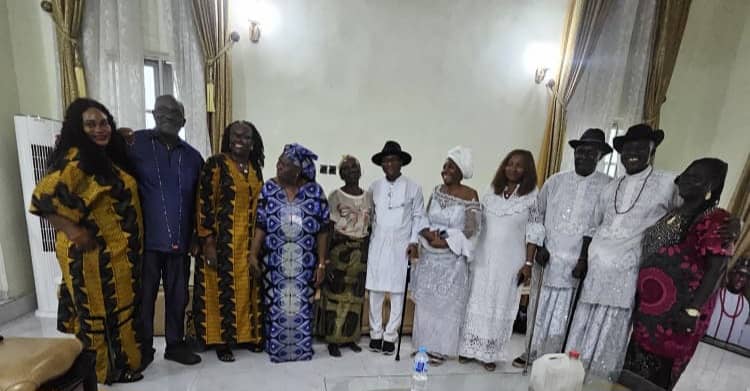
A historic community with rich culture and a people of intense display of love and pride of their rich heritage; recently, Okreka/Ofonibaya played host to sons and daughters of one of its most illustrious families, the Amgbadubas. They came from far and near to honour their departed sister, Lady Maria Teshoma Okoro nee Amgbaduba who died at the age of 85.
History account shows that the Amgbaduba family serve as the custodians of Okreka boundary maps and historical titles during local mediation or government zoning. Any wonder one of their illustrious sons, Chief Prince Emman Amgbaduba is one of the pillars in Delta State politics and public service.
On this occasion however, the entire Okreka/Ofonibaya were gathered to honour a daughter from a family that means so much to them. The final burial rites of a foremost daughter who was married to an Urhobo man and gave birth to 14 children, provided the entire community one-in-a-lifetime moment of deep reminiscence. The two days event did not disappoint in any way.
Travelling all the way from Lagos to Warri via Benin by road turned out to be one herculean journey many would remember for a very long time to come. Aside from the rains virtually all through the journey, the intermittent breaks along the highway due mostly to bad roads, an accident involving trailers and buses on the slope of the Ovia River. A journey of nine hours turned into a nightmarish 14 hours of snail-like crawling movement. That is a story for another day.
And by the time the entourage from Lagos arrived Warri enroute to Okwagbe Waterside, it was nightfall. The roads were wet, the convoy was contending with workers and businesses who had closed for the day, and the snarl continued until they got to the Waterfront. Crossing the Escravos River to Okreka/Ofonibaya was fun and easy because the community has been waiting all day for the arrival of the corpse of their daughter and her mourners.
On hand to receive the corpse, the children, in-laws, friends and well-wishers who have travelled from different parts of the country – Yenagoa, Port Harcourt, Benin, Warri, Otokutu: were the extensive Amgbaduba family led by their foremost son, Chief Prince Emman Amgbaduba elders and villagers. The centre of the community was already lined up with canopies, tables, drinks, and a live band was waiting to ignite the night with sonorous folkloric Ijaw songs and rhythms. The environment was lit-up, and the natives were waiting in anticipation.
There was no time left for much talks as the arrival of the corpse signalled the commencement of the traditional Wake-Keep. An all-night event, it flagged-off the moment the children of the deceased danced around bellowing to the mammoth crowd in the native Ijaw dialect: “Ado o” (general greeting and expression of welcome in reciprocate), and the crowd in return responded, “Ado o.” This ritual dance was performed twice and it was the greenlight for the commencement of the show.
Young women and young men, filed out in a single row, wriggling their waists, thumping their feet, and sporadic shout of ululates to complete the famous Owigiri wake-keep programme of the day. The rhythm of the night was endless as the live band electrified the atmosphere in a systematic effortless dovetail from one Ijaw song to another.
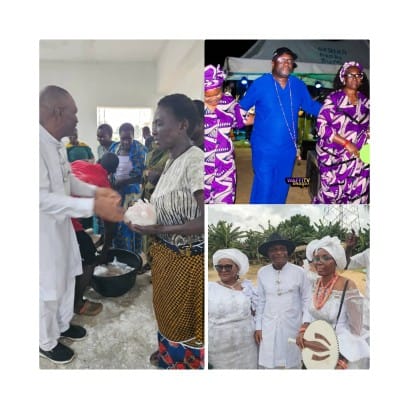
While this went on, different kinds of food came in an endless supply, including the native plantain and pepper soup. Different drinks, both the native brewed Ogogoro, whisky of different labels, including beers and soft drinks flowed unabated. It was a frenzy and a show spectacular to the eyes. And when you think the show was about ending, prominent speakers after another shared testimony of the virtues of the deceased and her family, inviting different groups to the dancing floor.

The party just begins all over again. An endless night which grew from one level of intensity to another. It turned out to what could be described as an endless night of dancing, eating, drinking and complete merry-making.
And for the children and grandchildren of the deceased, this was for them a unique cultural baptism like nothing they have ever heard or witnessed before now. The transition from their city-life living to witness a communal life rich in culture and tradition, remains a game changer. A vibrancy that is beyond anything they have ever imagined or seen.
The dance lasted until the wee hours of the following morning at about 5.55am when the band had to exit the stage and allow for the re-designing of the venue for the reception that will follow after the funeral church mass at the local Saint Theresa Catholic Church Okreka/Ofonibaya.
Was anyone tired after the rigorous all-night shindig? It was difficult to tell. A few hours after, they were gathered at the church supporting the family of the deceased to celebrate holy mass in her honour. She was a devout catholic all her life.
And church service over, her remains accompanied by her eldest son (Rev. Gregory Okoro) and eldest daughter (Pastor Mrs. Aleroh Onwuegbu), and other children was ferried through the waters back to the entrance of the community in the way it came for the interment of the corpse at a graveside in the community.
At the graveside, the immediate and extended families of the deceased were clad in all-white attires. The Catholic Priest, Rev Fr. Benedict Wurusibiwe conducted the graveside funeral, and thereafter the children, grandchildren and other family members performed the dust-to-dust ritual. And that signified the transition to glory of one well-lived life.
Reception that followed afterwards was a festive event and a continuation of the celebration of the previous day. The crowd defied the heavy downpour that followed after her burial. Guests matched the intensity of the rain as they filled up the spaces under the canopies. And as mark of honour for their departed mother, grandmother and sister, the family gave out some palliatives to the elderly in the community.
For family, in-laws and friends of the Okoros and the Amgbadubas, the burial programmes of Lady Maria Teshoma became a unifying factor, as it brought back long forgotten memories, emblematic re-unions, and new bonding that will last a lifetime. Her surviving younger sister Mama Patani automatically assumes responsibility for the moral well-being of the larger Amgbaduba family.
A People of Culture
For Okreka/Ofonibaya, it was a reminder of their rich heritage. A community known for housing one of the oldest primary schools in Delta State, Amazou Primary School, Okreka established in 1937 and hosted such prominent indigenes of the state like elder statesman Chief Edwin K. Clark.
The serene community retains an untainted natural vegetation and unpolluted air all through the year. Whether it rains or not, Okreka/Ofonibaya retains a natural cool and uninterrupted greenery with rich aquatic culture supplying its people and neighbours with seafood round the year. Predominantly farmers and fishermen, the people are without airs about them, and they wear their honour and dignity as an emblem. Without doubt, they like most Ijaw communities, live in one of the best organised settings in the Niger Delta.
It is not a surprise that their son, Chief Prince Emman Amgbaduba has remained one of the shining lights of contemporary Delta State politics and public service.
He has served twice as a commissioner and he is in his second term as chairman of the ruling political party in Delta State. For the event of the burial of his late sister, he deployed his rare capacity in human and material organisation to ensure that the event went smoothly.
And what is missing in Okreka/Ofonibaya? Nature in its own way, has created a canny design in Ofonibaya. A unique kind of equality exists. Every man in this community is equal in a unique way. Since they have been denied any bridge linking them with Okwagbe, the people of Okreka/Ofonibaya are not encumbered with the usual show of superiority over whose car is bigger among indigenes. There are no cars in Okreka/Ofonibaya. Everyone rides through the waters via boats or surfs its beautiful sands on foot.
A visit to Okreka’Ofonibaya is indeed a life-transforming experience. The people love nature and nature embraces them in a manner like Siamese twins.
