

By Our Reporter I Published: June 16, 2026
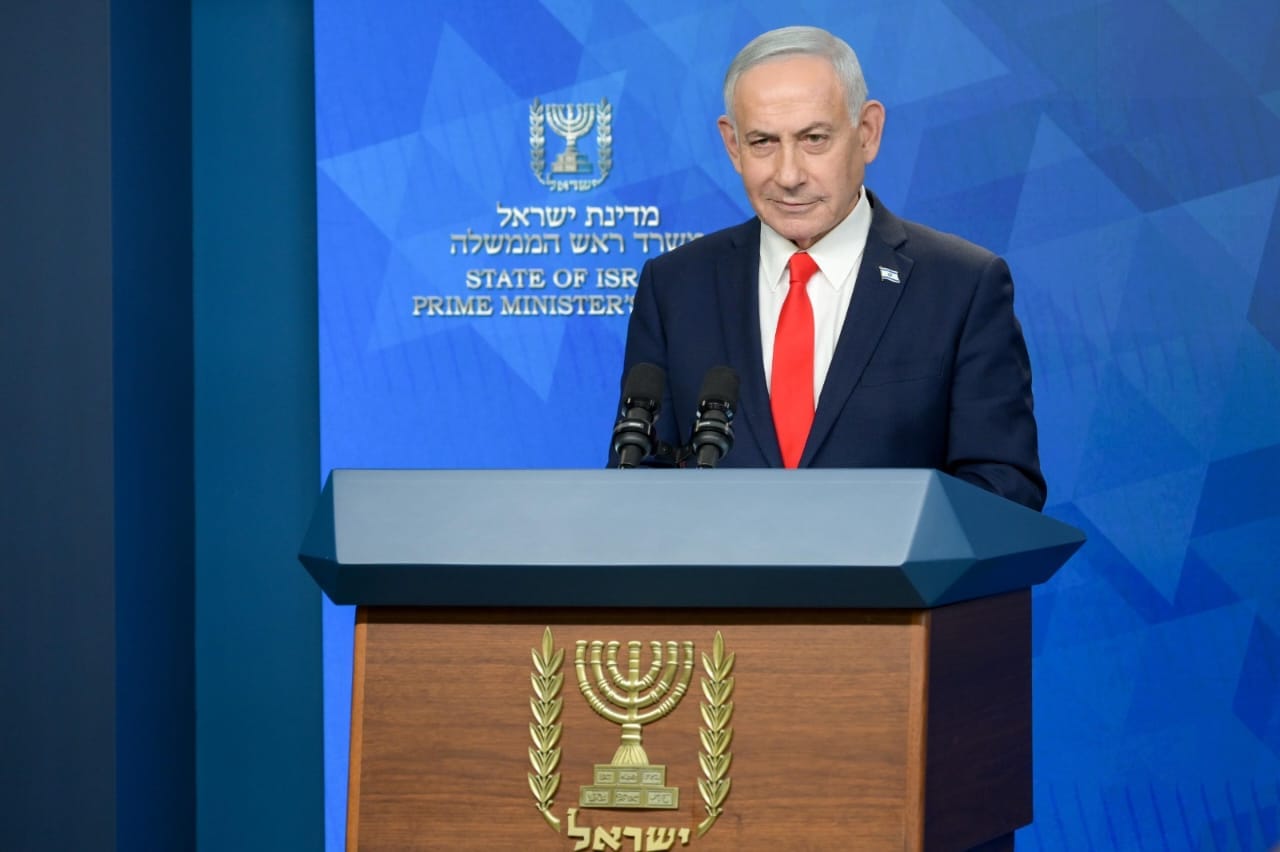
JERUSALEM — Appearing before a nation exhausted by years of compounding conflict, Prime Minister Benjamin Netanyahu stood at a press podium last night to declare that his lifelong mission had been achieved.
In a sweeping, triumphant address, he detailed a sequence of unprecedented military actions that he claimed have fundamentally altered the balance of power in the Middle East,
neutralizing Iran’s nuclear ambitions and shattering its network of regional proxies.
Yet, beneath the triumphalist rhetoric of “total victory” lay a far darker, more sobering subtext. Even as Mr. Netanyahu bragged of a shattered Iran, a liquidated Hamas leadership, and a severely degraded Hezbollah, he warned that “the struggle is not over and done.”
For an Israeli public yearning for a return to normalcy, the Prime Minister offered no exit strategy, no diplomatic horizon, and no blueprint for peace. Instead, he unveiled a new security doctrine of perpetual pre-emption and indefinite military occupation—a vision of a nation destined to live forever by the sword.
The center of Mr. Netanyahu’s speech was a staggering ledger of destruction directed at the “Axis of Evil,” primarily executed through two massive, joint military campaigns with the United States: Operation Rising Lion in June 2025 and the more recent Operation Roaring Lion in early 2026. Working in historic tandem with the Trump administration, Mr. Netanyahu claimed credit for executing the largest offensive air operations in Israel’s history.
”We neutralized nuclear scientists, decapitated the leaders of the terror regime, pulverized nuclear facilities, [and] destroyed missiles,” Mr. Netanyahu boasted, estimating the economic damage to Iran to be “closer to a trillion dollars.”
Turning his attention to regional proxies, the Prime Minister walked through a grim roll call of eliminated adversaries.
He noted the assassinations of Hamas leaders Mohammed Deif, Ismail Haniyeh, and Yahya Sinwar, claiming that “almost everyone” responsible for the horrific October 7, 2023 massacres had been liquidated.
He reminded voters of the sophisticated pager explosions that crippled Hezbollah and the assassination of its long-time chief, Hassan Nasrallah.
Crucially, Mr. Netanyahu claimed what many defense analysts previously deemed impossible: the return of “all our hostages from Gaza, down to the very last one.”
He used this achievement to settle domestic political scores, mocking the military consensus and political rivals who had urged him to bypass Rafah or accept a premature ceasefire. “I did not accept this nonsense,” he said defiantly.
To understand how Israel arrived at this point requires looking back at the strategic shifts of the past three years. For decades, Israel’s security establishment operated under a doctrine of deterrence and containment—managing conflicts with Hamas and Hezbollah while fighting a “shadow war” of covert sabotage against Iran’s nuclear program.
That doctrine dissolved on October 7, 2023. The intelligence failures of that day shattered the illusion of security and hardened Mr. Netanyahu’s resolve to shift from assessing an enemy’s intentions to completely destroying their capabilities.
When the conflict burst into open, conventional warfare between states during the “Twelve-Day War” of June 2025 (Operation Rising Lion), Israel and the U.S. launched hundreds of combat aircraft to decimate Iran’s air defenses and strike the Natanz, Isfahan, and Fordow nuclear complexes.

When Tehran attempted a rapid recovery—accelerating underground nuclear enrichment and rebuilding its ballistic missile stockpile—Mr. Netanyahu and President Trump responded with Operation Roaring Lion in early 2026, establishing total control over Iranian airspace.
Simultaneously, the geopolitical landscape fractured.
In Syria, Israeli forces took advantage of regional chaos to systematically dismantle the military apparatus of the Assad regime, which Mr. Netanyahu described as a “central link in the Axis of Evil.”
The Reality of the “Security Zones”
While Mr. Netanyahu frames these achievements as a miraculous defense of the state, critics inside and outside Israel see a recipe for permanent entanglement.
The Prime Minister confirmed that Israel has established deep, unilateral “security zones” inside Gaza, southern Lebanon, and Syria.
”We will remain in the security zones for as long as it is required to defend our country,” Mr. Netanyahu stated, drawing a hard line against any future Palestinian sovereignty or international peacekeeping forces.
By declaring that Israeli troops will permanently stand as a physical barrier on and beyond the nation’s borders, Mr. Netanyahu is formalizing an status of endless occupation.
The cost of maintaining this posture is already reflected in his announcement of a staggering 350 billion NIS (approximately $95 billion USD) supplement to the defense budget, aimed at securing “domestic armament independence.”
Critics argue that this budget expansion will come at the direct expense of Israel’s civilian economy, social services, and long-term economic stability.
Furthermore, by binding Israel’s strategic fortunes entirely to the political alignment of the Trump administration, Israel risks deep bipartisan alienation in Washington when the political tides inevitably turn.
Mr. Netanyahu closed his address with a mixture of religious nationalism and martial pride, quoting the Prophet Jeremiah: “Fear not, O Jacob My servant, and be not dismayed, O Israel!”
He asserted that alliances are only made with the strong, and that Israel’s raw military might is the sole key to its future.
But military dominance is not a political solution. By choosing to “break the barrier of fear” solely through kinetic force, Israel has isolated itself from traditional Western allies, incurred severe international legal scrutiny, and left itself surrounded by vacuum states—shattered regions in Gaza, Lebanon, and Syria where radicalism can easily reconstitute in the absence of a diplomatic alternative.
Mr. Netanyahu’s speech was designed to project absolute strength and vindication. Instead, it revealed the tragic paradox of modern Israel: a nation capable of achieving the most staggering tactical victories imaginable, yet led by a government entirely incapable of turning those victories into a lasting peace.
For the citizens of Israel, the Prime Minister’s message was clear: you have been saved from annihilation today, so that you may prepare to fight again tomorrow.
