

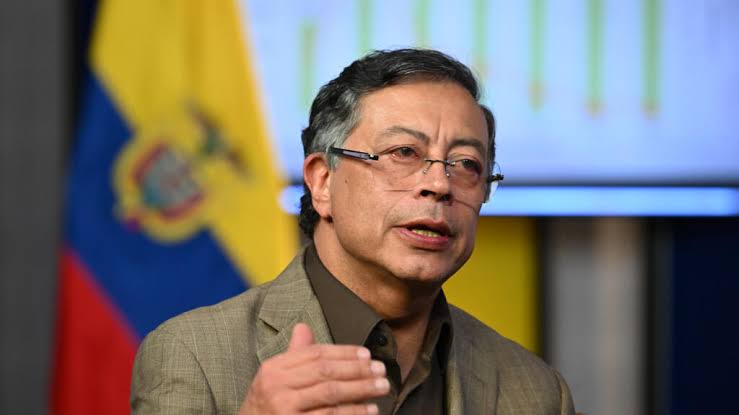
A house committee cited illegal political interference by the leftist leader ahead of a critical June 21 runoff, drawing sharp legal challenges
By SCM Foreign Desk
BOGOTA, Colombia — In a move that has plunged Colombia into an unprecedented constitutional crisis, a legislative investigative body on Wednesday ordered the temporary suspension of President Gustavo Petro from his executive duties.
The extraordinary directive, issued by the House of Representatives’ Commission of Investigation and Accusation, orders the leftist leader stripped of his presidential powers until June 21, 2026.
The decision has immediately ignited a fierce legal and political battle over the limits of executive power and the authority of Congress just days before the country votes in a pivotal presidential runoff election.
The head of the commission, Representative Gloria Arizabaleta, signed the order citing an urgent “precautionary measure.” According to the commission’s ruling, the suspension is tied to an ongoing investigation into allegations that Mr. Petro illegally used his office to interfere in the current electoral cycle.
Investigators focused heavily on a barrage of public statements and posts made by Mr. Petro on the social media platform X between June 6 and June 9, arguing that the president’s rhetoric threatened the impartiality of the upcoming vote.
Under Colombian law, public officials are bound by strict constitutional mandates of political neutrality and are barred from using their official positions to influence electoral contests.
The suspension has thrown the nation’s capital into confusion, with legal scholars and politicians fiercely debating whether a legislative committee has the constitutional authority to unilaterally sideline a sitting head of state.
Critics and constitutional experts quickly pointed out that while the Commission of Investigation and Accusation is tasked with probing high-ranking officials, the Colombian Constitution generally dictates that any formal sanction or suspension of a president requires a vote by the full congressional body or the Senate.
”This is a full constitutional crisis unfolding in real time,” said one Bogota-based legal analyst. “We are seeing an investigative body act as judge and jury to suspend a sitting president, creating a profound conflict between the branches of government.”

The dramatic showdown marks a turbulent climax to the final weeks of Mr. Petro’s four-year term. As Colombia’s first elected leftist president, Mr. Petro’s tenure has been defined by polarizing ambitious reform agendas, strained institutional relationships, and a highly combative relationship with the press and opposition.
The suspension comes at an intensely volatile moment, directly preceding the June 21 presidential runoff election to determine Mr. Petro’s successor.
The race features a deeply divided electorate, pitting Mr. Petro’s chosen progressive successor, Iván Cepeda of the Pacto Histórico coalition, against conservative rival Abelardo de la Espriella.
Tensions reached a boiling point in recent days following a series of highly controversial public statements by the president. Over the weekend, Mr. Petro drew sharp domestic and international condemnation after using a Nazi slogan on social media to strike back at a newspaper op-ed that had endorsed the right-wing candidate, Mr. De la Espriella.
While Mr. Petro defended the remarks as a critique of what he labeled “fascist phrases” in the op-ed, the incident drew formal rebukes from diplomatic allies and international bodies, further isolating his administration.
Simultaneously, the opposition has accused Mr. Petro of abusing his platform to actively campaign for Mr. Cepeda. Late last month, presidential candidate Claudia López filed a formal 58-page complaint with the legislature, alleging a blatant lack of electoral guarantees and aggressive executive overreach.
Historically, the Commission of Investigation and Accusation has been widely dismissed by Colombians as toothless, often derided as the “Commission of Acquittals” because its highly politicized, partisan gridlock rarely results in actual sanctions against sitting presidents. However, the decision by Ms. Arizabaleta to bypass standard delays and enforce a temporary suspension through June 21—the exact date of the election—signals a aggressive new front in Colombia’s institutional warfare.
As of late Wednesday, the Petro administration had not issued a formal response regarding whether the president would comply with the order or challenge its legal validity in court.
With the presidential election less than two weeks away, the standoff threatens to fundamentally destabilize the democratic transition of power in one of Washington’s closest geopolitical allies in Latin America.
