

By SCM Correspondent
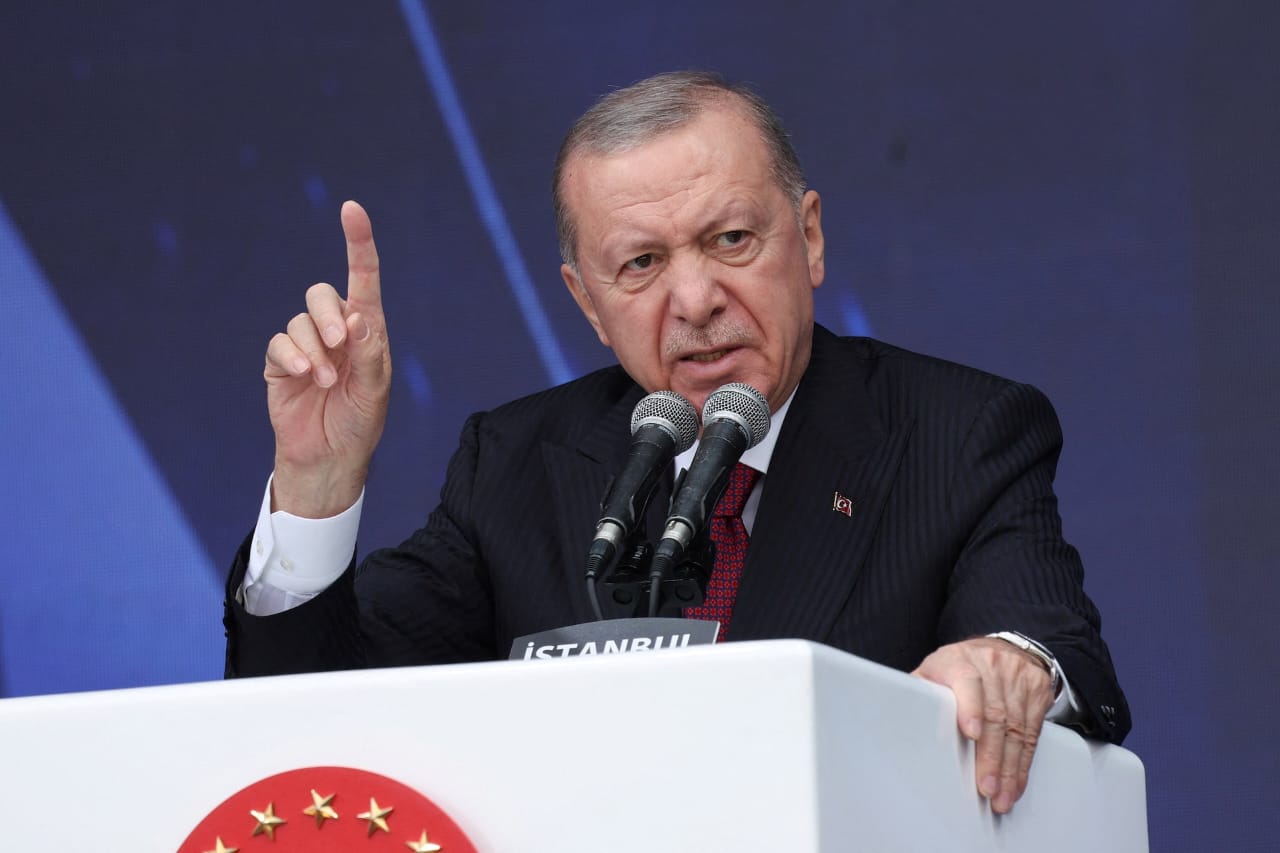
ISTANBUL — Turkish President Recep Tayyip Erdoğan issued a sharp warning on Wednesday, declaring that Israel’s ongoing military campaigns in Syria and Lebanon have breached regional boundaries and now pose a “direct threat” to the national security of Turkey.
Speaking to lawmakers in Ankara, Mr. Erdoğan framed Israel’s military strategy as an uncontained hazard to global stability, labeling the country an obstacle to peace.
His remarks mark a significant escalation in rhetoric, explicitly linking Turkey’s own defense to the territorial integrity of its war-torn southern neighbors.
”The Israeli regime has crossed all boundaries and has become a threat to the entire world,” Mr. Erdoğan said, adding that Turkey cannot afford to look the away.
“Israel’s attacks on Syria and Lebanon have reached a point where they now also constitute a threat to Turkey. If Israel’s banditry is not stopped, the entire world, together with the region, will bear the consequences.”
The Turkish president emphasized that both Syria and Lebanon are “vital” to Turkey’s security architecture.
The remarks underscore a deepening anxiety in Ankara that the multi-front conflict involving Israel, Iran-backed proxy networks, and regional state actors could spill across the Turkish border, complicating an already delicate security matrix in northern Syria.
The diplomatic friction has been compounded by broader regional negotiations. Turkish Foreign Minister Hakan Fidan recently noted that Israel is actively working behind the scenes to derail ongoing diplomatic talks between the United States and Iran.
According to Mr. Fidan, Israeli leadership views any potential Washington-Tehran accord in its current form as detrimental to its strategic interests, driving it to actively sabotage the negotiation process.

The comments drew a swift, vitriolic response from Jerusalem. Israeli Prime Minister Benjamin Netanyahu fired back, calling the Turkish leader an “antisemitic dictator” and dismissing his right to criticize Israel. Mr. Netanyahu maintained that the Israel Defense Forces would continue to act decisively against Iran and its regional proxies.
As the war of words escalates, diplomatic channels between the two historic regional powers remain frozen, with little indication that either side is prepared to de-escalate.
1. The Collapse of the Turkey-Israel Alliance
Turkey was historically the first Muslim-majority nation to recognize Israel (in 1949), and the two countries enjoyed a robust military and economic partnership throughout the 1990s.
However, relations deteriorated sharply under Erdoğan’s Justice and Development Party (AKP). The relationship collapsed entirely following the outbreak of the Gaza war in October 2023.
Turkey has since halted all trade with Israel, backed South Africa’s genocide case against Israel at the International Court of Justice, and openly defended the political wing of Hamas, which Ankara views as a liberation movement rather than a terrorist organization.
2. The Strategic Balance in Syria and Lebanon
Turkey shares a volatile 560-mile border with Syria. Following years of civil war and the recent overthrow of the Assad regime, Turkey maintains a significant military footprint in northern Syria to counter Kurdish militias (such as the YPG) and manage refugee flows.
When Israel strikes targets inside Syria or moves against Hezbollah in Lebanon, it directly threatens the fragile spheres of influence that Turkey has negotiated with other regional powerbrokers. Erdoğan’s assertion that Turkey’s security “extends to Aleppo, Damascus, and Beirut” reflects Ankara’s long-standing view that any power vacuum or escalation on its southern flank presents an existential threat.
3. The Eastern Mediterranean Matrix
Erdoğan’s warning also touches on maritime anxieties. Turkey has long been locked in a geopolitical dispute over resource rights and territorial boundaries in the Eastern Mediterranean with Greece and Cyprus. Recent defense discussions regarding an emerging “strategic depth” alignment between Israel, Greece, and Cyprus have alarmed Ankara.
By framing Israel as a regional “bandit,” Erdoğan is signaling to smaller Mediterranean actors that aligning too closely with Israeli military policy carries severe geopolitical risks.
Erdogan
