

By SCM Reporter
An ordinary afternoon in a Moscow suburb nearly turned into an unimaginable tragedy for one young family this week. A two-year-old boy is recovering in a Russian hospital after managing to lodge an open safety pin deep inside his nasal cavity—sparking a frantic, high-stakes medical emergency that has left doctors issuing an urgent warning to parents worldwide.
The drama began when the adventurous toddler, whose identity has been withheld by authorities, found the stray sewing item. With the lightning-fast speed known all too well by parents of two-year-olds, the boy curiously shoved the metal pin directly up his right nostril.
The Fatal Mistake: ‘We Thought We Could Get It Out’
Realizing what had happened, the boy’s panicked parents initially attempted to extract the object themselves using household tweezers. It was a well-intentioned decision that almost proved fatal.
Instead of dislodging the metal, the parents’ frantic pulling caused the spring-loaded safety pin to snap completely open inside the toddler’s narrow nasal passage. The sharp, exposed point punctured the delicate internal tissue, triggering sudden and heavy bleeding.
Recognizing they were wildly out of their depth as their son screamed in agony and blood began to pour, the terrified parents abandoned their efforts and phoned for an emergency ambulance.
The toddler was rushed to a leading pediatric hospital in Moscow, where a specialized team of ear, nose, and throat (ENT) surgeons was waiting.

”When the patient arrived, he was highly distressed, and the bleeding was significant,” said one of the attending pediatric surgeons.
“The real danger wasn’t just the bleeding, but the placement. With an open pin, one wrong move can tear a major blood vessel, or worse, the child could inhale sharply and lodge the sharp metal directly into his windpipe or lungs.”
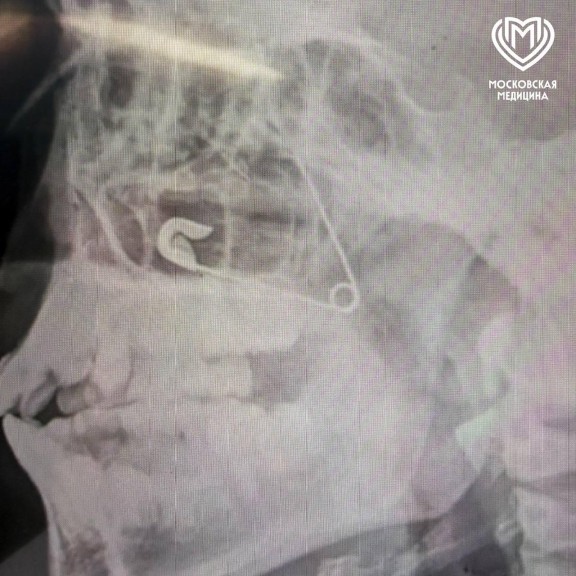
Medical staff immediately ordered emergency X-rays to locate the exact positioning of the pin. The imaging revealed a terrifying sight: the sharp end of the pin was wedged firmly into the mucous membrane, pointing upwards toward the sinus cavity.
Undergoing emergency surgery under general anesthesia, doctors used specialized endoscopic cameras and micro-forceps to carefully compress the open pin, unhook it from the torn flesh, and extract it without causing further internal lacerations.
