

By SCM Staff Writer
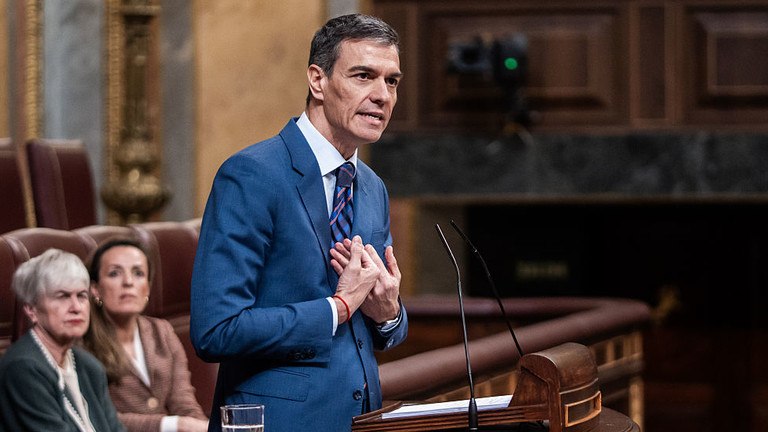
MADRID — Spanish Prime Minister Pedro Sánchez on Wednesday directly challenged Washington’s use of financial warfare against international judicial institutions, formally requesting that the European Commission activate a rarely used legal shield to protect European entities and individuals from United States sanctions targeting the International Criminal Court (I.C.C.).
In a sharply worded letter to European Commission President Ursula von der Leyen, Mr. Sánchez argued that the European Union could no longer passively witness American attempts to penalize judicial officers investigating alleged war crimes in Gaza.
”The E.U. cannot remain idle in the face of this persecution,” Mr. Sánchez declared in a statement published on social media, framing the request as a vital defense of global multilateralism and the rule of law.
The extraordinary appeal marks a significant escalation in the diplomatic fallout over the Israel-Hamas war, threatening to widen a volatile transatlantic rift between Washington and its European allies regarding international accountability and the limits of state sovereignty.
The mechanism requested by Spain—the E.U.’s Blocking Statute—was originally created in 1996 to neutralize the extraterritorial effects of U.S. laws, such as Washington’s trade embargoes on Cuba and sanctions against Iran.
The statute works by forbidding E.U. citizens and companies from complying with specified foreign sanctions regimes, allowing them to recover damages resulting from those sanctions, and nullifying the effect of any foreign court rulings based on them within Europe.
While historically deployed to protect European commercial and economic interests, Mr. Sánchez is urging Brussels to adapt the statute into a broader geopolitical armor. The Spanish government explicitly requested that the measure be expanded to shield I.C.C. judges and prosecutors, as well as Francesca Albanese, the United Nations Special Rapporteur for the Palestinian territories, from aggressive financial and travel restrictions imposed by Washington.
The U.S. measures, which include frozen bank accounts, restrictions on financial transactions, and sweeping travel bans, have severely complicated the day-to-day operations of international jurists. Spain contends these penalties strike at the core of judicial independence.
The legal warfare between Washington and The Hague traces back to early 2025, when President Donald J. Trump issued Executive Order 14203. The executive order leveled severe economic sanctions against the I.C.C. following the court’s issuance of arrest warrants for senior Israeli officials—including Prime Minister Benjamin Netanyahu and former Defense Minister Yoav Gallant—alleging war crimes and crimes against humanity during Israel’s military campaign in Gaza.

The U.S., which is not a party to the Rome Statute that established the I.C.C., fiercely rejected the court’s jurisdiction, characterizing the warrants as “illegitimate and baseless” assaults on a democratic ally. Israel has consistently denied wrongdoing, asserting its military operations strictly adhere to international humanitarian law.
However, Washington’s punitive counter-strategy has triggered severe blowback from international bodies. United Nations experts and human rights organizations have repeatedly warned that targeting justice personnel sets a dangerous precedent.
By early 2026, the number of sanctioned I.C.C. prosecutors and judges had climbed to 11, drawing intense condemnation from global legal observers who warned that the sanctions send a “chilling message” to victims of atrocities worldwide.
Spain’s aggressive stance underscores a deep, unresolved fracture within the European Union regarding the conflict in the Middle East.
While countries like Spain, Ireland, and Belgium have taken a hard line against Israeli military actions—including formally recognizing Palestinian statehood—other powerful member states, such as Germany, remain highly cautious about taking actions that openly undermine Israel or alienate the United States.
For the European Commission to activate or amend the Blocking Statute, it would require broad consensus among member states, a prospect that legal analysts say faces steep political hurdles in Brussels.
Even if the E.U. leadership hesitates to implement the statute, Mr. Sánchez’s move signals that European patience with Washington’s extraterritorial leverage is wearing thin.
By forcing a debate on whether Europe will tolerate American penalties against international judges on European soil, Madrid has ensured that the battle over international justice will now be fought not just in The Hague, but in the heart of the Western alliance.
