

By SCM Correspondent l June 3, 2026
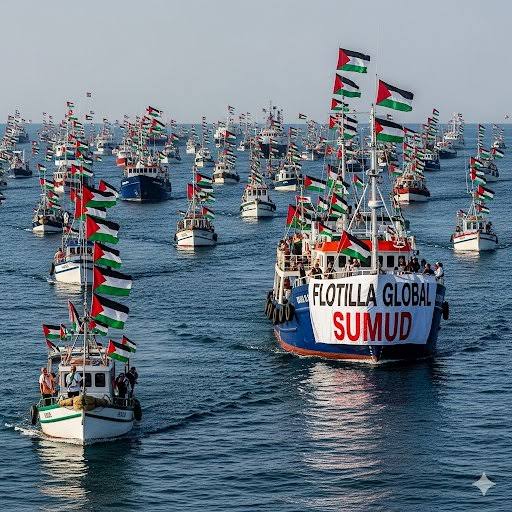
TUNIS, Tunisia — Ten unarmed humanitarian volunteers, part of the Global Sumud Flotilla seeking to deliver life-saving aid to the Gaza Strip have been detained in neighboring Libya for nearly two weeks, sparkng a multi-national diplomatic scramble and a high-stakes hunger strike.
The volunteers, part of the Global Sumud Land Convoy, have now been held for ten days under what organizers describe as “arbitrary detention.” On Tuesday, Libyan authorities reportedly extended their detention for an additional ten days, offering no public justification for the decision.
In protest of their confinement, the detainees—who include doctors, a journalist, and prominent human rights defenders—entered the fourth day of a hunger strike on Wednesday, raising urgent health concerns among their families and advocacy groups.
According to representatives of the convoy, the team was in Libya to negotiate safe transit and logistical passage for an aid shipment destined for the blockaded Gaza Strip.
The crisis is rapidly escalating into a complex diplomatic headache, involving citizens from at least eight nations across Europe, North America, and South America. The Global Sumud Land Convoy has issued an urgent directive calling on the governments of Spain, Poland, the United States, Argentina, Uruguay, Portugal, Tunisia, and Italy to intervene immediately.
”They are doctors and human rights defenders, not political actors,” said a spokesperson for the campaign in a statement released early Wednesday.
“They were negotiating safe passage for life-saving aid. To detain them is an affront to international humanitarian law.”
The State Department and corresponding foreign ministries in Madrid, Warsaw, and Buenos Aires said they were aware of reports of detained citizens in Libya and were actively seeking clarification, though none have yet released formal diplomatic protests.
Libya’s fragmented internal security architecture has long made it a highly volatile environment for international NGOs. The country remains split between competing administrations in the east and west, with various localized militias exercising de facto control over regional transit hubs and border checkpoints.

It remains unclear which specific faction or security agency within Libya is currently holding the volunteers, or where exactly they are being housed.
To properly background this story for readers, The New York Times would integrate the following crucial context to explain why this situation is occurring:
The Humanitarian Bottleneck to Gaza
Since the escalation of the conflict in Gaza, traditional aid routes via the Rafah crossing in Egypt and various Israeli-controlled terminals have faced severe bottlenecks, security threats, and bureaucratic delays.
International civil society groups have increasingly turned to creative, alternative overland and maritime routes—such as transiting through North Africa—to bypass gridlocked border points, despite the immense geopolitical risks.
Libya has been locked in unstable political transitions for over a decade. The country is broadly split between the UN-recognized Government of National Unity (GNU) in Tripoli (west) and the Libyan National Army (LNA) controlled by Field Marshal Khalifa Haftar in Benghazi (east).
Navigating these territories requires highly sensitive, fragmented negotiations with local warlords and security apparatuses. Detentions of foreign nationals are frequently used by local factions to exert leverage or display sovereign authority to international bodies.
The convoy’s name utilizes the Arabic term Sumud (صمود), which translates to “steadfastness” or “resolute perseverance.” It is a central cultural concept and political term used by Palestinians to describe their connection to the land and resistance against displacement.
Using this branding indicates that the convoy is closely aligned with Palestinian solidarity movements, a factor that likely complicated their security clearance with conservative or transactional security factions inside Libya.
