

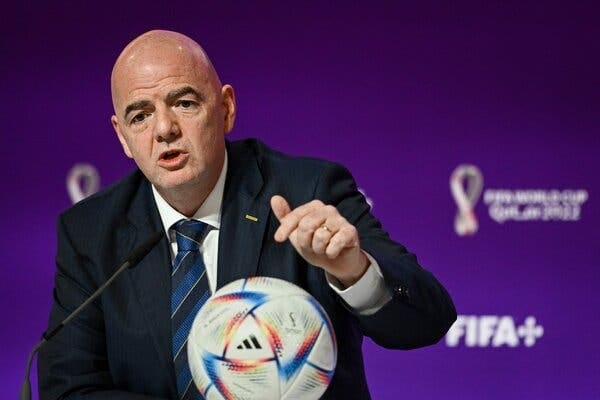
By SCM Sports Desk I July 30, 2026
GENEVA — European soccer’s governing body delivered a seismic ultimatum to FIFA on Thursday, unanimously voting to boycott all future FIFA competitions—including the World Cup—if global soccer president Gianni Infantino proceeds with plans to sell off a minority ownership stake in the tournament to private equity investors.
Following an emergency online meeting of UEFA’s 55 member associations, European soccer officials voted 55–0 to reject the proposal, putting the sport’s premier event in existential jeopardy. The boycott threat marks the most severe fracture in international sports governance in decades, pitting Europe’s billionaire clubs and marquee national teams directly against FIFA’s leadership.
“No UEFA national teams will participate in any FIFA competition for so long as these proposals remain alive,” UEFA said in an unprecedented statement released shortly after the vote. “The World Cup cannot be treated as an investment product. It is one of football’s greatest sporting legacies. No part of it should ever be surrendered to private investors. The World Cup is not for sale.”
A Secret $20 Billion Plan Sparks Mutiny
The crisis erupted earlier this week after details leaked of a secret commercial restructuring orchestrated by Mr. Infantino. Under the plan, FIFA intended to spin off its global commercial operations into a newly created subsidiary valued at roughly $20 billion. FIFA proposed selling a 20 percent non-controlling stake in the entity to private equity firms, raising an estimated $4 billion in immediate cash.
Among the prospective anchor investors is Thrive Capital, a New York investment firm founded by Joshua Kushner. Wall Street giant JPMorgan Chase was reportedly retained to advise on the deal structure.

To win over global support, Mr. Infantino issued an ultimatum to FIFA’s 211 member federations, giving them until Sept. 19 to sign off on the deal. In exchange, each member association was promised a one-time windfall of $20 million, with potential total funding packages reaching $40 million per country over the next four-year cycle.
While many smaller federations across Africa, Asia, and Oceania rely heavily on FIFA disbursements to finance grassroots operations, European leaders blasted the financial incentive as leverage designed to push through a permanent surrender of the sport’s public custodian role.
“Fifa cannot continue to use our sport to enrich themselves and their friends,” UEFA said in a scathing statement leading up to Thursday’s vote. “The moment external investors acquire ownership interests in FIFA competitions, football changes forever. Commercial return becomes a permanent obligation.”
High-Stakes Geopolitics in Global Sports
The battle reflects a longstanding tension between FIFA and European soccer leaders over financial control, calendar congestion, and commercial expansion.
If European nations hold firm on their boycott threat, the immediate fallout would shatter upcoming global tournaments, beginning with the 2027 FIFA Women’s World Cup. A World Cup lacking European powerhouses like England, France, Spain, Germany, and Italy would gut the tournament’s broadcast value and alienate major global sponsors. Wall Street analysts noted Thursday that private investors would likely withdraw their capital commitments if Europe refuses to field its teams.
The controversy has also drawn scrutiny toward the governance of Mr. Infantino, who served as UEFA’s general secretary before rising to the FIFA presidency in 2016 on a platform of transparency. Key stakeholders—including England’s Football Association—expressed outrage over being kept entirely in the dark regarding negotiations with American investment groups.
FIFA officials maintained that the proposed entity would only handle commercial execution—such as sponsorships, licensing, and broadcast rights—while FIFA would retain total governance over sporting rules, tournament formats, and match calendars. In letters sent to federations, Mr. Infantino framed the deal as a “singular and unique funding opportunity” to level the playing field for developing soccer nations worldwide.
However, with 55 European member nations standing in total opposition, Mr. Infantino now faces the steepest political challenge of his decade-long presidency. Without a dramatic reversal before the September deadline, global soccer appears headed toward an historic standoff.
