

By SCM International Desk I Thursday, Sept 10, 2026
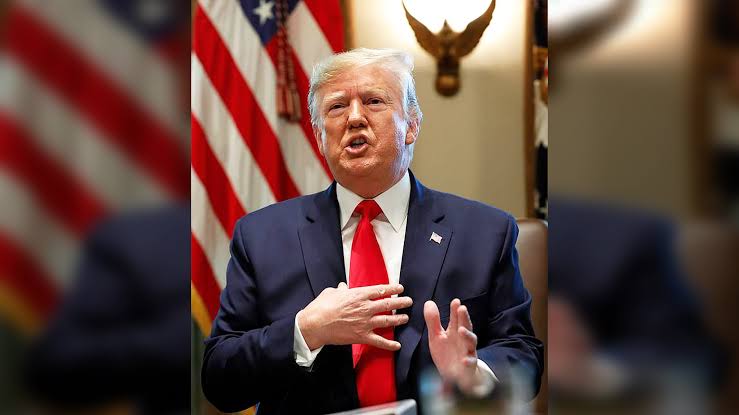
DALLAS — In an unprecedented move to shore up his party’s flagging electoral fortunes ahead of November’s midterms, President Donald J. Trump promised on Wednesday night to give a $5,000 direct payout to every adult citizen in the United States — provided voters deliver Republicans full control of Congress.
Speaking before a raucous crowd at the Republican National Committee’s midterm convention in Dallas, Mr. Trump framed the staggering cash incentive, which he dubbed the “Trump Dividend,” as a shareholder distribution derived from the nation’s economic output.
“Because of our tremendous strength and success economically, I will issue a dividend to every adult citizen in the United States of America for $5,000,” Mr. Trump said, framing the financial enticement as conditional on GOP victories. “If the Republicans win, you win with us and you get $5,000.”
Pivotally pairing the massive wealth-redistribution pledge with intense ideological attacks, the president sought to sharpen the contrast between his party and the opposition, framing the high-stakes election in existential terms.
“America is NOT FOR SALE — and we do NOT negotiate with Communists, Socialists, or Radical Left LUNATICS,” Mr. Trump declared to thunderous applause, employing his signature rhetoric to lump moderate and progressive opponents into a single ideological enemy.
If enacted, the proposal would carry an extraordinary price tag, easily exceeding $1 trillion. White House officials did not immediately provide details on how the payout would be financed or administered, though Vice President JD Vance suggested in subsequent television appearances that tariff revenues could cover the cost.
However, policy experts and fiscal conservatives were quick to point out that total U.S. tariff revenue falls drastically short of the needed funds, particularly after recent Supreme Court rulings struck down several of the administration’s broader protectionist trade measures.
The proposal faces massive legislative hurdles. Direct cash payments require congressional authorization and appropriation, meaning Mr. Trump cannot unilaterally issue checks via executive decree. With the national debt topping $40 trillion and annual deficits nearing $1.8 trillion, deficit hawks on Capitol Hill — including several within the president’s own party — expressed immediate skepticism over injecting another massive wave of stimulus into the economy.
Economists also warned that floating $5,000 checks to roughly 260 million adults could re-ignite consumer inflation, undermining the very economic stability the president claimed as the basis for the payout.

The proposal comes as Republicans face severe headwinds entering the stretch run of the campaign season. Historically, the party occupying the White House routinely loses congressional seats during midterm elections. Republicans currently defend a paper-thin majority in the House and face increasingly tight races in key Senate battlegrounds.
Facing lukewarm approval ratings and persistent voter anxiety over inflation and foreign policy conflicts, Mr. Trump has resorted to unconventional methods to motivate his political base. The $5,000 pledge echoes smaller targeted payouts during his administration — such as executive actions granting $1,776 checks to military members — but vastly scales up the financial stake.
Critically, the transaction-style pledge is accompanied by a sharp escalation in political branding. By declaring that “America is not for sale” while simultaneously conditioning government payouts on political turnout, the president is leveraging both economic populism and Cold War-era red-scare language.
Political analysts note that applying labels like “Communists” and “Socialists” to political rivals has become a central pillar of Mr. Trump’s campaign messaging, serving to energize core supporters and portray the upcoming midterms not merely as a policy choice, but as a defense of American capitalism.
Democrats were swift to denounce the pledge, characterizing it as a blatant attempt to buy votes with taxpayer money that the government does not have.
”This is an act of political desperation from a president who knows his party is on the verge of losing Congress,” said Representative Hakeem Jeffries of New York, the House Democratic Leader, in a statement.
“Promising fantasy cash payouts contingent on an election outcome crosses every line of ethical governance.”
Despite the immediate political pushback and legal ambiguity, some key GOP allies signaled eagerness to run on the pledge. Senator Bernie Moreno, Republican of Ohio, took to social media late Wednesday night to affirm support, writing that he would prepare legislation to pass the “Trump Dividend” immediately following the election.
Whether the promise of a direct financial windfall will outweigh voters’ broader economic concerns remains to be seen as both parties gear up for the final weeks before Election Day.
