



By SCM Staff Writer I Tuesday, October 14, 2025
FREETOWN, Sierra Leone – As surgical teams aboard the floating hospital of Mercy Ships perform complex operations across Africa, one volunteer’s meticulous work ensures the safety of every patient.
His name is Frank Seibure, and his dedication to the often-unseen field of sterile processing has become a cornerstone of the ship’s life-saving mission.
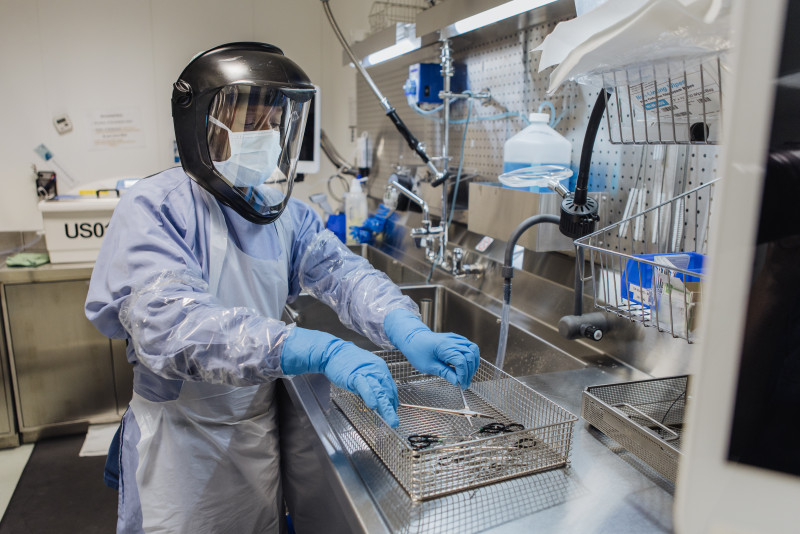
Seibure’s commitment is being highlighted this week during Sterile Processing Week, whose theme, “Serving with a purpose,” perfectly encapsulates his journey. Sterile processing is frequently called the “heart of the hospital” because any failure in the procedure — the cleaning, sterilization, and preparation of surgical instruments — can have devastating consequences for patients.
“If instruments aren’t properly sterilized, patients can end up with more complications than they came in with,” Seibure explained. His work ensures that every scalpel, clamp, and tray is sterile and ready, directly protecting patients and supporting the critical surgical missions.
Seibure’s path to this specialized field is one of profound purpose. Before donning scrubs, he was a young human rights advocate in his native Sierra Leone, driven by the harsh realities of civil war he witnessed as a child. That calling to serve humanity eventually led him to Mercy Ships in 2011.
He started with no experience, joining the ship’s day crew in sterile processing. Driven by a deep passion to help, he embraced the rigorous training, quickly rising through the ranks to become a full volunteer crew member and, later, a Certified Healthcare Leader in Sterile Processing.
“My biggest driving force is to make an impact on society, help those in need, and serve humanity,” Seibure shared.
The complexity of his work is often misunderstood. Contrary to popular assumptions, sterile processing is not merely about washing tools; it is a knowledge-intensive discipline that integrates both life science and engineering.
This high-demand specialization is facing a growing crisis, according to a recent report from Surgical Directions, Unseen but essential: the knowledge demands and staffing crisis in sterile processing. The report revealed a growing patient safety risk linked to chronic staffing shortages and underinvestment in these critical hospital departments.
Beyond his clinical duties aboard the hospital ship, Seibure has found a passion for training.
He finds joy in passing on his specialized knowledge to new volunteers and local healthcare professionals across the continent, many of whom have gone on to become leaders in the field.
“The highlight of my time with Mercy Ships is that I’ve trained many young people to become sterile processing technicians,” Seibure said, underscoring how his impact has rippled across nations.
Through his service, he continues to learn from the rich, international mix of cultures on board, enhancing his natural leadership qualities and reinforcing his commitment to serving others.