

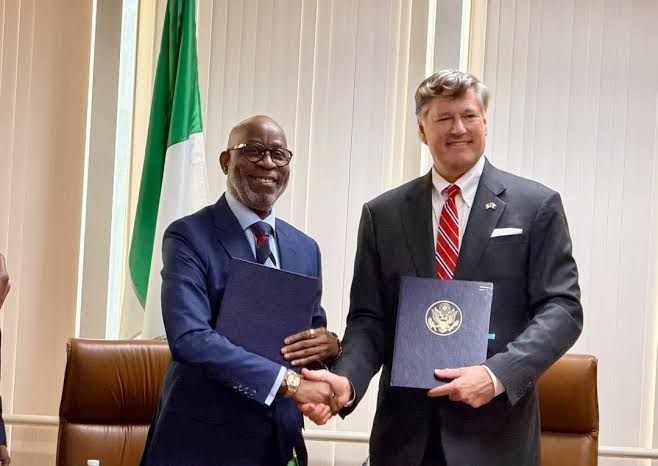
Signing a major bilateral Memorandum of Understanding (MoU) with the world’s largest economy without immediate public availability of its terms risks repeating those historical mistakes.While the Ministry of Solid Minerals Development has assured the public that the framework prioritizes local value addition over raw material exportation, verbal assurances cannot substitute for legal scrutiny. The public, host communities, local industrial players, and civil society must be able to read the fine print.
LAGOS – Nigeria’s solid minerals sector has long hovered in the shadow of crude oil—a vast, underused frontier of economic promise. With global energy transitions placing lithium, rare earth elements, and cobalt at the center of modern geopolitics, Nigeria finds itself holding a high-stakes winning ticket, with unexploited mineral wealth estimated at over $700 billion.
It is against this background that the recent Critical Minerals Framework Agreement between Nigeria and the United States was hailed by government officials as a historic breakthrough.
However, a critical question remains: What exactly did Nigeria sign?
The decision by Lawyers for Civil Liberties to file a Freedom of Information (FOI) request before the Attorney-General of the Federation (AGF) and the Minister of Solid Minerals Development is not merely a routine legal gesture. It is a vital intervention in constitutional governance, resource rights, and institutional accountability.
1. The Pitfalls of Secret Bilateral Agreements
Historically, Nigeria’s major natural resource agreements—particularly in the oil and gas sector—have been plagued by secret negotiations, vague concession terms, and opaque tax concessions.
Decades of non-disclosure left host communities impoverished, environmental degradation unaddressed, and the Nigerian state with questionable revenues while foreign conglomerates extracted immense value.

Signing a major bilateral Memorandum of Understanding (MoU) with the world’s largest economy without immediate public availability of its terms risks repeating those historical mistakes.
While the Ministry of Solid Minerals Development has assured the public that the framework prioritizes local value addition over raw material exportation, verbal assurances cannot substitute for legal scrutiny. The public, host communities, local industrial players, and civil society must be able to read the fine print.
2. The Legal and Statutory Imperative
Under the Freedom of Information (FOI) Act 2011, public access to information held by government institutions is a fundamental right, not a discretionary favor. The FOI Act establishes a mandatory seven-day window for public institutions to process and grant access to requested documents, subject only to strict, legally defined exemptions (such as active national security threats or trade secrets).
A framework agreement governing sovereign mineral assets across dozens of states cannot validly hide behind secrecy claims. Sovereign minerals belong to the citizens of Nigeria, held in trust by the Federal Government. Therefore:
Resource Rights: Citizens have a right to know what royalties, tax breaks, and export conditions were negotiated.
Environmental Safeguards: Mineral extraction, especially open-cast mining for lithium and rare earths, carries significant ecological risks. What binding commitments were made regarding environmental remediation and community restoration?
Local Content Enforcement: Does the agreement contain legally enforceable clauses mandating technology transfer and local processing plants, or are these merely non-binding aspirational statements?
3. Setting a Precedent for the “Renewed Hope” Era
If the Federal Government is committed to building a transparent, investor-friendly, and law-governed economy, the response to this FOI application will be a key test. Proactively releasing the unredacted text of the Nigeria–US Critical Minerals MoU would build public trust, validate the government’s reform agenda, and set a standard for future international agreements.
Refusing or delaying disclosure, on the other hand, will only heighten suspicion, invite public cynicism, and potentially spark litigation that could slow down the very foreign investment the administration seeks to attract.
International partnerships are crucial for modernizing Nigeria’s solid minerals sector. However, development cannot come at the expense of national transparency and democratic oversight.
The AGF and the Minister of Solid Minerals Development should seize this opportunity to demonstrate compliance with the rule of law by promptly making the entire $700 billion Critical Minerals Framework Agreement available for public inspection.
Transparency is not an obstacle to economic growth; it is its strongest foundation.
