

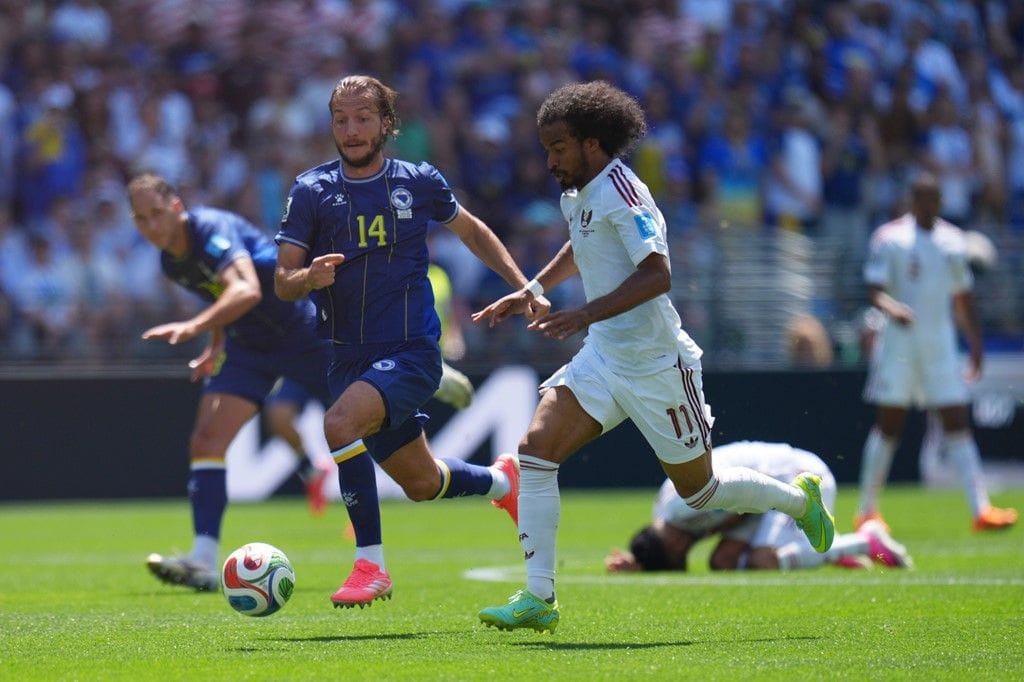
By Our Chief Football Correspondent at Seattle Stadium
The ageless, peerless Edin Džeko may be forty years old, but inside the cauldron of Seattle Stadium, the Bosnian captain rolled back the years to inspire a majestic 3-1 victory over Qatar, keeping his nation’s FIFA World Cup knockout-stage hopes breathing.
On a night filled with high-stakes tension in Group B, it was Bosnia and Herzegovina who displayed the clinical edge, leaving Qatar marooned at the bottom of the table and heading for an early flight home.
This was a classic World Cup battle of survival, and under the brilliant Pacific Northwest afternoon sky, Bosnia’s big-game players rose to the occasion when their country needed them most.
Before kickoff, the narrative surrounding Sergej Barbarez’s side was one of sheer desperation.
Having drawn with Canada and suffered a heavy defeat to Switzerland, the Dragons knew nothing less than three points would suffice. Barbarez opted for a robust, physical four-four-two formation, pairing the iconic Džeko with Ermedin Demirović upfront, flanked by the energetic Esmir Bajraktarević—the young starlet dubbed the ‘Milwaukee Messi’—who finally got to realize his boyhood dream of starting alongside his idol.
Qatar, managed by Julen Lopetegui, lined up in an adventurous four-three-three system, desperate to rectify their own goal-difference nightmare following a six-nil thrashing by Canada.
The match began at a frantic pace, with Qatar attempting to control the tempo through patient, possession-based football.
Midfielders Karim Boudiaf and Ahmed Fathy looked to establish a rhythm, but Bosnia’s midfield duo of Ivan Šunjić and Ivan Bašić refused to yield an inch.
The Europeans constantly threatened from distance, testing Qatari goalkeeper Mahmoud Abunada with a barrage of powerful, long-range efforts. Šunjić forced a smart diving save, while Bašić watched one shot scrape the crossbar and another deflect wide. Bosnia’s aerial dominance was becoming an structural nightmare for the Qatari backline, which struggled to cope with deliveries into the penalty area.
The pressure finally told in the twenty-ninth minute. Stepping up onto the world stage, young star Kerim Alajbegović broke the deadlock with a moment of absolute magic. Collecting the ball outside the box, the forward unleashed a ferocious, bending strike that flew past the outstretched arms of Abunada and nestled perfectly into the back of the net.
The Bosnian contingent in the stadium erupted, and the Dragons had the vital breakthrough they craved.
Smelling blood in the water, Bosnia pressed forward relentlessly. Just five minutes later, the legendary Džeko made his presence felt. A beautifully whipped cross from the left wing found the veteran striker lurking at the back post.
Džeko met the ball with a thunderous volley, driving it back across the six-yard box. In his desperate attempt to clear the danger, Qatari defender Sultan Al-Brake could only look on in horror as the ball deflected off him and trickled over the line for an unfortunate own goal.
It was two-nil, and Bosnia looked out of sight. Džeko nearly put the match completely to bed in the thirty-eighth minute, breaking clean through on a one-on-one opportunity, only to see his powerful shot cannon off the base of the upright.
Yet, Qatar refused to surrender without a fight. In the forty-first minute, just before the halftime whistle, the Asian nation found a lifeline. Capitalizing on a momentary lapse in the Bosnian defense, Sultan Al-Brake partially redeemed himself by flashing a dangerous cross along the six-yard box.

Qatari captain Hassan Al-Haydos reacted quickest, pouncing on the loose ball to tap it home and reduce the deficit to 2-1, breathing life back into the contest before the interval.
The second half began with both managers shuffling their tactical cards. Barbarez introduced Amar Memić and Benjamin Tahirović to solidify his lines, while Lopetegui brought on Abdulaziz Hatem. Qatar chased the equalizer with renewed vigor, and their star man Akram Afif nearly found it in the fifty-seventh minute when he jinked into the penalty area, only to see his powerful effort rattle the side netting.
Moments later, Qatar suffered a devastating blow when goalscorer Al-Haydos was forced to hobble off with a career-threatening injury.
As the clock ticked down, the match dissolved into a tense, physical affair. Referee Jesús Valenzuela had his hands full, eventually booking Qatar’s Ahmed Fathy and Bosnia’s substitute Ermin Mahmić as tempers flared.
The definitive, heartbreaking blow for Qatar arrived in the eightieth minute. Following a chaotic scramble inside the Qatari penalty box, the twenty-one-year-old substitute Mahmić reacted with lightning reflexes, poking the loose ball past Abunada to make it 3-1.
Statistically, the encounter was remarkably balanced, reflecting the frantic, end-to-end nature of the game. Both nations split the possession equally, with each side commanding exactly fifty percent of the ball over the course of the ninety minutes.
However, Bosnia’s efficiency in the final third proved decisive. The Dragons registered a total of fourteen shot attempts, with seven of those finding the target, forcing the Qatari goalkeeper into several crucial interventions.
Conversely, Qatar managed ten total attempts on goal, but only three were on target, illustrating their struggles to penetrate a resolute Bosnian central defense anchored by Nikola Katić and Stjepan Radeljić.
Corner kicks were also telling of Bosnia’s aerial pressure, as they earned six corners compared to Qatar’s four. In terms of discipline, it was a relatively controlled match for the stakes involved, with each side receiving just one yellow card apiece.
When the final whistle blew, the scoreboard read three-one in favor of Bosnia and Herzegovina. The victory secures them three priceless points, moving them into a strong position within the pool of the tournament’s best third-placed teams as they anxiously await the conclusion of the remaining group fixtures to confirm their spot in the Round of 32.
For Qatar, the defeat marks the end of their World Cup journey, but for Džeko and his roaring Dragons, the dream lives on.
