

By SCM Foreign Desk I Tuesday, July 21.2026
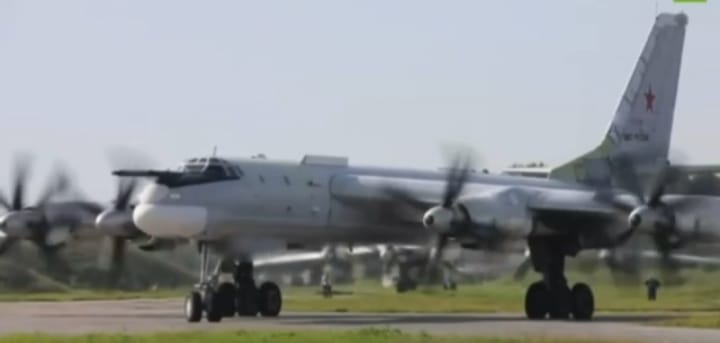
MOSCOW — Russia’s Ministry of Defence announced that two of its Tu-95MS long-range strategic bombers completed an extended 11-hour patrol over the neutral waters of the Sea of Japan. The mission, escorted by high-performance Su-35S and Su-30SM fighter jets, represents Moscow’s latest demonstration of power projection in the Asia-Pacific theater.
According to official military statements, the flight adhered strictly to international airspace regulations and remained within neutral airspace throughout the maneuver.
However, the presence of heavy nuclear-capable platforms near sovereign Allied territories prompted foreign fighter aircraft—including jets from Japan’s Air Self-Defense Force—to scramble and shadow the Russian formation during key legs of the transit.
”Strategic bombers Tu-95MS of the long-range aviation conducted a scheduled flight in the airspace above neutral waters of the Sea of Japan,” the Russian Defence Ministry said in a statement. “During certain segments of the flight, the strategic missile carriers were escorted by foreign fighters.”
Strategic Signaling in the Indo-Pacific
While Moscow routinely classifies such flights as scheduled training exercises, Western defense analysts view the 11-hour mission as a deliberate political and military signal. By deploying long-range strategic assets into East Asia, Russia underscores that its military bandwidth extends far beyond the war in Ukraine, maintaining operational readiness across its Pacific flank.
The Sea of Japan—bordered by Russia, Japan, South Korea, and North Korea—has increasingly become a focal point of geopolitical friction. Tokyo and Seoul have repeatedly raised concerns over Russian and Chinese military activity near their Air Defense Identification Zones (ADIZ). In response to the flight, Japanese defense officials monitored the track closely to ensure sovereign boundaries were preserved.

The patrol comes against a backdrop of deepening security cooperation between the United States and its regional allies. Washington, Tokyo, and Seoul have intensified joint military drills and intelligence-sharing initiatives aimed at countering regional threats, a development Moscow and Beijing have publicly criticized.
Additionally, Russia and China have conducted routine joint strategic air patrols across the Sea of Japan, East China Sea, and Western Pacific, cementing a bilateral defense posture designed to challenge Western primacy in the Indo-Pacific.
The Cold War Workhorse Modernized
Known to NATO by the reporting name “Bear-H,” the Tupolev Tu-95MS is a cornerstone of Russia’s airborne nuclear triad. Though the core design dates back to the Cold War, modern variants deployed by the Russian Aerospace Forces have undergone extensive upgrades. Equipped with updated turboprop engines, advanced navigation suites, and specialized avionics, the Tu-95MS functions primarily as a standoff missile carrier.
The aircraft can launch long-range, air-delivered cruise missiles—such as the conventional Kh-101 and nuclear-capable Kh-102—allowing it to strike targets thousands of kilometers away without approaching enemy air defense umbrellas.
Escorting the bombers during the flight were Sukhoi Su-35S multirole air-superiority fighters and Su-30SM twin-seat fighters. The inclusion of dedicated tactical escorts highlights Moscow’s focus on integrated strike package tactics during long-endurance patrols.
A Routine Pattern of Global Patrols
The Russian Defence Ministry reiterated that its long-range aviation branch regularly operates over international waters in the Arctic, the North Atlantic, the Black Sea, the Baltic Sea, and the Pacific Ocean.
However, as security alignments in Asia shift toward tighter trilateral bonds between the U.S., Japan, and South Korea, even standard aerial patrols carry heightened strategic weight.
Moscow’s ability to conduct an 11-hour, multi-aircraft deployment demonstrates both operational endurance and a persistent intent to assert influence over maritime approaches in East Asia.
