

By Emmanuel Thomas I Thursday, July 16. 2026
NEW YORK — To the average consumer, a ten-figure debt profile is the stuff of financial nightmares. But to Robert Kiyosaki, the polarizing author of the seminal 1997 personal finance book Rich Dad Poor Dad, it is a badge of honor—and a calculated weapon against the modern banking system.
Kiyosaki recently revealed that he is carrying a staggering $1.2 billion in debt. Rather than expressing panic, the 76-year-old guru is doubling down on his controversial thesis: debt is not a liability if you use it correctly. It is an investment strategy.
”I use debt as money, and I don’t save cash because in 1971 the dollar became debt,” Kiyosaki said, referencing the year President Richard Nixon severed the U.S. dollar’s final ties to the gold standard. “If I go bust, the bank goes bust. Not my problem.”
Kiyosaki’s financial ideology has always been rooted in a strict binary: the difference between assets and liabilities. In his world, an asset is something that puts money into your pocket, while a liability is something that takes money out.
While traditional financial planners advocate for living debt-free, Kiyosaki separates leverage into two distinct categories:
Bad Debt: Loans used to purchase depreciating assets or lifestyle luxuries. “I drive a Ferrari. Guess what? It’s paid off 100% because it is a liability. I drive a Rolls-Royce. It is paid off 100%,” Kiyosaki explained, showing that he refuses to finance personal toys.
Good Debt: Debt used as leverage to purchase cash-flowing, income-generating assets like real estate, commercial businesses, or raw commodities.
By borrowing billions to acquire physical properties and businesses, Kiyosaki claims he is able to use the cash flow generated by those assets to cover the debt payments while reaping massive tax advantages.
Under current U.S. tax codes, using debt to invest allows real estate moguls to legally reduce their taxable income to near zero through depreciation and interest write-offs.
Kiyosaki’s road to $1.2 billion in leverage has been paved with both immense commercial success and notable financial turbulence.

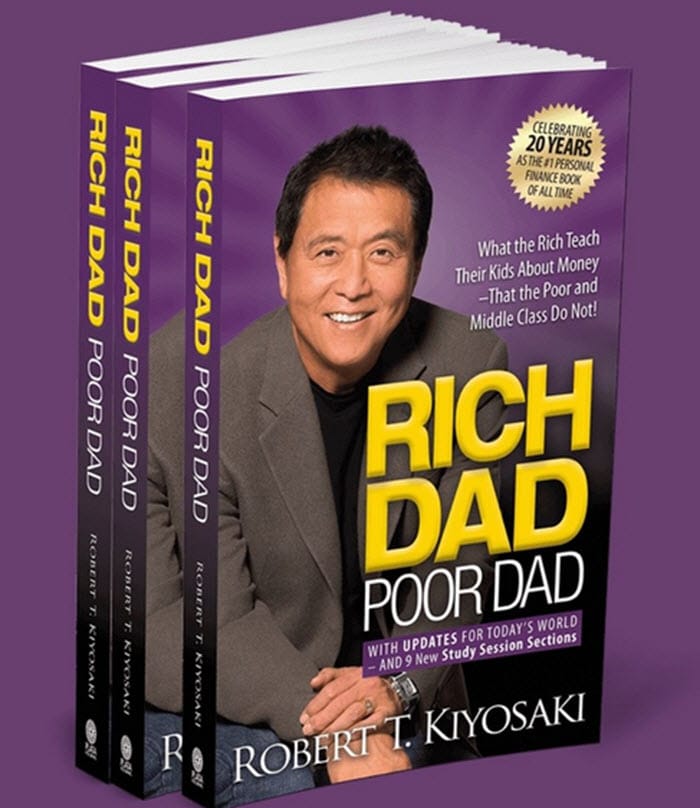
Rich Dad Poor Dad—which contrasts the financial habits of Kiyosaki’s highly educated but financially struggling biological father (“Poor Dad”) with his friend’s entrepreneurial father (“Rich Dad”)—spent years on the New York Times bestseller list, selling over 32 million copies. It birthed an empire of board games, seminars, and coaching programs.
However, Kiyosaki’s high-leverage strategies have faced real-world consequences before. In 2012, one of his primary corporate entities, Rich Global LLC, filed for Chapter 11 bankruptcy protection after a court ordered it to pay nearly $24 million to a licensing partner.
Critics argue that Kiyosaki’s philosophy ignores the catastrophic risk of market downturns. Traditional advisors, such as radio host Dave Ramsey, preach the opposite gospel: absolute debt-free living.
Ramsey, who himself went bankrupt using leverage in his 20s, warns that when the market turns and tenants stop paying rent, those multi-million-dollar loans do not simply become “the bank’s problem”—they result in total foreclosure and ruin.
Kiyosaki’s massive debt load is also a philosophical protest against what he views as an inherently unstable fiat currency system. Because the U.S. Federal Reserve can print money, eroding its purchasing power through inflation, Kiyosaki argues that “savers are losers”.
Instead of hoarding cash, he converts his earnings into what he calls “real money”: Bitcoin, gold, silver, and even Wagyu cattle. By holding hard assets and paying them off with depreciating, inflated dollars, Kiyosaki believes he is perfectly positioned for what he frequently warns is an impending, historic market crash.
Whether his $1.2 billion position is a masterclass in modern portfolio theory or a ticking financial time bomb remains a point of fierce debate on Wall Street. But for Kiyosaki, the gamble is simple: in an economy built on debt, the debtor is king.
For those looking to understand his perspective directly, The Rich Dad Radio Show offers an in-depth breakdown of how Kiyosaki differentiates good debt from bad debt in an inflationary environment.
