

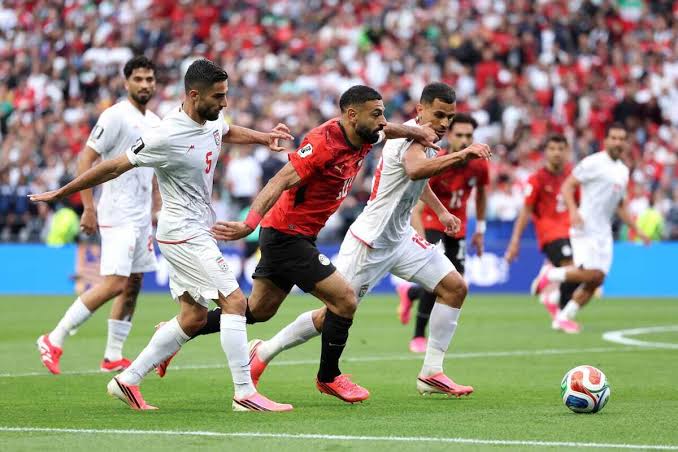
By Our Chief Football Correspondent at Seattle Stadium
IT WAS a night of raw emotion, historical milestones, and a level of agonizing stoppage-time drama that only the FIFA World Cup can generate. Under the gleaming lights of Seattle, the Pharaohs of Egypt script a legendary chapter in their footballing folklore by reaching the knockout rounds of the tournament for the first time in their history.
Yet, as the Egyptian fans bounced to the drums of historic success, the Iranian squad fell to their knees in absolute despair. A frantic, chaotic, and pulsating encounter finished one-all, but that simple scoreline barely scratches the surface of an incredible Pacific Northwest epic.
The narrative arc of the match swung on the performances of the talismanic figures and the razor-thin margins of modern technology. All eyes in Seattle were fixed on Egypt’s legendary forward, Mohamed Salah.
The global icon delivered the first major moment of quality within five minutes of the opening whistle. Shaking off a heavy defensive marker inside the penalty area, Salah showed exceptional upper-body strength and vision to carve open space. His trademark left-footed drive was partially blocked but fell perfectly into the path of Mahmoud Saber.
The midfield maestro made no mistake, rifling a powerful, precise effort right between the legs of Iran’s goalkeeper, Alireza Beiranvand, to send the travelling Egyptian contingent into absolute raptures.
But Iran, known for their fierce resilience and collective spirit, refused to follow the script. Just five minutes after falling behind, Team Melli had a golden opportunity to draw level when they were awarded a penalty.
Up stepped their captain and star forward, Mehdi Taremi. In a battle of psychological warfare, Egypt’s rising goalkeeper, Mostafa Shobeir, guesses right, pulling off a magnificent diving save to deny the Inter Milan striker.
It was a moment that should have deflated Iran, but instead, it lit a fire under them.
In the fourteenth minute, the stadium bore witness to a moment of individual brilliance from an unlikely source. Ramin Rezaeian burst down the right flank, capitalising on a momentary lapse in the Egyptian backline.
From an incredibly tight, almost impossible angle, the veteran defender struck a ferocious effort that completely bypassed Shobeir and nestled into the far corner. Two goals inside the first quarter of an hour set the template for a box-office battle.
The tactical battle intensified as both teams aggressively fought for dominance. Looking at the match statistics in prose, it was a fiercely contested midfield war, evidenced by the high disciplinary count.

Egypt racked up three yellow cards over the course of the match, with goalscorer Mahmoud Saber entering the referee’s book in the twentieth minute, followed by substitute defender Yasser Ibrahim in the forty-second minute, and Mohanad Lasheen late in stoppage time. Iran, matching their opponents’ intensity, picked up four cautions.
Hossein Kanaanizadegan was booked in the nineteenth minute, Ali Nemati in the forty-third, Saeid Ezatolahi in the seventy-ninth, and Shojae Khalilzadeh deep into injury time.
The second half brought severe anxiety for Egypt when Mohamed Salah signaled to the bench in the fifty-sixth minute. The former Liverpool superstar had been clutching his left hamstring and immediately requested to come off. As he sat on the bench with the area heavily strapped and iced, a collective hush fell over the stadium.
Egypt’s manager, Hossam Hassan, was forced to adjust his tactical setup, introducing Zizo to fill the massive void left by their captain. Without Salah’s outlet pace, Egypt dropped deep, inviting relentless Iranian pressure.
What followed in the final ten minutes was pure, unadulterated footballing theatre. Down to ten men in the closing moments due to a late injury and having exhausted all their substitutions, Egypt were camped in their own penalty box.
In the ninety-third minute, the stadium erupted. Iran won a set-piece, and after a chaotic scramble, the thirty-seven-year-old veteran defender Shojae Khalilzadeh pounced on a loose rebound to fire the ball home.
The Iranian bench emptied, players shed tears of joy, and a pitch invader even evaded security to join the wild celebrations. Iran were heading to the last-32. But then came the dreaded finger-to-the-ear gesture from the referee. The Video Assistant Referee (VAR) spent an agonizing two minutes reviewing the phase of play. The digital lines were drawn, and by a fraction of a millimeter, Khalilzadeh was deemed offside. The goal was ruthlessly scratched off.
Even then, the drama was not concluded. In the ninety-seventh minute, Saeid Ezatolahi rose highest from an in-swinging corner, launching a powerful header that beat Shobeir but crashed spectacularly against the crossbar. It was the final kick of an unforgettable match.
The whistle blew, confirming a historic achievement for Egypt, who finish second in Group G with five points, just behind leaders Belgium, setting up a blockbuster Round of 32 clash against Australia in Dallas on July 3.
Iran, finishing third with three points from three consecutive draws, face a nerve-shredding twenty-four-hour wait to see if they advance as one of the best third-placed sides. Football can be beautifully cruel, and Seattle witnessed both sides of the coin.
