

By Eyitayo Alawode I Tuesday, July 01, 2026
IBADAN, Oyo – Public commentary, at its core, is an examination of how government works and the character of those entrusted with it. In political tradition, a ruler’s legitimacy rests not only on holding power, but on upholding an unwritten contract of decorum, restraint and fidelity to duty.
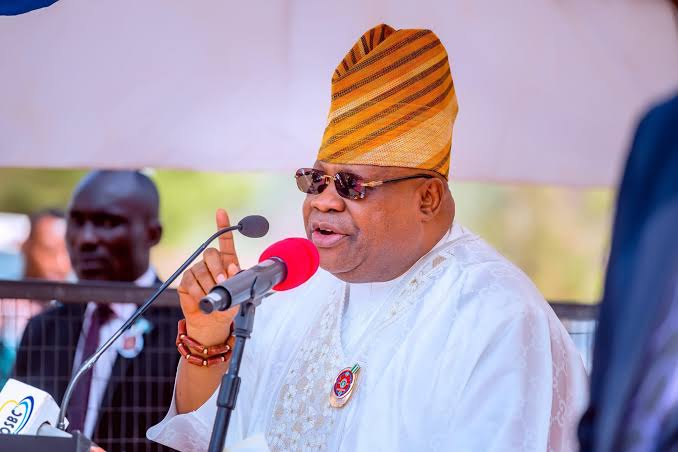
The murder of an indigene, Mr. Aderogba Ajayi, should have drawn a solemn, measured response from the state’s chief security officer. Instead, the State of the Living Spring was treated to an unrefined, unstatesmanlike tirade from Governor Ademola Adeleke
When a state executive replaces statesmanship with theatrical vulgarity, governance slips from serious democracy into tragic comedy.
The recent, combustible events in Esa-Oke, Obokun Local Government Area, have forced Osun State back into an unflattering spotlight.
The murder of an indigene, Mr. Aderogba Ajayi, should have drawn a solemn, measured response from the state’s chief security officer. Instead, the State of the Living Spring was treated to an unrefined, unstatesmanlike tirade from Governor Ademola Adeleke.
During a condolence visit that should have been defined by solemnity and a firm commitment to impartial justice, Governor Adeleke turned a funeral into an aggressive, political arena. Rather
than allowing the Nigeria Police Force and other security agencies to conduct a thorough investigation to identify the perpetrators, the governor made open, unverified accusations against
political opponents.
In a manner that subverted the dignity of his office, he started dancing again, this time, by pointed fingers at opposition figures, acting as investigator, prosecutor, judge and jury on a public stage. Get it right: to weaponize grief through careless generalisations for partisan gain is a failure of leadership. It degrades the state and undermines the rule of law.
This outburst at Esa-Oke is not an isolated error; it is part of a pattern of reactive governance seen in recent security breaches across the state. Days before Esa-Oke, the ancient town of Ilobu
in Irepodun Local Government Area was thrown into mourning after the murder of a fourteen- year-old, Ezekiel Olapade. Rather than allow professional intelligence to identify those behind
the killing, the state administration rushed to assign political labels and trade blame before facts were known.
A similar approach played out in the killing of Oyebamiji Quzeem, popularly known as “Mosquito”, whose broad-daylight murder became fodder for the administration’s blame game.
In each of these cases, from Ilobu to Esa-Oke, the administration’s response has been to bypass institutional process for immediate, volatile public indictments.
Conventionally, governance is measured by careful fiscal policy, sustainable infrastructure, and commitment to institutional transparency. When an executive prioritizes optics and premature
accusations over substance, it creates a vacuum where rigour should be.

The demand for the immediate redeployment of the Commissioner of Police, Ibrahim Gotan, after these incidents, shows a model driven by reaction rather than structured, inter-agency collaboration.
With the August 15, 2026, governorship election approaching, this lack of institutional decorum contrasts sharply with the record of his challenger, Asiwaju Munirudeen Bola Oyebamiji of the All Progressives Congress (APC). Where the incumbent relies on reaction and emotion, Oyebamiji brings calculated, technocratic sobriety drawn from corporate finance and public administration.
With postgraduate degrees in Public Administration and Business Management, Oyebamiji’s career was forged in the disciplined, risk-averse environment of commercial banking.
In public service, his work as Managing Director of the Osun State Investment Company Limited and later as Commissioner for Finance under two administrations was marked by a
methodical devotion to fiscal discipline.
At a time when subnational governments struggle with opaque accounts and unsustainable debt, Oyebamiji managed the state’s tight treasury with a steady hand.
His tenure as Managing Director and CEO of the National Inland Waterways Authority under the federal presidency further confirms an administrative record that value process over grandstanding.
The coming ballot is a fundamental referendum on the standard of leadership Osun requires. Can a state facing real structural and security pressures be led by an executive whose response to
tragedy is a public diatribe driven by blame? Or does it need the calm, institutional approach of a seasoned administrator?
The developmental trajectory of any society is directly tied to the quality of its leadership.
When economic policy, land reform, and security architecture demand deep and sustained engagement, a state cannot afford governance that collapses into outbursts at provocation. The vituperation at Esa-Oke, and the reactive handling of Ilobu and Quzeem, have shown the fragility of the current standard.
Osun deserves leadership that knows the governor’s microphone is for cohesion, public reassurance, and constitutional order, not for speculative, divisive talk. As voters prepare to decide, the contrast is clear. One side shows a pattern of outbursts that weaken state authority; the other offers a record of quiet, technocratic competence to rebuild it.
The choice will determine whether Osun settles for an erratic, emotional standard, or reclaims its place as a serious bastion of progressive governance.
▪Alawode lives in Ibadan, Oyo State
