

By Admin | Tuesday, Sept 29, 2026
LAGOS, Nigeria — Africa’s most influential telecommunications companies and sovereign investment institutions are operating in an increasingly complex environment where financial performance, regulatory scrutiny, public trust, and institutional reputation are becoming difficult to separate.
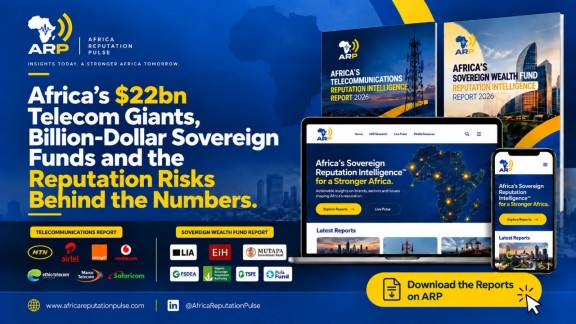
Against this backdrop, Africa Reputation Pulse (ARP) has released two new intelligence dossiers examining the reputation landscape surrounding some of the continent’s most consequential economic institutions: Africa’s Telecommunications Reputation Intelligence Report 2026 and Africa’s Sovereign Wealth Fund Reputation Intelligence Report 2026.
The two reports examine how leading telecommunications operators and sovereign investment institutions are represented across African media, financial reporting, regulatory developments, public narratives, and emerging AI-driven information environments.
Telecom Reputation Tied to Financial and Regulatory Power
The telecommunications intelligence tracks major operators including MTN Group, Airtel Africa, Orange Africa & Middle East, Vodacom Group, Ethio Telecom, Maroc Telecom, and Safaricom Group—examining developments across financial performance, regulation, customer experience, digital services, data governance, and corporate visibility.
The report’s market-value lens records figures including approximately $22 billion for MTN Group, $18 billion for Vodacom, $14 billion for Airtel Africa, and $11 billion for Safaricom, based on the cited public market and valuation sources included in the research.
However, the intelligence goes beyond market capitalisation.
In Nigeria, the research documents a year of heightened regulatory and consumer scrutiny, including enforcement around telecommunications service quality and compensation for poor network performance.
Meanwhile, across the continent, major strategic developments are reshaping reputation narratives around individual operators.
Safaricom, for example, is navigating a major governance and ownership story following Vodacom’s acquisition of the Kenyan government’s stake. The research also captures the subsequent September 2026 court ruling and appeals surrounding the transaction.
Airtel Africa’s mobile money business is also entering a new phase, with the research tracking its planned London listing and the prospectus process announced in September.
Sovereign Wealth Funds as Reputation Assets
The second dossier turns to a different but increasingly important part of Africa’s economic architecture: sovereign wealth funds and state-backed investment institutions.

The research examines institutions including the Libyan Investment Authority, Ethiopian Investment Holdings, Mutapa Investment Fund, Fundo Soberano de Angola, Nigeria Sovereign Investment Authority (NSIA), The Sovereign Fund of Egypt, and the Pula Fund.
The numbers demonstrate why these institutions increasingly matter to the wider African investment narrative:
Nigeria: The NSIA was reported to have generated ₦478.8 billion in income in 2025, with assets reaching approximately ₦4.9 trillion, according to media sources tracked in the dossier.
Libya: The research records US1.25 billion in profits generated by the Long Term Investment Portfolio in 2025, alongside reporting on the Libyan Investment Authority’s US41.7 billion in direct financial assets.
Zimbabwe: The Mutapa Investment Fund enters the intelligence landscape with a reported US$1 billion-plus 2026 deal pipeline.
Angola: The country’s sovereign fund reported a 200% profit increase to €451 million.
Egypt: The Sovereign Fund of Egypt is positioning for greater continental activity, with plans for Africa-focused investment and a newly established EGP 10 billion industrial investment sub-fund.
Beyond Financial Performance
For ARP, the significance of these findings extends beyond whether an institution is growing, investing, or generating returns.
The two dossiers examine the reputation environment surrounding economic power: how institutions are discussed, what issues drive visibility, where regulatory pressure emerges, how financial milestones are interpreted, and how institutional information is becoming vital to digital and AI-mediated discovery.
The research also incorporates data protection, artificial intelligence governance, and emerging AI retrieval considerations—reflecting a broader shift in how institutional reputation is built and interpreted.
Reputation as Economic Intelligence
“The reputation of an institution can no longer be separated from the evidence surrounding its financial performance, regulatory relationships, stakeholder experience, and public narrative,” said Philip Odiakose, Lead Analyst at Africa Reputation Pulse. “For organisations operating at this scale, reputation is increasingly part of the economic intelligence story.”
According to Odiakose, the growing importance of reputation intelligence reflects a fundamental change in how institutions are assessed.
Two New Intelligence Resources for Africa
The release represents another expansion of ARP’s research programme focused on building an evidence-led view of how African institutions, companies, and economic sectors are perceived and discussed.
The Africa’s Telecommunications Reputation Intelligence Report 2026 and the Africa’s Sovereign Wealth Fund Reputation Intelligence Report 2026 offer detailed insights into the reputational forces shaping the continent’s telecommunications sector and state investment vehicles as they navigate capital mobilisation, economic development, and continental investment.
