

By Our Foreign Desk
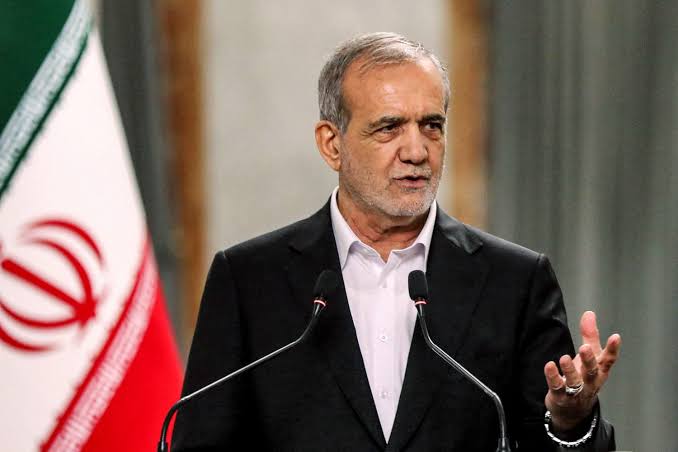
TEHRAN — In his first major economic address since the recent conflict, Iran’s newly inaugurated President Masoud Pezeshkian declared on Monday that Tehran would not yield to “excessive demands” in ongoing diplomatic negotiations, signaling that a recent military standoff had only strengthened Iran’s hand at the bargaining table.
Speaking at a national convention of trade unions and guilds in Tehran, Mr. Pezeshkian struck a highly nationalistic and triumphant tone. He explicitly linked Iran’s current diplomatic strategy to the legacy of the country’s late Supreme Leader, Ayatollah Seyyed Ali Khamenei, whom he eulogized as a martyr of the recent war with Israel and the United States.
“The negotiations that are underway are being pursued with dignity and authority,” Mr. Pezeshkian said, according to the state-run Islamic Republic News Agency (IRNA). “Wherever they seek to disregard the rights of the Iranian nation, we will not back down under any circumstances.”
The address coincided with the approach of Muharram, a sacred period of mourning in the Shiite calendar, lending a somber, religious weight to a speech that focused heavily on national resilience.
The Iranian president focused heavily on the regional fallout of the recent conflict, framing a strategic shift in Lebanon as a major victory for Tehran’s axis of influence.
Mr. Pezeshkian claimed that the “steadfastness and resistance” of Iranian-backed regional forces and diplomats had forced their adversaries—an implicit reference to Israel—to halt military operations in Lebanon.
”The fact that today… the opposing side has been compelled to retreat on the issue of Lebanon and has ceased the killing and massacre of the oppressed people of that country, this is no small achievement,” he told the audience.
Regional analysts view the remarks as an attempt by the new administration to project strength to both domestic hardliners and Western interlocutors, framing the post-war status quo not as a compromise, but as a forced retreat by Israel and Washington. Mr. Pezeshkian sought to broad-base this achievement, praising both front-line fighters who “gave their lives for the dignity and honor of the country” and ordinary merchants who stabilized the economy during the conflict.

Beyond regional geopolitics, the central focus of the address was domestic economic survival. Iran’s merchant guilds and traditional bazaari business networks have historically been a critical pillar of political stability in the country, and their support is vital for the survival of Mr. Pezeshkian’s government.
The president praised the guilds for maintaining public services during what he characterized as a devastating wartime blockade imposed by the United States and Israel. Despite the severe strain of recent months, Mr. Pezeshkian claimed the country’s economy was on the verge of a turnaround.
”Fortunately, good openings have been achieved, the necessary foundations for economic prosperity have been laid, and the path for trade, investment, and guild activities has been made more available than before.”
He also emphasized an aggressive diplomatic push to strengthen trade and cooperation with regional neighbors to bypass Western sanctions, claiming that Iran’s global standing had never been stronger. “Today, Iran is at the top of world news, and Iran and Iranians are spoken of with dignity and respect,” he said, attributing the shift to national solidarity.
The ceremony concluded with Mr. Pezeshkian presenting commemorative plaques and trophies to the families of trade union members killed during the war, reinforcing a political narrative that binds Iran’s commercial class directly to its military apparatus.
