

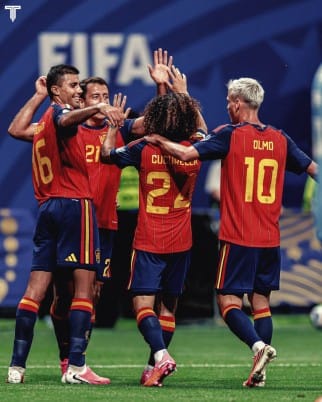
By Our Sports Correspondent in Atlanta
The European kings are officially back in business. After an opening-round stalemate against tournament debutants Cape Verde that left the footballing world scratching its collective head, Luis de la Fuente’s red-hot matadors unleashed an absolute storm in Atlanta.
Spain didn’t just win; they sent a terrifying statement of intent across the Atlantic with a devastating 4-0 drubbing of an entirely outclassed Saudi Arabia side.
At the absolute heart of this clinical demolition was Spain’s golden boy, Lamine Yamal, alongside the ruthless Mikel Oyarzabal. Returning to the starting lineup after a grueling two-month layoff with a troublesome hamstring injury, the eighteen-year-old Yamal played as if he had never been away.
The Barcelona prodigy injected immediate urgency, flair, and terrifying pace into a Spanish frontline that had looked completely toothless just days prior.
From the opening whistle at the spectacular Atlanta Stadium, it was less of a football match and more of a footballing lecture. Spain dominated the ball with arrogant ease, executing their trademark high-press system that pinned the Green Falcons deep within their own territory.
Saudi Arabia’s backline looked entirely shell-shocked by the sheer velocity of Spain’s passing networks.
The breakthrough arrived after just ten minutes of absolute baseline dominance, and it was a moment scripted in football heaven. Mikel Oyarzabal, desperate to make amends for an underwhelming performance in the opening match, turned provider.
The Real Sociedad forward chased down a loose ball and drove a low, fizzing cross precisely into the danger zone. Darting behind the sleeping Saudi defense like a ghost was Yamal, who slid in effortlessly at the back post to tuck the ball home.
In doing so, at just 18 years and 343 days old, Yamal etched his name into the history books as the eighth-youngest goalscorer in the entire history of the FIFA World Cup.
He also became the second-youngest Spaniard ever to find the back of the net on global football’s grandest stage, sitting proudly just behind his international teammate Gavi.
With the Saudi game plan completely shattered inside the opening quarter of an hour, Oyarzabal took center stage to put the game completely out of reach before the first-half hydration break even arrived.
The deadly frontman capitalised heavily on Saudi Arabia’s total inability to clear their lines under endless waves of intense Spanish pressure.

In the twenty-first minute, Oyarzabal pounced on a loose defensive clearance, showing immense composure to finish from close range past the sprawling Saudi goalkeeper Mohammed Al-Owais. Just three minutes later, before the traveling Saudi fans could even process the second goal, Oyarzabal struck again.
Moving with predatory instinct inside the penalty box, he latched onto another precise delivery to slot home his second of the afternoon, making it 3-0 in the twenty-fourth minute.
The Real Sociedad talisman was completely unplayable and could have walked away with the match ball before halftime. He agonizingly clipped the top of the crossbar with an audacious effort following a sloppy clearance from the Saudi defense, before driving another fierce effort just inches wide of the far post.
With the three points securely in the bag and progress to the knockout stages all but assured, Luis de la Fuente opted for luxury, handing both Yamal and Oyarzabal a well-earned rest at halftime. Off came the first-half heroes, replaced by Ferran Torres and Yéremy Pino, but the relentless pressure from La Roja did not waver.
Just four minutes into the second period, the misery deepened for Saudi Arabia. The industrious Chelsea fullback Marc Cucurella unleashed a stinging volley that Al-Owais did well to parry away.
However, luck was completely absent for the Saudis as the rebounded ball struck the unfortunate defender Hassan Altambakti and deflected straight into his own net to make it 4-0.
Spain continued to manipulate the tempo, suffocating any potential Saudi counter-attacks. Ferran Torres thought he had added a fifth late in the game, but a lengthy VAR check eventually ruled the goal out for offside, sparing the Middle Eastern side further embarrassment.
Saudi Arabia’s frustrating afternoon was compounded by disciplinary issues, with star man Salem Al-Dawsari receiving a caution in the first half and Mohamed Kanno picking up a yellow card in the second before leaving the pitch wrapped in bandages following a nasty collision.
The sheer scale of Spain’s dominance was perfectly reflected in the match numbers. La Roja completely monopolized possession, controlling the football for sixty-eight percent of the match, leaving Saudi Arabia chasing shadows with just thirty-two percent.
Spain’s midfield engine room operated at peak efficiency, completing over six hundred and fifty passes with an astounding completion rate of ninety-one percent, while the Saudis struggled to string together negative sequences, completing fewer than two hundred and fifty passes.
In the attacking third, the gulf in class was staggering. Spain unleashed a total of eighteen shots over the ninety minutes, with nine of those efforts hitting the target accurately. In contrast, Saudi Arabia failed to register a single shot on target, finishing the match with an attacking tally of zero.
Defensively, Spain was rarely troubled, forcing Unai Simón into zero saves, while Al-Owais was forced into making five critical interventions to keep the scoreline down.
Spain also earned nine corner kicks compared to Saudi Arabia’s lonely two, telling the complete story of a truly one-sided World Cup masterclass.
