

By Our Correspondent
ABUJA, Nigeria — Operatives of Nigeria’s anti-corruption agency have arrested a fugitive former cabinet minister who went underground earlier this month after being convicted in absentia for siphoning billions of nairas meant for critical hydroelectric energy infrastructure.
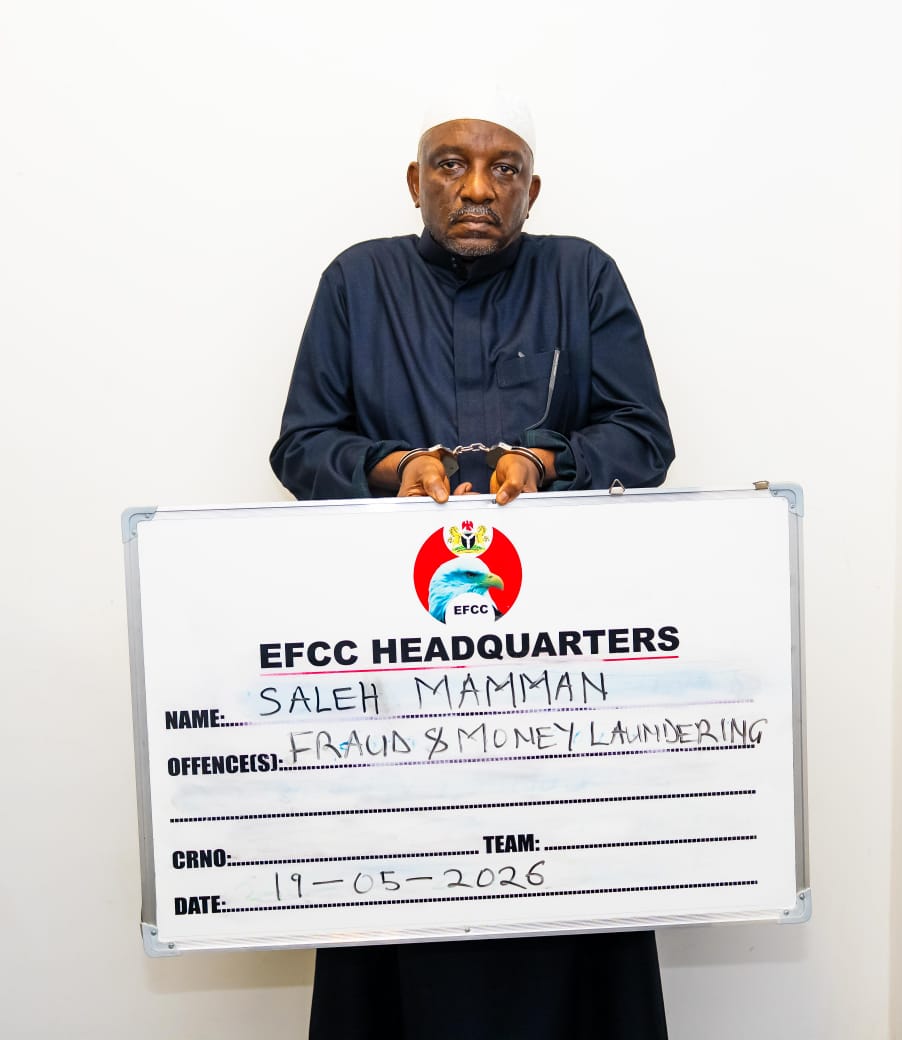
The Economic and Financial Crimes Commission (EFCC) announced on Tuesday that Saleh Mamman, who served as Nigeria’s Minister of Power from 2019 to 2021, was apprehended during a pre-dawn raid in the Rigasa neighborhood of Kaduna State, in the country’s northwest.
The arrest brings an end to a high-profile, weeks-long manhunt that captivated a nation routinely plagued by systemic corruption and chronic electricity shortages.
“The former minister went underground after he was convicted by the Federal High Court sitting in Abuja on corruption charges,” Ola Olukoyede, the Executive Chairman of the EFCC, told reporters on Tuesday.
Mr. Olukoyede disclosed that Mamman was taken into custody in the early hours of Tuesday, May 19, following “weeks of intensive surveillance and intelligence gathering.”
“For us, getting the convict to serve his jail terms is extremely important in view of the seriousness with which we are tackling corrupt practices,” Mr. Olukoyede added, noting that the agency is currently processing Mamman’s immediate transfer to a federal correctional facility.
The capture follows a landmark May 7 ruling by Justice James Omotosho of the Federal High Court in Abuja. Justice Omotosho found Mamman guilty on 12 counts of financial fraud and the diversion of public funds.
According to court documents, the EFCC successfully proved that Mamman and a network of close associates siphoned at least 22 billion Nigerian naira (approximately $15 million USD) through a web of proxy companies.
The funds had been explicitly earmarked by the federal government for the execution of the Mambilla and Zungeru hydroelectric power projects—two massive infrastructure initiatives central to solving Nigeria’s decades-long energy crisis.
In a scathing written judgment, Justice Omotosho condemned Mamman’s actions as a “gross abuse of public trust,” ruling that the defense had failed to present any credible evidence to counter the prosecution’s staggering paper trail.

Following the conviction, the court ordered Mamman to appear on May 13 for formal sentencing. When he failed to show up, the court took the rare step of proceeding in his absence, handing down a combined, consecutive sentence totaling 75 years in prison without the option of a fine for the majority of the counts.
Contextual Background: A Legacy of Darkness
Mamman’s conviction and subsequent flight from justice underscore a deeper, systemic wound in Nigeria.
Despite being Africa’s largest economy and a major oil producer, Nigeria’s national electrical grid collapses frequently, leaving tens of millions of citizens and businesses reliant on expensive, polluting diesel generators.
The Mambilla and Zungeru projects were designed to pivot the nation toward sustainable, clean hydroelectric energy.
The Mambilla project alone, situated in eastern Taraba State, was envisioned as a 3,050-megawatt facility that would drastically reshape the country’s economic landscape.
Saleh MammanMamman was appointed to steer these vital projects in 2019 by former President Muhammadu Buhari. Buhari had won the presidency largely on an aggressive anti-corruption platform, promising to jail corrupt officials and claw back billions stolen from public coffers.
Mamman’s conviction represents one of the most high-profile takedowns of a senior official from that era, dealing a retroactive blow to the previous administration’s legacy.
Even as Mamman prepares to begin his 75-year sentence, his legal troubles are far from over. The former minister is concurrently facing a separate, massive corruption trial before the Federal Capital Territory High Court in Abuja.
In that secondary case, the EFCC alleges that Mamman and seven co-defendants orchestrated an even larger fraud scheme, siphoning 31 billion naira (roughly $21 million USD) from public funds. On May 11, just days after his initial conviction, Justice Maryanne Anenih of the FCT High Court issued an independent bench warrant for Mamman’s arrest after he repeatedly boycotted those proceedings as well.
With Mamman now securely in federal custody, anti-corruption advocates view his capture as a rare win for accountability in a sector historically viewed as untouchable.
He is expected to be moved to a maximum-security prison by the end of the week.
