

By SCM Foreign Desk
TEHRAN — Iranian President Masoud Pezeshkian declared that his country is engaged in a “full-scale war” with the United States, issuing a defiant message that Iran would not surrender under economic pressure or military threat.
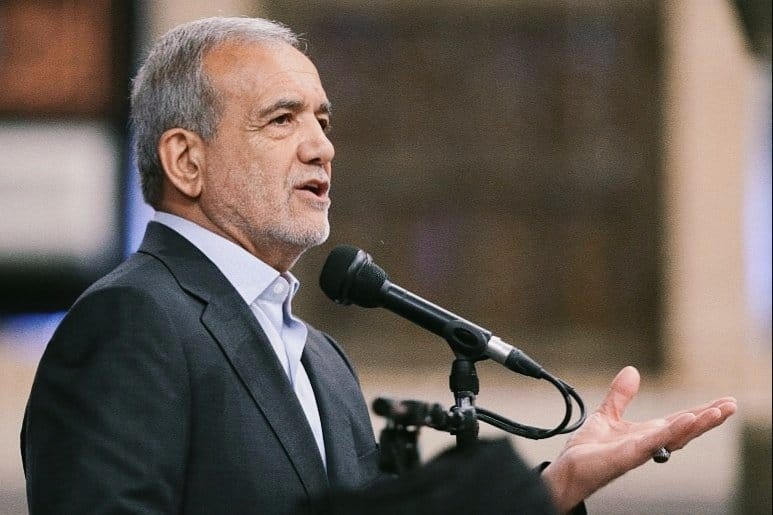
Speaking before judicial leaders in Tehran, Mr. Pezeshkian framed the ongoing confrontation between the two geopolitical rivals not merely as a localized skirmish or an exchange of localized strikes, but as an all-encompassing war designed to destabilize the Islamic Republic.
“The reality is that today the Islamic Republic of Iran is engaged in a full-scale war,” Mr. Pezeshkian said, according to official state media.
“Today’s war is not simply a war of missiles; the enemy has come to the conclusion that it cannot force the Iranian nation to surrender through military attacks.”
He reiterated that Iran’s leadership would hold its ground regardless of the escalation: “Iran will not surrender under any circumstances.”
Shift to ‘Hybrid Warfare’ and Economic Battlegrounds
Mr. Pezeshkian’s rhetoric marks a calculated shift in how Tehran characterizes its escalating conflict with Washington.
By emphasizing that the war has moved beyond conventional weaponry, the president signaled that domestic economic stability and the protection of citizens’ livelihoods have become primary security objectives.

U.S. sanctions, targeting Iran’s energy sector and financial networks, have long squeezed the country’s economy. However, Iranian officials increasingly describe these measures alongside ongoing cyber operations and targeted regional strikes as part of a broader “hybrid warfare” campaign.
”The enemies of this nation are trying with all their might to block our paths of progress,” Mr. Pezeshkian noted, calling for national unity across government factions to navigate the mounting economic strain.
Tensions between Washington and Tehran have flared sharply over military deployments in the Middle East and strategic maritime routes such as the Strait of Hormuz. Despite the harsh public statements, diplomatic channels remain subtly active behind closed doors.
Iranian Foreign Ministry spokespeople recently acknowledged receiving messages transmitted through third-party intermediaries. While details of these communications remain undisclosed, they underscore a dual track: fierce public rhetoric aimed at signaling resolve, running parallel to secret negotiations intended to prevent a broader regional collapse.
For Western diplomats, Mr. Pezeshkian’s statements reflect both domestic political necessity—reassuring hardliners that Tehran will not back down—and a sobering reality check on how deeply entrenched the standoff between Washington and Tehran has become.
For visual coverage of President Pezeshkian’s remarks and updates on the ongoing conflict, watch Iran President Pezeshkian Warns of Full-Scale War With U.S..
This news broadcast offers direct footage of President Pezeshkian’s address in Tehran and breaks down the diplomatic context surrounding backchannel talks.
