

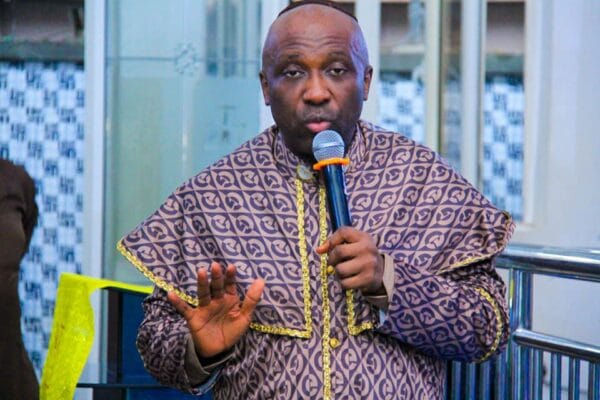
Sir Ifeanyi Ejiofor and Primate Elijah Ayodele
Titus Eleweke , South East Editor
AWKA, Anambra – The Nigeria human rights lawyer and lead counsel to the Indigenous People of Biafra (IPOB), Sir Ifeanyi Ejiofor, has criticized Primate Elijah Ayodele over what he described as increasingly indistinguishable political prophecies that create confusion within the country.
Sir Ifeanyi Ejiofor, a social crusader and national commentator, took on Ayodele in a statement titled:
“WEEKEND MUSINGS: WHEN THE PULPIT BECOMES A POLITICAL FORECASTING CENTRE: A MODEST APPEAL TO PRIMATE AYODELE TO CHOOSE BETWEEN THE CASSOCK AND THE CAMPAIGN FIELD.”
According to him, there is perhaps no greater tragedy in contemporary Christendom than the gradual transformation of some sacred altars into political observatories, where divine revelation appears increasingly indistinguishable from political speculation.
He argued that prophecy, once reserved for the salvation of souls, now competes vigorously with election forecasts, power permutations, and partisan calculations.
“Ordinarily, men clothed in cassocks are expected to be fishers of men, custodians of faith, guardians of morality, and ambassadors of the Kingdom of God. Their divine mandate is neither ambiguous nor negotiable. They are called to reconcile humanity to God, not to become perpetual commentators on the ever-changing fortunes of politicians and political parties,” he stated.
According to him, in recent years, Primate Elijah Ayodele has carved out a unique and rather curious niche for himself within Nigeria’s public space.
He noted that hardly a day passes without another prophecy, prediction, warning, forecast, permutation, projection, or political bulletin emanating from his altar.
Ejiofor asked: “One is tempted to wonder whether Heaven now convenes daily political strategy meetings from which he alone receives exclusive briefings.”
According to him, the frequency of these pronouncements has become so relentless that many political observers now await Ayodele’s forecasts with the same anticipation usually reserved for election results, opinion polls, or intelligence briefings.
He added that, at times, one struggles to determine whether one is listening to a clergyman delivering divine messages or a political analyst offering electoral projections under ecclesiastical cover.
“The concern here is neither personal nor denominational. Every citizen enjoys the constitutionally guaranteed right to freedom of expression. The issue, however, is whether the incessant intrusion of prophetic declarations into partisan political matters advances the cause of Christianity or merely fuels uncertainty within an already fragile democratic order.
“Democracy thrives on institutions, reasoned debate, electoral participation, and the sovereign will of the people. It becomes vulnerable when public discourse is persistently inundated with prophetic declarations predicting victories, defeats, conspiracies, impeachments, disasters, collapses, betrayals, and political cataclysms. Such pronouncements often generate avoidable tension, deepen political anxieties, and sometimes create an atmosphere in which democratic choices appear subordinate to prophetic predictions.
“One must ask: At what point does prophecy cease to be spiritual guidance and begin to resemble political fortune-telling?” he queried.

The human rights lawyer, who is also the Dunu-Ezeugosinachi of Igboland, said the Holy Scriptures provide considerable guidance on the responsibilities of those called into ministry.
According to him, “In Matthew 28:19–20, Christ commissioned His disciples to preach the Gospel and make disciples of all nations. In 2 Timothy 4:2, believers are instructed to ‘preach the word; be instant in season and out of season.’ The emphasis is unmistakably on evangelism, righteousness, repentance, and spiritual transformation.”
He noted that the Apostle Paul repeatedly admonished ministers of the Gospel to avoid worldly entanglements capable of distracting them from their sacred calling. In 2 Timothy 2:4, he declared:
“No man that warreth entangleth himself with the affairs of this life; that he may please him who hath chosen him to be a soldier.”
He added that while ministers are undoubtedly entitled to express opinions on matters affecting society, there is a vast difference between offering occasional moral guidance on governance and maintaining a continuous stream of political forecasts that effectively positions the preacher as a permanent participant in the political arena.
Ejiofor further stated that one cannot help but admire the remarkable energy with which some modern prophets monitor political developments.
He wondered whether, if the same intensity were devoted exclusively to evangelism, discipleship, moral reformation, and soul-winning, the nation might witness an even greater spiritual revival.
“The irony is impossible to ignore. Many churches struggle with declining moral standards among their congregants, increasing social decadence, widespread corruption, youth disillusionment, and a growing crisis of faith. Yet, while these pressing spiritual concerns persist, some clerics appear unusually preoccupied with predicting who will become governor, who will lose elections, who will be removed from office, and who is plotting against whom.
“This inversion of priorities deserves thoughtful reflection,” he added.
The human rights lawyer maintained that the Church performs its noblest function when it serves as the conscience of society, not when it becomes an unofficial annex of political contestation.
According to him, the pulpit commands respect because it derives its authority from divine truth, not because it competes with political commentators and election analysts.
He said the intervention was offered in good faith and with utmost respect, noting that if Primate Ayodele genuinely possesses an irresistible passion for political forecasting, perhaps he should consider shedding the burden of clerical ambiguity and openly joining the political arena, where forecasts, projections, campaigns, alliances, and strategic calculations properly belong.
According to Ejiofor, one cannot effectively occupy the altar and the campaign field simultaneously without risking confusion regarding the source of one’s authority.
“The time may have come for a clear choice.
“Either the cassock should remain devoted to its sacred purpose of preaching Christ and advancing the Kingdom of God, or its wearer should courageously embrace the political wrestling ring and contend openly with politicians rather than through perpetual prophetic interventions,” he stated.
He further noted that Nigeria needs prophets who will speak truth to power, not prophets who appear perpetually fascinated by power itself.
Ejiofor stressed that the nation needs spiritual shepherds more than political forecasters.
He added that the Church needs pulpits that inspire faith more than they generate headlines.
This version retains all the original arguments and quotations while improving grammar, readability, sentence structure, attribution, punctuation, and overall journalistic presentation.
