

By SCM Foreign Desk
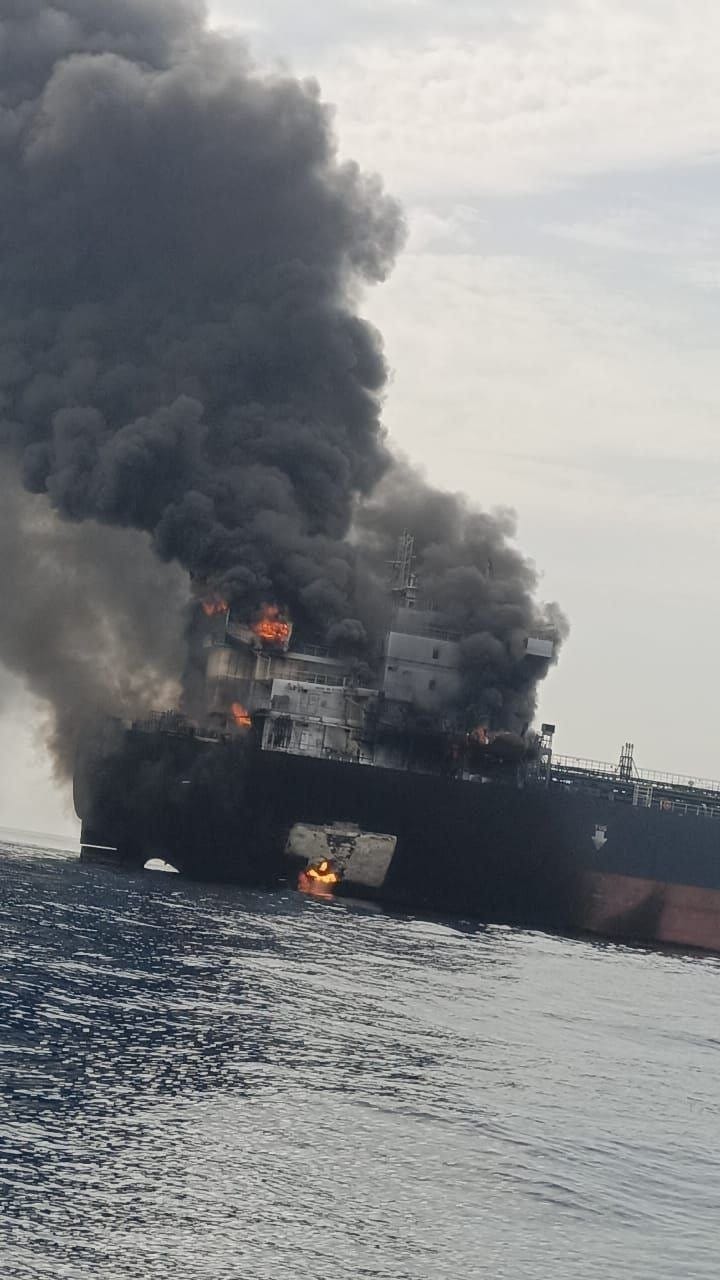
WASHINGTON — A commercial vessel granted safe passage through the Strait of Hormuz by the United States military was set ablaze on Tuesday after coming under Iranian attack, in the latest and most dangerous escalation yet over control of the world’s most critical maritime energy bottleneck.
The strike was the fourth on a merchant ship in the narrow waterway within 24 hours, marking a severe intensification of Tehran’s campaign to enforce its sovereignty over the passage.
According to maritime tracking data and regional security officials, the burning ship had entered the strait under clearance provided by American naval forces. However, U.S. officials had failed to coordinate the vessel’s transit with Iran’s Islamic Revolutionary Guard Corps (IRGC) — a oversight that Iranian forces immediately seized upon.
Shortly after entering the disputed shipping lane, the vessel was struck by Iranian projectiles, leaving its engine room damaged and fires raging on deck.
The string of attacks underscores a grim reality that maritime risk analysts have warned of for months: in the narrow waters between Iran and Oman, security assurances from Washington are no longer enough to guarantee safe passage. Tehran has made clear that only direct clearance from the IRGC can protect foreign flag vessels from falling target to its coastal missile batteries, armed drones, and fast-attack speedboats.
The immediate toll on global commerce has been swift. With insurance premiums for Middle Eastern waters soaring to record highs, major commercial shipping conglomerates are resorting to extraordinary incentives to keep oil and cargo flowing.
Several European and Asian shipping firms have begun offering ship captains and crew members double their baseline salaries as hazardous-duty compensation to risk navigating the perilous 21-mile-wide strait.
”Captains are effectively being asked to play Russian roulette with a 100,000-ton vessel,” said Marcus Vance, a senior maritime security analyst at the International Maritime Risk Group.
“The U.S. Navy can offer regional surveillance, but it cannot guarantee immunity from low-altitude drone swarms or sudden artillery strikes coming straight from the Iranian coastline.”
Despite the surge in hazard pay, many vessel masters are flatly refusing to cross without explicit Iranian authorization. Dozens of crude oil tankers and liquified natural gas (LNG) carriers remain anchored in the Gulf of Oman, unwilling to push past the choke point until international diplomatic channels resolve the standoff.
The Strait of Hormuz has long served as the central artery of global energy commerce. In peace times, roughly 20 percent of the world’s petroleum supplies and a fifth of global LNG exports pass through the narrow channel connecting the Persian Gulf to the Indian Ocean.
Tensions in the region escalated dramatically following months of military posturing between Washington, its regional allies, and Tehran. Iranian officials have increasingly asserted that national security considerations give them exclusive jurisdiction over navigation protocols in the strait.

While international law guarantees the right of “transit passage” through international straits for all vessels, Iran argues that ongoing hostile actions by Western militaries negate standard international navigation agreements.
The recent flurry of attacks demonstrates Tehran’s determination to operationalize its warnings. Over the weekend, the IRGC Navy released statements warning foreign shipowners that relying on “unilateral U.S. guarantees” would lead directly to maritime security incidents.
”The United States cannot grant permission for transit in waters it does not control,” read a statement carried by Iran’s semi-official Tasnim News Agency. “Vessels that bypass the established clearance protocols of the Islamic Republic enter at their own peril.”
The burning ship in the Strait of Hormuz represents a major intelligence and operational setback for Western naval forces. U.S. Central Command had urged commercial vessels to utilize designated transit corridors, promising heightened surveillance and overwatch.
However, the speed and localized nature of Iranian strikes have revealed the limits of American deterrence within range of Iran’s coastal defense network.
Oil markets reacted nervously to news of the four vessel strikes. Brent crude futures jumped nearly 4.5 percent in early trading, as energy traders braced for potential prolonged supply disruptions across Europe and Asia.
As emergency response teams attempt to contain the fire on the stricken vessel, diplomats in Geneva and at the United Nations are scrambling to open direct communications between Washington and Tehran to prevent a broader war on the open seas.
For now, however, the message from the Persian Gulf is stark: without the IRGC’s stamp of approval, no ship in the Strait of Hormuz is safe.
