

By Titus Eleweke, Editor, South East I Sunday, Sept 27, 2026
AWKA, Anambra – In public service, political affiliation may determine the platform on which an elected representative emerges, but it should not be the measure by which the people assess the value of that representation.
The more enduring test is what remains on the ground: the roads improved, the communities connected, the lights that illuminate the night, the water made available, the children supported, the sick attended to, and the families whose circumstances are meaningfully improved.
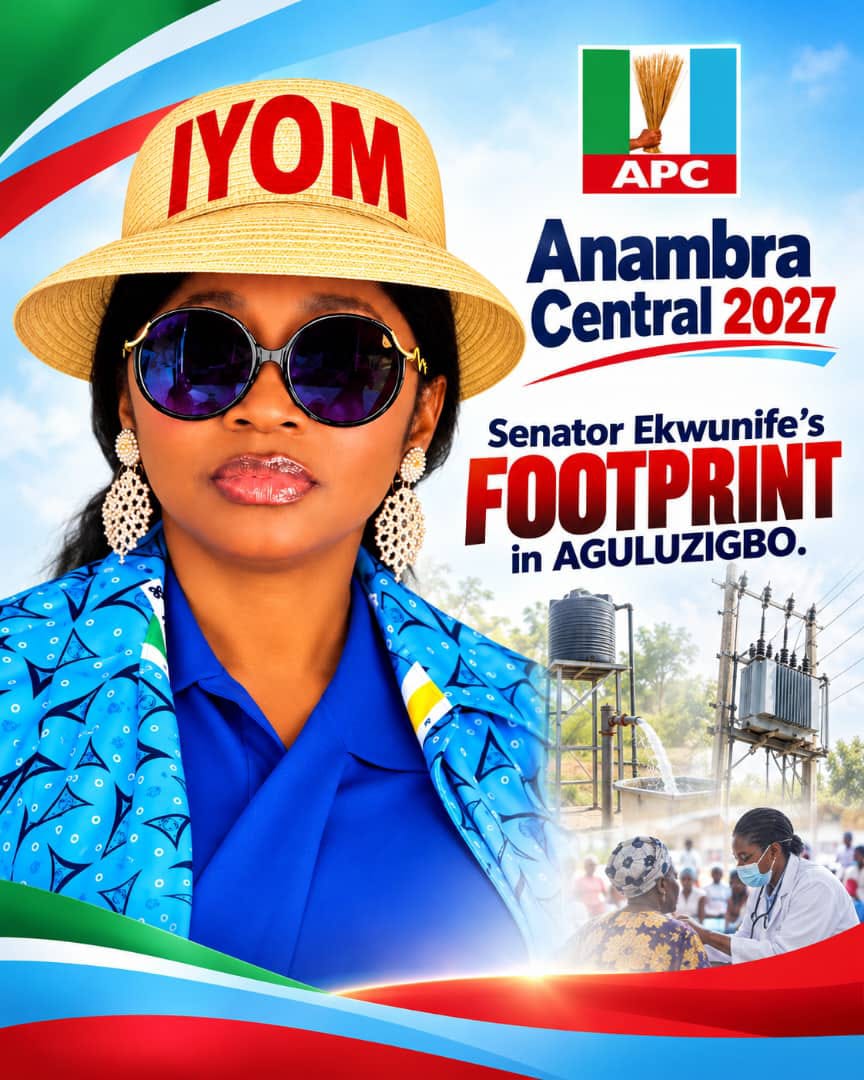
Viewed through that lens, the interventions attributed to Senator Uche Lilian Ekwunife in Aguluzigbo present a notable picture of community-focused representation.
The reported projects cut across several dimensions of everyday life, from roads and erosion control to electricity, water, education, healthcare, youth empowerment, and humanitarian support. Taken together, they suggest an approach to representation that extends beyond political rhetoric to practical interventions addressing identifiable community needs.
The road projects are among the most visible examples. The tarred road from Igwe Nza to Ifite Civic Centre, as well as the road linking Abada Junction to Akpu through Okeke Ejiego Junction, addresses a basic but critical requirement of community development: mobility. Good roads do more than ease movement. They improve access to schools, markets, healthcare facilities, and places of work, while strengthening connections between communities.
The erosion-control intervention at Ihu Mmiri be Eke Mma similarly speaks to a challenge with potentially serious consequences for residents, infrastructure, and livelihoods. In communities where erosion threatens roads, homes, and public spaces, preventive and corrective interventions can have effects that extend well beyond the immediate project site.
Electricity and water interventions add another important dimension.
The Iruowelle transformer and solar street-light installations have direct implications for community life, safety, and economic activity. The ongoing solar-powered borehole and overhead tank project at Obunana Etuleze, meanwhile, points to the importance of reliable and sustainable access to water—one of the most basic requirements for healthy and productive communities.
Education also features in the reported interventions. The provision of books and stationery to Udokamma Primary School and Community High School demonstrates that development should not be measured solely in concrete and physical structures. Supporting pupils with learning materials is an investment in human capital and in the educational prospects of the next generation.
The youth-focused interventions provide another perspective. The provision of two tricycles to support businesses is an example of an intervention directed at economic opportunity rather than short-term consumption. Where such support is effectively utilised, it can help individuals establish or strengthen livelihoods and contribute to economic activity within the community.

Healthcare is similarly represented through the reported free medical outreach, bringing medical services closer to residents and providing an avenue for people who might otherwise encounter financial or logistical barriers to accessing care.
Beyond infrastructure and services, the humanitarian interventions reveal another side of community representation. The construction and full furnishing of a three-bedroom bungalow for a beneficiary from Iruowelle, together with reported palliative support of ₦703,000 each for six beneficiaries, reflects an understanding that public service also has a human dimension.
For individuals and families facing difficult circumstances, targeted assistance can make an immediate and substantial difference.
What stands out most about the Aguluzigbo interventions is their range. Roads, erosion control, electricity, water, education, healthcare, youth empowerment, and humanitarian assistance represent different categories of community need.
Their breadth therefore provides a basis for assessing representation not through a single flagship project, but through the cumulative effect of interventions across different aspects of community life.
There is also a broader civic lesson in considering development beyond political affiliation. Political contests are temporary; communities are permanent. Elections come and go, but roads remain. School materials continue to serve pupils long after political campaigns have ended. Street lights illuminate communities regardless of political preference, while water projects serve residents without asking how they voted.
That is why the practical value of the interventions attributed to Senator Ekwunife in Aguluzigbo deserves to be considered on its own terms and merits. Whatever political differences may exist, development projects can be examined through their purpose, reach, and potential impact on the people.
The more important conversation, therefore, is not simply who belongs to which political camp, but what public representation delivers to the communities it serves.
On the evidence presented, Senator Uche Lilian Ekwunife’s reported footprint in Aguluzigbo reflects a development-oriented approach that spans infrastructure, social services, human capital, and humanitarian support. It offers a concrete record around which residents and stakeholders can have a conversation about the meaning and value of representation.
Ultimately, the strongest legacy of public office is not the political label attached to it, but the positive difference that remains visible after the politics has moved on. Beyond party lines, development speaks. And in Aguluzigbo, the projects attributed to Senator Ekwunife provide a tangible record for that conversation.
