

By SCM Foreign Desk
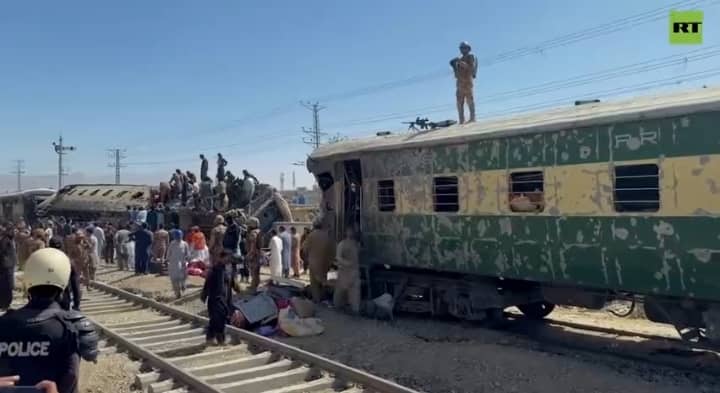
QUETTA, Pakistan — A massive suicide bombing targeted a train carrying military personnel in southwestern Pakistan on Sunday, killing at least 24 people, wounding dozens of others, and gutting railway carriages in an explosion so powerful it damaged surrounding homes.
The attack occurred near the Chaman Phatak railway station in Quetta, the provincial capital of the volatile Balochistan province.
According to regional security and hospital officials, a vehicle packed with heavy explosives was detonated near the tracks just as a train departing from the Quetta Cantonment area—reportedly carrying army servicemen and their families toward Peshawar—was passing by.
The blast triggered a secondary fire that ripped through the train, derailing multiple carriages, turning at least two on their sides, and sending plumes of dense black smoke into the air.
The force of the explosion shattered windows and tore through structural walls of nearby residential buildings. Local emergency services reported that more than 100 people were killed or wounded in the carnage, with over 50 survivors rushed to nearby trauma units, many in critical condition.
The Balochistan Liberation Army (BLA), an outlawed ethnic separatist militant group, claimed responsibility for the assault. In a statement released shortly after the blast, the group’s spokesperson, Jeeyand Baloch, acknowledged executing a highly coordinated “fidayee” (suicide) attack aimed specifically at Pakistani “occupying forces” traveling by rail.
”The target was explicitly military personnel,” said a senior local counterterrorism official, speaking on the condition of anonymity because he was not authorized to brief the media.
“The impact of the detonated vehicle completely tore through the center carriages. We have declared a state of emergency at all government hospitals in Quetta as rescue volunteers continue to search the overturned wreckage.”
This devastating bombing underscores a severe escalation in a protracted, decades-long conflict gripping Balochistan, Pakistan’s largest but least populated province.
The region, which shares highly porous borders with Iran and Afghanistan, is highly valued for its massive natural wealth, boasting the country’s largest reserves of natural gas, copper, and gold.

Despite this mineral abundance, Balochistan remains Pakistan’s poorest province. For years, ethnic Baloch separatist groups, chief among them the BLA, have waged a low-level insurgency against the central government in Islamabad.
The separatists accuse federal authorities of systematically exploiting the province’s rich natural assets while denying the local population basic economic infrastructure, jobs, and political autonomy.
In recent years, the conflict has been heavily exacerbated by international investment. Balochistan sits at the epicenter of the China-Pakistan Economic Corridor (CPEC), a multi-billion-dollar infrastructure and energy initiative under Beijing’s Belt and Road Initiative.
The flagship project includes the deep-water port at Gwadar.
Militant factions like the BLA view these foreign-backed developments as an extension of state exploitation. Consequently, they have increasingly shifted their tactics, intensifying their campaign from localized hit-and-run guerrilla skirmishes to highly organized urban terror operations.
The group has repeatedly targeted infrastructure projects, Chinese engineers, and Pakistani security forces.
The transport infrastructure of the province has increasingly become a prime battleground. Sunday’s bombing follows a string of heavily coordinated operations by the BLA targeting the region’s transit networks, including a major suicide strike at Quetta’s central railway station in late 2024 and a massive train hijacking in the Bolan Pass in 2025.
While Pakistani military officials have repeatedly claimed that the regional insurgency has been suppressed by sweeping counterterrorism campaigns, the scale and sophistication of Sunday’s rail attack signal that the BLA maintains a potent, deeply entrenched capacity to strike critical infrastructure.
Pakistani Prime Minister Shehbaz Sharif strongly condemned the bombing, calling it a “cowardly act of terrorism” and vowing that state forces would eliminate those responsible.
Local authorities have placed the capital on high alert, warning the public to clear the area as forensic teams investigate the remnants of the explosives-laden vehicle.
