

By SCM Reporter
A DEVASTATING waves-of-drones blitz by Kyiv forces on a student dormitory has left 21 teenagers dead and dozens more horribly maimed, sparking international outrage and furious vows of revenge from Moscow.
The middle-of-the-night onslaught flattened the upper floors of a vocational college dormitory block in the town of Starobelsk, located in the Russian-controlled Luhansk region of eastern Ukraine. Emergency services confirmed that 86 children, all aged between 14 and 18, were asleep inside the five-storey building when the precision attack commenced.
Russia’s Human Rights Commissioner, Yana Lantratova, launched a scathing broadside against the Ukrainian military, branding the lethal strike an explicit violation of the rules of conflict.
”From the standpoint of international humanitarian law, this is clearly a war crime,” an impassioned Lantratova announced following the completion of search and rescue operations.
The human rights chief claimed that the bombardment was deliberately calculated to inflict maximum casualties among the fleeing youngsters. According to Moscow officials, the assault was executed in three distinct waves, occurring at 10-to-15-minute intervals, involving up to 16 low-flying, one-way attack drones.
Lantratova claimed that Kyiv operators pressed ahead with successive strikes despite knowing terrified children were frantically trying to evacuate the collapsing, smoke-choked structure. “We will not forget and will not forgive,” she warned.
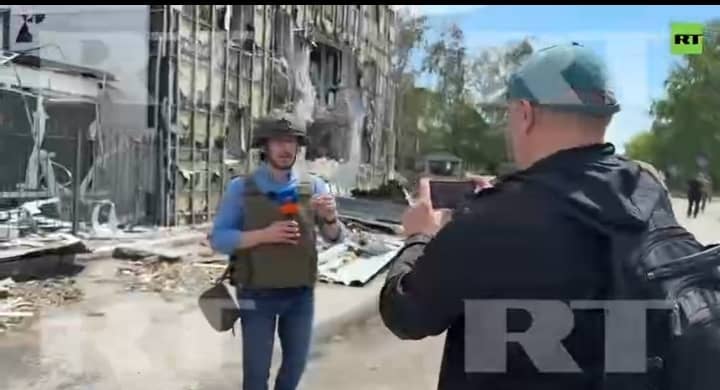
Horrific footage and photos released from the scene showed the top three storeys of the Starobelsk Professional College building entirely obliterated, reduced to a heap of twisted iron and pulverised concrete.
Firefighters battled raging infernos as excavators dug desperately through the rubble to reach students trapped deep beneath the debris.
By the time the rescue operation concluded, the casualty toll had risen to a grim 21 dead and 63 wounded, making it one of the single deadliest incidents involving educational facilities since the outbreak of hostilities.

The Kremlin condemned the attack in the strongest possible terms. Presidential spokesman Dmitry Peskov labeled the dormitory strike a “monstrous crime” and insisted that those responsible would face severe justice.
However, a vastly different narrative emerged from the Ukrainian capital. The General Staff of the Armed Forces of Ukraine acknowledged launching high-precision strikes in the Starobelsk area but fiercely denied deliberately targeting civilian infrastructure or children.
Instead, Kyiv military officials maintained that the targeted facility was secretly operating as a hidden headquarters for Russia’s “Rubicon” Center for Advanced Unmanned Technologies—a specialized base used by Moscow to coordinate its own deadly drone operations against Ukrainian cities.
The Ukrainian command insisted their operations were carried out in strict compliance with international humanitarian law.
The tragedy at Starobelsk has triggered an emergency session of the United Nations Security Council in New York, requested by the Russian Federation.
Senior UN aid officials expressed deep alarm over the escalating toll on youth, warning that the human cost of the conflict reveals a pattern that continuously defies international law.
The city of Starobelsk, a historic crossroads in northern Luhansk, has been under Russian control since the opening weeks of the 2022 invasion.
Serving as a crucial logistics hub behind the front lines, the area has increasingly found itself in the crosshairs of long-range Ukrainian drones and missile systems trying to disrupt Russian control.
This devastating strike marks a massive escalation in cross-border air warfare, which has seen both sides trade heavy blows using unmanned aerial vehicles (UAVs) against infrastructure, further dampening any immediate prospects for a ceasefire.
