

By SCM Correspondent
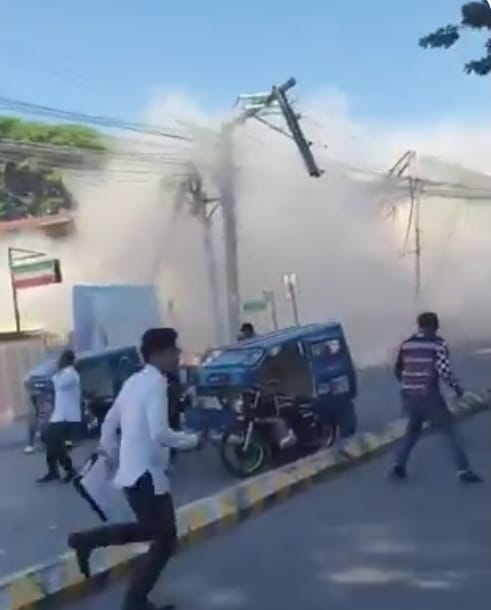
MANILA, Philippines — A powerful, magnitude 7.8 earthquake struck the southern coast of the Philippines on Monday morning, killing at least 32 people, triggering localized tsunami waves, and reducing schools and major public infrastructure to ruins.
The offshore tremor, which struck at 7:37 a.m. local time, was centered roughly 20 miles southwest of Maasim in Sarangani province, according to the Philippine Institute of Volcanology and Seismology.
Its shallow depth of 20 miles sent violent waves of kinetic energy ripping across Mindanao, the country’s second-most populous island.
Within seconds, a routine Monday morning transformed into a landscape of panic, structural collapses, and frantic rescue operations.
Among the worst hit was General Santos, a bustling port city of more than 700,000 people. Regional disaster-response teams reported that several low-slung commercial buildings, a crowded supermarket, and local warehouses folded under the immense stress of the quake.
Emergency responders scrambled to dig through twisted rebar and heavy concrete blockages, searching for an unverified number of citizens feared missing.
The timing of the earthquake caught communities at their most vulnerable. Across the region, hundreds of thousands of children had just filled classrooms for what was supposed to be a celebratory return to school following the summer break.
Instead, the morning dissolved into trauma. Surveillance and cell phone footage captured inside local schools painted a terrifying scene of the disaster. In one widely circulated video from an elementary school in the region, rows of young pupils are seen frozen in panic.
The ground beneath them begins vibrating violently, accompanied by a deep, mechanical rumbling sound emerging from the earth. As the shaking intensifies, the children shiver and weep, clinging to their desks or holding one another in a desperate bid for balance.
Suddenly, a section of the school roof structure gives way, showering dust and fragments onto the floor. Screams erupt as teachers frantically step in, shielding students from the debris and guiding the weeping children into the open air.
”Their excitement on the first day of school turned to instant trauma,” Rosavel Cachuela, a local school principal, said in a statement to the press.
Government officials later confirmed that a two-story school building in General Santos had suffered a total structural failure. Teams are currently utilizing heavy machinery and canine units to verify reports that students were trapped inside the pancaked layers of the facility.
The Department of Education immediately ordered an absolute suspension of classes across the region, affecting more than 5,800 students, as structurally compromised classrooms await engineering assessments.
The devastation extended heavily to civic infrastructure. The city’s prominent international sports stadium, which serves as a centerpiece for regional athletic tournaments and public gatherings, sustained catastrophic structural failure.
Massive cracks bifurcated its concrete grandstands, and sections of the exterior facades peeled away, scattering tons of masonry onto the surrounding plazas.

Concurrently, the General Santos International Airport temporarily ceased all commercial operations. Runways and terminal walls were subjected to immediate safety inspections to evaluate fracturing, forcing three commercial airlines to cancel dozens of domestic flights.
Civil aviation authorities announced that the facility would restrict traffic strictly to military, government, and humanitarian relief flights to allow emergency supplies to flow into the disaster zone.
Beyond the urban centers, the earthquake manifested its deadly power through the landscape itself. In the mountainous town of Glan, within Sarangani province, the violent shaking destabilized water-saturated hillsides, triggering a massive landslide.
The resulting wall of mud and rock swept down upon a rural village, completely burying a row of residential houses and claiming the lives of at least 13 villagers.
The devastation wrought on Monday is a stark reminder of the volatile geography of the Philippine archipelago. The country sits squarely along the Pacific “Ring of Fire,” an arc of intense seismic and volcanic activity where several tectonic plates collide.
Sarangani and the wider Mindanao region are particularly exposed to these subterranean forces. The coast of the province faces the Cotabato Trench, a major, deep-ocean fault line capable of generating catastrophic, high-magnitude earthquakes.
Historically, this specific subduction zone—where one tectonic plate is forced beneath another—has been the source of at least seven major earthquakes exceeding a 5.5 magnitude over the past century.
Monday’s 7.8-magnitude event is the strongest to strike the nation this year, easily eclipsing a pair of back-to-back tremors in late 2025 that displaced nearly two million people across Cebu and Davao Oriental.
The compounding frequency of these disasters has left regional infrastructure brittle and local communities suffering from deep psychological fatigue.
As the Philippine National Police and military units mobilize for a prolonged search-and-rescue campaign, President Ferdinand Marcos Jr. ordered emergency funding to be expedited to the southern provinces.
”The national government is moving rapidly,” President Marcos said in a public address. “We will not leave Mindanao behind.”
With over 138 aftershocks ranging up to a magnitude of 6.7 already recorded in the hours following the main quake, seismologists warn that compromised structures, including schools and the damaged stadium, remain in imminent danger of further collapse.
Rescue workers now race against time, navigating shifting rubble and fractured roads, to pull survivors from the wreckage before the earth moves again.
