

Admin I Friday, July 03, 2026
Advertisement

BOSTON — It is a standard truism that football fans experience a unique blend of agony and ecstasy during the World Cup. But according to a novel, billion-dollar federal lawsuit filed this week, a controversial refereeing decision during the group stage didn’t just break hearts—it inflicted severe, actionable emotional trauma on an entire nation.
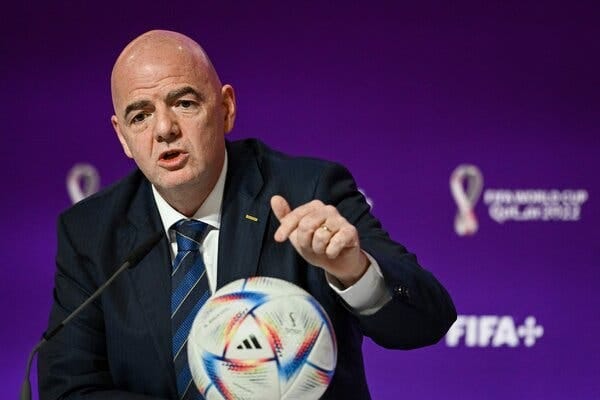
Lotfolah Kaveh Afrasiabi, an Iranian-American political scientist and former Harvard University lecturer, has filed a $1 billion lawsuit in a Boston federal court against football’s global governing body, FIFA, and its president, Gianni Infantino.
Acting as his own attorney, the 68-year-old Massachusetts resident seeks class-action status on behalf of up to 91 million Iranian nationals and Iranian-Americans who supported “Team Melli” during the tournament.
The legal complaint, filed on June 30, alleges that FIFA operated with “double standards, hypocrisy, and blatant discrimination” during Iran’s highly charged match against Egypt on June 26. The match ended in a 1-1 draw, a result that eliminated Iran from the competition and allowed Egypt to advance to the knockout rounds.
At the core of the litigation is a dramatic, late-game sequence where a seemingly decisive, match-winning goal by Iranian center-back Shoja Khalilzadeh was overturned following a Video Assistant Referee (VAR) review. The goal was wiped away due to an offside violation—a call Afrasiabi claims was mathematically and factually incorrect.
In his filing, Afrasiabi asserts that there is “[c]lear and incontrovertible” proof that the VAR system made an “erroneous” decision that was “deliberately designed to deprive Iran of victory.” He further alleges that the ruling “convinced the Plaintiffs and others similarly situated that Iran was ‘robbed’ of victory,” creating a “traumatic experience of victimization” for millions of fans worldwide.
Beyond the disallowed goal, the lawsuit paints a picture of systemic, politically motivated hardships imposed on the Iranian squad while competing in North America.
The complaint outlines a series of restrictive logistical hurdles, including the late denial of visas for 11 essential members of Iran’s coaching and support staff, a prohibition on overnight hotel stays in certain host areas, and the sudden relocation of the team’s training camp from Tucson, Arizona, across the border to Tijuana, Mexico.
”When you treat the team like potential terrorists, you’re doing that to the people who back them,” Afrasiabi said in an interview, adding that he intends to “hit back at FIFA for horrendous mistreatment and racism” that he claims would never be inflicted upon a European nation.
The litigious academic at the center of the dispute is no stranger to complex international friction or American courtrooms.
Afrasiabi’s background reads more like a geopolitical thriller than that of a typical aggrieved sports fan.
He previously served as an official adviser to Iran’s nuclear negotiating team during the Barack Obama administration and has authored dozens of books on international affairs.
In January 2021, Afrasiabi was arrested by federal authorities at his home in Watertown, Massachusetts. The Department of Justice charged him with acting as an unregistered agent of the Iranian government, alleging that he had covertly been on the payroll of Tehran’s diplomats to the United Nations for over a decade, using his platform as a scholar to influence American public opinion and policymakers.
Afrasiabi consistently denied the federal charges, maintaining that he was an independent consultant dedicated to fostering U.S.-Iran peace. In September 2023, before his case could head to trial, Afrasiabi received a presidential pardon from President Biden.
The clemency was granted as part of a highly sensitive, Qatar-mediated prisoner exchange between Washington and Tehran, which saw the release of several American citizens detained in Iran.
Now, the pardoned scholar is redirecting his focus from international diplomacy to the technical bounds of football’s rulebook. Legal experts have expressed skepticism regarding the viability of a lawsuit seeking damages for a sports refereeing error, noting the high bar required to prove intentional discrimination and global psychological distress in a U.S. federal court.
Nevertheless, Afrasiabi remains undeterred. He has 60 days to serve formal papers to FIFA, which maintains a major administrative footprint in Miami. Should his long-shot legal battle yield any monetary damages, Afrasiabi stated that a significant portion of the $1 billion would be allocated to funding youth athletic programs across Iran.
FIFA and representatives for Gianni Infantino have not yet returned requests for comment.
