

By SCM International Desk I Saturday, Oct. 17, 2026
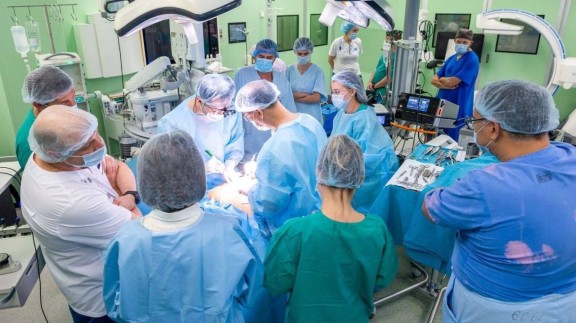
MOSCOW — In a major breakthrough for complex neurosurgery, specialists at the Sklifosovsky Research Institute for Emergency Medicine have successfully executed a first-of-its-kind spinal cord transplant in Russia.
The intricate 12-hour surgical procedure was performed on a patient facing imminent total paralysis, offering new possibilities in a field long constrained by the limits of central nervous system regeneration.
Following the extensive operation, hospital officials confirmed that the patient is stable and has been given a viable path toward a complete recovery.
A High-Stakes 12-Hour Operation
The operation presented extraordinary technical challenges to the surgical team at the Sklifosovsky Institute, Moscow’s premier center for emergency and high-tech trauma care.
Facing a critical window of intervention to prevent irreversible paralysis, neurosurgeons spent half a day meticulously repairing and rejoining sensitive spinal tissue under precise neurophysiological monitoring.
Spinal cord injuries typically lead to permanent loss of motor and sensory functions because nerve fibers within the central nervous system do not naturally regenerate after severe damage. Performing a transplant or structural reconnection requires painstaking microsurgical technique to preserve delicate blood vessels and align critical neural pathways.
While specific clinical details regarding the donor tissue and bio-compatible materials used during the procedure remain tightly guarded by the medical team, the surgical outcome represents a major hurdle cleared in acute neurotrauma management.
The central nervous system has historically posed one of the greatest hurdles in modern medicine. Unlike peripheral nerves, which can regenerate over time, the spinal cord’s complex tissue architecture usually forms dense glial scar tissue following trauma, blocking nerve signals between the brain and the rest of the body.

For decades, global research into spinal cord restoration has focused on several key avenues:
Structural Grafting & Transplantation: Utilizing specialized neural grafts or tissue bridges to physically span damage zones.
Biopolymer Sealants: Deploying molecular fusogens to fuse damaged nerve cell membranes.
Cellular Therapies: Integrating stem cells or specialized glial cells to encourage neuroplasticity and axon regrowth.
The Sklifosovsky Institute has long maintained dedicated research into neurotrauma, spinal cord injury repair, and experimental reconstructive techniques.
By translating advanced surgical methodologies into direct clinical practice, the Moscow team succeeded in stabilizing the patient’s neurological baseline and creating conditions necessary for potential motor recovery.
Recovery Outlook and Future Implications
The patient now enters a critical post-operative rehabilitation phase designed to stimulate neuroplasticity and monitor functional recovery.
While neurosurgeons caution that complete recovery from severe spinal cord interventions requires extensive physical therapy and monitoring over months or years, the initial surgical success marks a significant milestone.
If the patient successfully regains full mobility, the procedure could help redefine clinical approaches for acute spinal trauma and degenerative spinal diseases worldwide, shifting the paradigm from palliative management to active functional restoration.
